369:  Chełmno Holocaust Film

Archival Spaces 369:

The World Will Tremble (2024)

Uploaded 21 March 2025

Roll call in Chełmno, The World Will Tremble (2025)

A Los Angeles Jewish Film Festival screening of The World Will Tremble (2025) preceded its L.A. run this week at the Laemmle Theatres in Beverly Hills and Encino. The title is a quote from a village Rabbi in Rzuchow, Poland who has just heard the testimony of two prisoners, escapees from the Nazi death center at Chełmno (Kulmhof) in early January 1942, where Jewish populations from the surrounding villages are being systematically gassed in mobile vans. The title bears a degree of irony because we now know that while the BBC and the New York Times reported on the mass killings as early as June and July 1942, few wished to hear of it. It is known, for example, that U.S. State Department officials actively blocked reports about the mass murder of Jews from reaching the United States. The British Foreign Office, known to be filled with anti-Semites, was no better: when Polish diplomat and eye-witness Jan Karski met with Foreign Minister Anthony Eden, his report fell on deaf ears.

Oliver Jackson-Cohen, Jeremy Neumark, The World Will Tremble (2025)
David Kross, The World Will Tremble (2025)

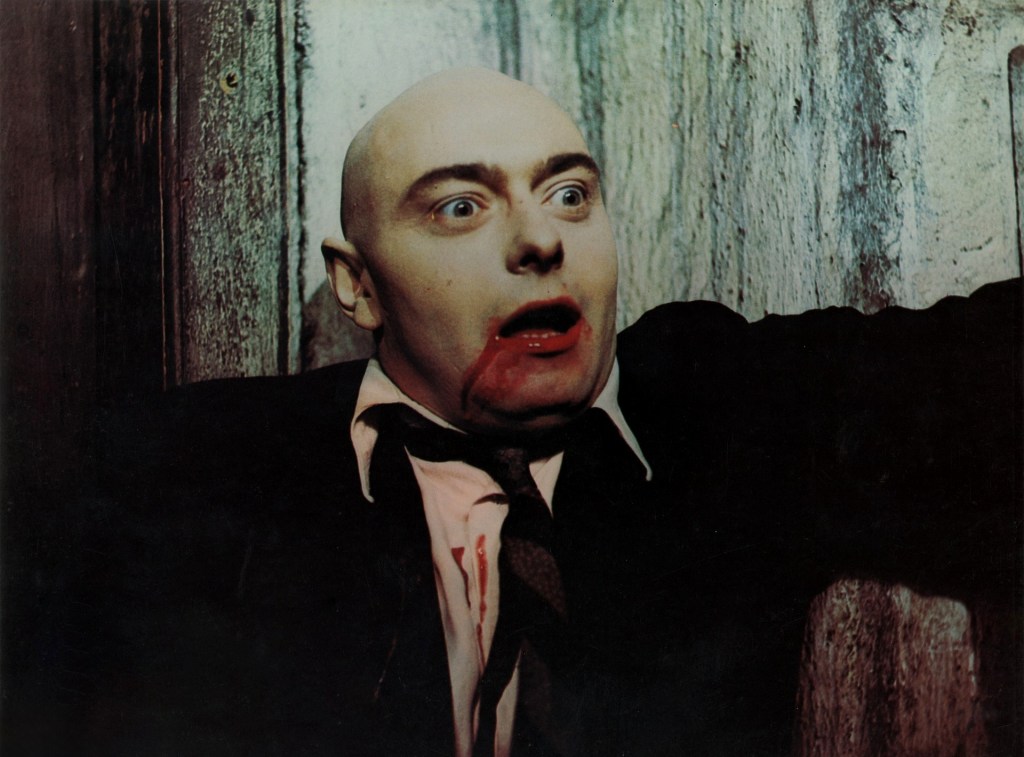
Directed by Israeli-American, Lior Geller, The World Will Tremble, opens with a group of Jewish prisoners digging a large pit under the watchful eyes of armed Nazi guards. Three are chosen to go back to the camp – actually an abandoned manorial estate – where they are told to sort clothing and thereby witness the murder of Jewish villagers. Transported by truck, the arrivals, men, women, and children, are told they will be sent to Leipzig to work, but first need to write a letter home and be de-loused. Leaving their clothes and suitcases behind, they are herded into a truck, whose exhaust is connected to the van’s enclosed interior. The victims are killed by carbon monoxide poison before the gas vans reach the field where the dead are buried in mass graves by the prisoners who had dug the pits. Miraculously, two of the men assigned to the work detail manage to escape, helped by a Polish farm woman who gives them railroad uniforms, and a stolen motorcycle. They make it to the home of a village rabbi (Anton Lesser), where they report what they have seen. That account eventually made its way through the Polish Underground to London, where it is reported on the BBC on 26 June 1942, the earliest evidence of the Shoah to reach the Allies.

Sturmbahnnführer Herbert Lange

Divided essentially into two halves, Geller’s film visualizes for the first time, this earliest phase of the Shoah, before the Nazis perfected an industrialized form of death in Auschwitz, only months later. We hear the Camp Commandant Herbert Lange (David Kross) saying Berlin wants more “productivity,” 700 dead a day, are far too few. In reality, no less than 152,000 humans were eventually killed in Chełmno. We also see the unbelievable cruelty of the Nazi guards, whose target practice consists of forcing inmates who hold glass milk bottles over their heads, which are then shattered by bullets, or who have the inmates dance to the tune of flying bullets. When a young Jewish woman who has been serving as Lange’s sexual relief is accidentally killed, the Commandant screams at the guard to get him another. But while we see the faces of inmates carrying bodies, the corpses in the van and mass graves remain discreetly out of camera range, thus avoiding exploiting the memory of the dead.

Original Grojanowski Report in Polish (1942)
Chełmno Memorial at site of mass graves

Although accurate in spirit, The World Will Tremble does condense some of the admittedly confusing historical facts. One of the film’s escapees, Mordechaï Podchlebnik (Jeremy Neumark Jones), did escape from Chełmno, later testifying at trials in Poland (1945), at the Eichmann trial in Jerusalem (1961), and appearing in Claude Lanzmann’s Shoah (1984), but he was not one of the authors of the first report. During the Winter of 1942, five prisoners escaped: Mordechaï Podchlebnik, Milnak Meyer, Abraham Tauber, Abram Roj, and Szlama Ber Winer (alias Yakov Grojanowski). Grojanowski (Oliver Jackson-Cohen)  fled Chełmno to the Warsaw Ghetto, where his “Grojanowski Report” to the Ghetto’s Oneg Shabbat resistance group formed the basis for the BBC broadcast and later media reports. The New York Times wrote on July 2nd: “In the early Winter the Germans were methodically proceeding to exterminate all Jews. They sent special gas chambers on wheels… In the village of Chełmo near Kolo ninety persons at a time were put into the gas chambers.”(p. 6) According to other published sources, two further Chełmno survivors, Yitzhak Justman, and Yerachmiel Yisrael Widawski, deposited their testimonies at the Piotrków Trybunalski Ghetto in March 1942 with Rabbi Moshe Chaim Lau and later spoke with Rabbi Chanoch Gad Justman in the the Częstochowa Ghetto. Widawski’s description of finding his fiancé among the corpses forms one of the most heart-wrenching scenes in the film.

Gas Wagon produced by Deutz (Coloigne) used in Chełmo (1945)

I first read about the Chełmo gas wagons when I was a graduate student, writing a seminar paper about Holocaust news in the German exile newspaper, Freies Deutschland/Alemania Libre, published during World War II in Mexico City by exiled German Communists. Not surprisingly, the horror of Auschwitz, Maidanek, and Sobibor has overshadowed the crimes committed in Chełmno. Thanks to Lior Gelller, we now have a film about this often under-reported site of the Shoah, and its handful of survivors.       

368: 75th Berlinale (Retrospective)

Archival Spaces 368

Retro: German Genre Films from the 1970s

7 March 2025

Nicht schummeln, Liebling (1971, Joachim Hasler)

Hard to believe that it was 51 years ago that I attended my first Berlinale film screening. I actually wasn’t in town that Summer of 1974 for the Festival but rather to research my master’s thesis (Ernst Lubitsch) at the Deutsche Kinemathek, which was then still located on the Theodor-Heuss-Platz. Thanks to the Kinemathek’s Walter Seidler, I got to see R.W. Fassbinder’s Effie Briest and also experienced a press conference with Fassbinder. Since then, I have attended about half of all subsequent Festivals, including 2025, where my focus – though not exclusively – was on the Retrospective curated the last 19 years by Kinemathek Director, Dr. Rainer Rother. Given his retirement, the Berlinale honored him during the Festival with the prestigious Berlin Camera Award.

This year’s retro, “Wild, Weird, Bloody. German Genre Films of the 70’s,” included films from both East and West Germany: crime, horror, musicals, melodramas, not New German (art) Cinema. Unfortunately, I missed some films I was dying to see, including The Tenderness of Wolves (1973, Ulli Lommel), The Girls from Atlantis (1970, Eckhardt Schmidt), and Spare Parts (1979, Rainer Erler). The first two films I caught up with were musicals from the German Democratic Republic; indeed the East Germans were represented exclusively by musicals and a comedy, since horror and crime were considered decadent, exploitive capitalist genres, – sci-fi and westerns were made, but as anti-capitalist Lehrstücke – while musicals were a concession to popular tastes, fuelled by the almost universal availability of West German television.

Hut ab wenn du küsst (1971, Rolf Losansky)

The DEFA musical, Hat Off When You Kiss (1971, Rolf Losansky), features a war between the sexes fought on the relationship level between lovers: He is a boring petit bourgeois engineer who can’t stand the fact that she is an auto mechanic and loves her work. In revolt, she pretends to be interested in a swarmy Argentine industrialist while both visit the Leipzig Trade Fair, allowing the producers to show off wares from the East Block Comecon. The film ends with a truce of sorts, but Hat Off reveals the extent to which East German men were unhappy about their spouses working, even though the State propagated gender equality and actually needed women to work.

Nicht schummeln, Liebling (1973, Joachim Hasler)

Don’t Cheat, Darling (1973, Joachim Hasler) starts out visually like a West German musical in a small Bavarian town, but when Young Pioneers join the parade, it’s clear this is East of the Elbe. The town is crazy about Fussball, engendering a town-wide war between the sexes, led by a new girl’s technical college director and the town mayor. Hardly a Communist in sight, only certain termini technici reveal the film’s location, as male footballers and nubile female students face off in energetically choreographed dance numbers.

Orpheus in der Unterwelt (1973, Horst Bonnet)

An exceedingly weird operetta adaption of Jacques Offenbach’s Orpheus in the Underworld (1973, Horst Bonnet) constituted the third GDR contribution. It opens with Offenbach setting off from 19th century Paris to Greece in a hot air balloon, where he witnesses Euridice being seduced by Pluto and taken to Hades, while husband Orpheus is glad to be rid of her so he can sleep around. Offenbach (and public opinion) force Orpheus to the underworld to rescue Euridice; meanwhile, Juno is on Jupiter’s case because she thinks he seduced Euridice. While the gods are stand-ins for the capitalist ruling classes, both Olympus– all in white – and Hades in black seem to be hotbeds of libertinism, with naked breasts front and center, the film ending in chaos and cancans, like the operetta.

Armin Mueller-Stahl in Nelken in Aspik (1976, Günther Reisch)

Finally, the screwball comedy Carnations in Aspic (1976, Günther Reisch) is a pretty wild critique of the East German economy’s total dysfunctionality, although the film sates that the events depicted could only happen in film and have NOTHING to do with contemporary GDR reality. A commercial designer in the State advertising agency loses some front teeth through his own stupidity, forcing him to remain silent during office meetings, whereupon he is promoted up the food chain because his bosses think he always agrees with them. He actually just wants to get the girl, not the work responsibility, so he tries to screw- up, but that only brings him more promotions. Meanwhile, we get slogans like: “If you buy a Wartburg, it will be delivered in time for your son to drive,” a bitter comment on the 10-15 year delivery times for East German cars.

Fremde Stadt (1970, Rudolf Thome)

Cynicism characterizes the three West German films I viewed. Strange City (1970, Rudolf Thome) opens like a film noir in b & w with a well-dressed 30-something – 70s German heartthrob Roger Fritz – arriving in Munich at night with a suitcase full of cash. He finds his estranged wife and wants her to launder the money he has stolen from the Düsseldorf bank, but a dogged Munich cop and another couple are on his tail. A crime, but no violence, just lots of maneuvering to possess the booty. In the end, two crooked cops and the two couples split the loot, all happily riding off into the sunset, proving crime does pay. 

Blutiger Freitag (1972, Rolf Olson)

Bloody Friday (1972, Rolf Olsen), a German-Italian co-production, takes violence and blood-letting to the extreme, in keeping with Giallo genre aesthetics.  A violent criminal escapes from custody, organizing a bank robbery with two accomplices in a suburban Munich bank that includes taking hostages to guarantee their getaway, after stealing weapons from a U.S. Army transport. The bearded gang leader kills indiscriminately, drinks on the job and rapes a hostage he accuses of being a lesbian. Meanwhile, the police are under massive pressure because one of the hostages is the daughter of a rich industrialist. In the end, the robbers either shoot each other or are gunned down by the police when they hole up in a deserted Bavarian tavern.   

Deadlock (1970, Roland Klick)

Deadlock (1970, Roland Klick) opens with a wounded man carrying a suitcase full of cash through the desert, while Can’s avant-garde Krautrock blares on the soundtrack, mocking Ennio Morricone; the hero faints just before an old pickup rumbles into the scene, its decrepent occupant taking the bank robber to an abandoned mining town. When the robber’s accomplice shows up, an extended and deadly cat-and-mouse game ensues between the three men to make off with the cash, ending with the death of two (innocent) women and two men. An anti-Western of stasis rather than action, however, without a carefully set-up final duel.

This year’s Berlinale retrospective proved once again that European genre films are still mostly terra incognita for American film scholars, despite the many pleasures to be found here.

Fremde Stadt (1970, Rudolf Thome)

367:  Santa’s Restoration

Archival Spaces 367 

The First Mexican Sound Film Restored

Uploaded 21 February 2025

Considered Mexico’s first “national” production in the sound film era, Santa (1932) was based on the eponymous Mexican novel (1903) by Federico Gamboa, which is as much a modernist portrait of Mexico City, as it is of the fate of its heroine. Santa, a beautiful country girl, is seduced and abandoned by an Army officer. She goes to the city, where she becomes a well-known courtesan of the wealthy, before descending into poverty and death. The film was featured in “Recuerdos de un cine en español: Latin American Cinema in Los Angeles, 1930-1960,” a major retrospective I co-curated in 2017 at UCLA, however, we were only able to show an unrestored print from Mexico’s UNAM. In Hollywood Goes Latin. Spanish-Language Filmmaking in Los Angeles, I also discussed the importance of Santa’s Los Angeles premiere in establishing a major beachhead for the Mexican sound film industry in America: throughout the 1930s and 1940s, virtually every Mexican film screened in L.A.’s first-run cinemas. Now, Viviana García Besné, the force behind Permanencia Voluntaria, has nearly completed a new restoration, which vastly improves the soundtrack and adds footage previously unseen in any surviving prints. Viviana’s great uncles, Rafael and José and Rafael Calderón (Azteca Films) financed Santa.

On May 20, 1932, the Teatro California in Los Angeles premiered Santa, directed by Antonio Moreno and starring Lupita Tovar, both of whom had substantial careers in Hollywood. According to L.A.’s Spanish language daily newspaper, La Opinión, Santa was coproduced by the Calderóns, who financed the premiere, and which drew an A-list of Hollywood personalities, including Tovar, José Mojica, Mona Maris, Laurel and Hardy, Ramón Pereda, Juan Torena, and Carlos Villarías. Critics praised the film for its realism and its melodrama; it was enormously successful with audiences in the U.S., with theatrical runs held over in many cities.

Viviana García Besné

After a worldwide search, Permanencia Voluntaria ascertained definitively that no original negative or master positive of Santa survived, while circulating prints evidenced poor image quality and missing sound. The original negatives for Santa likely burned in the 1982 fire at the Cineteca Nacional’s Churubusco Studios storage. The Cineteca Nacional in Mexico City, however, owned a 10 reel, 35mm, acetate, composite negative (4th generation internegative), with a variable density soundtrack, but image quality was marred by high contrast. Not until Viviana García Besné uncovered six unaccounted-for nitrate reels at the Filmoteca de la UNAM, one including a censored sequence missing from circulating prints, did a restoration seem feasible. Furthermore, Viviana’s team had already found the original Vitaphone 78 RPM sound disks (1932), donated by Paul Kohner (Lupita’s husband) to the Academy Film Archive, an audio source far superior in quality to any of the existing film elements, also running several minutes longer than previous releases. These were lovingly transferred by John Polito at Audio Mechanics.

Nitrate damage on 35mm print of SANTA

A VHS release from the 1980s also included some footage not found elsewhere. But where was the missing footage? After months and months of research, it was determined the material had come from a 16mm print at UNAM which had been destroyed years ago. Then, a 16mm print donated by Lupita Tovar, the film’s star, to UCLA proved to be virtually complete, with only a few seconds missing. Miraculously, Tovar’s personal print included a filmed introduction by Federico Gamboa, which had been excised from every circulating version.

Before Restoration
After Restoration

Once a new version had been digitally assembled, the team began the complicated task of clean-up and image improvement. Given the severe physical damage, compromised by lossy splices, water damage, projection wear, and poor lab work, extensive hand painting was undertaken to minimize image distortion, followed by dust-busting and stabilization. Next, image grading was done to ameliorate the disparate quality of the source materials, compounded by decades of wear and generational loss. Achieving this, required countless hours of grading and testing, the color correction handled by Ross Lipman, and the digital restoration by Peter Conheim. Finally, the film-out process—transferring the restored digital image back onto 35mm film stock–initially fell short of expectations, because labs today seldom work with b & w materials, but after much experimentation at FOTOKEM the delicate tonal range achieved during digital grading was also visible in output 35mm prints. According to Viviana García Besné, “While a few seconds of Federico Gamboa’s spoken introduction remain missing, this restored version represents the most comprehensive and faithful iteration of the film available today.”

The budget for the restoration of Santa surpassed $100,000. With a matching grant from the National Film Preservation Foundation, Permanencia Voluntaria, has finished most of the work, but still needs $20,000 in completion funds, before the film can be made available for DVD release. Anyone wishing to make a donation to help complete the project can do so at https://pdnfoundation.org/give-to-a-fund/permanencia-voluntaria-film-fund.

Santa (Center) with a drunk client

366:   German Musicals 3

Archival Spaces 366:  

Marta Eggerth’s First Film

Uploaded 7 February 2025

New Year’s Celeration on set of Die Bräutigamswitwe, Elstree Studios, London

The independent film producer/director Richard Eichberg produced his films up to early 1928 at UFA’s Babelsberg Studios, then moved his base of operation to London’s Elstree Studios and British International Pictures, although he also continued to produce films in Berlin. In 1930, Eichberg hired the Hungarian coloratura soprano, Marta Eggerth, in her first sound film, Die Bräutigamswitwe/The Groom’s Widow (1931), after she had starred in a part-talkie in Budapest earlier that year. By that time, the 18-year-old had already sung on some of the major opera stages of Europe, including in Max Reinhardt’s 1929 staging of Die Fledermaus. Although identified in the credits as a “sound film farce,” The Groom’s Widow includes at least four musical numbers, while the film musical features anarchic comedy, a mixture of genres, and a discontinuous cabaret-style plot, similar to contemporary UFA musicals. Eggerth’s film career would take off in Berlin, which continued – even though she was Jewish – after Hitler’s rise, before emigrating to Hollywood with her singing partner, Jan Kiepura.

Die Bräutigamswitwe (1931, Richard Eichberg)
Georg Alexander, Marta Eggerth in Die Bräutigamswitwe

After getting wildly drunk at his own bachelor party, rich playboy George Brown (George Alexander) wakes up with a hangover and a bride, Fay Miller (Marta Eggerth), – she’s a chorus girl – even though he is to be married that morning to his upper-class fiancé, Maud (Gertrude Kohlmann). To make matters worse, Fay’s burley fiancé, Bill Huber (Fritz Kampers) shows up to give George a thrashing. Both supposedly die in the tussle that follows.  At the inquest, Fay and Maude then argue over who is really the groom’s widow. George and Bill turn up alive separately, each worried they have murdered the other, leading to a cat and mouse game, engineered by Fay who knows the truth, before all is resolved and George realizes he loves his little chorus girl. This is after all aimed at the American market, where the English Version, Let’s Love and Laugh, opened before playing in the U.K, where it was produced.  

Dueling widows at the inquest in Die Bräutigamswitwe
Annoying in-laws in Die Bräutigamswitwe

All four musical numbers, written by Hans May with lyrics by Jean Gilbert, feature Eggerth’s operatic voice, in particular in Eggerth and Kohlmann’s dueling duet, “The Groom’s Widow,” where each claims to be the true heir. The film seemingly begins in a classroom, where the students sing “ABC, Love doesn’t hurt,” the number morphing into a cabaret stage when the students tear off their frocks to dance; a final chorus /curtain call reprises the opening Schlager, “My Heart is a Salon for Beautiful Women.” The film’s broad comedy involves not only a war between the romantic leads, but also the intrusion of Fay’s uncouth, petit bourgeois parents, who immediately move into George’s mansion, featuring a stiff and anal-retentive butler, and a police detective who solves crimes through séances, a parody of Dr. Mabuse. Mashed into the discontinuous action are other genres: George and Bill believe they are seeing ghosts, a parody of ghost/horror films; when George’s valuables are stolen from his safe because Fay gets distracted, Fay is falsely accused, the plot briefly turns into a Hitchcokian crime drama; not surprising, given that scriptwriter Walter Mycroft, wrote Hitchcock’s Murder (1930), and co-scriptwriter Frederick J. Jackson started his career at Lubin in 1915.

Richard Eichberg

One of Eggerth’s favorite composers, Hans May, wrote songs for five Eggerth films before he and lyricist Jean Gilbert were forced into exile in 1933; cameraman Heinrich Gärtner and scriptwriter Károly Nóti also fled the Nazis. Despite the Propaganda Ministry’s ideological prohibitions against “Jewish” film operettas, Marta Eggert continued starring in no less than twelve musicals (not counting seven English, Italian, and French versions); surprisingly, but typical for crass Nazi opportunism, many of the films were financed by Jewish producers from Austria. They were distributed throughout the Reich, in the rest of Europe, and in South America.  The actress’s blonde curls, her Hungarian star image, and the fact that the Reich needed the hard currency certainly impacted Goebbels’ decision to approve Eggerth’s films. Hungarian actresses, like Eggerth (and before 1933 Gitta Alpar), but also so-called “Aryans,” like Marika Rökk, Hilde von Stolz, and Käthe von Nagy, gave Nazi cinema an international flair, thus normalcy, when out in the street life was anything but normal for Jews and non-white people.  

Operetta composer Franz Lehar’s work was also banned by Goebbels, however, the composer received special dispensation to write Eggerth’s Der Zarewitsch (1933, Viktor Jansen), The Whole World Revolves Around Love (1935, Viktor Tourjansky) and  Where the Lark Sings (1936, Karel Lamac). Martha Eggerths subsequent films in the Third Reich (until she left in 1938) mixed musicals with other genres, including Douglas Sirk’s The Court Concert (1936. 

Kiepura and Eggerth on Paris train to Cherbourg in 1937

It was on the set of My Heart is Calling You (1934, Carmine Gallone) that Eggerth met and fell in love with the Polish operatic tenor, Jan Kiepura. They married in 1936. When he received a contract to the New York Met, Eggerth moved to New York, where she continued her stage career. During the war she appeared in only two films, both Judy Garland musicals, which she personally hated, no longer the star. After the war, she and Kiepura starred in three European filmed operettas, including The Land of Smiles (1952), but maintained their New York residence until Marta died at 101 years in 2013.

The couple in The Land of Smiles