327: A Midsummer Night’s Dream

Archival Spaces 327

A Mid-Summer Night’s Dream (1925) restored

Uploaded 4 August 2023

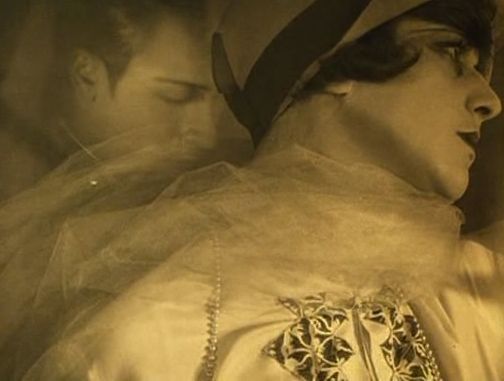
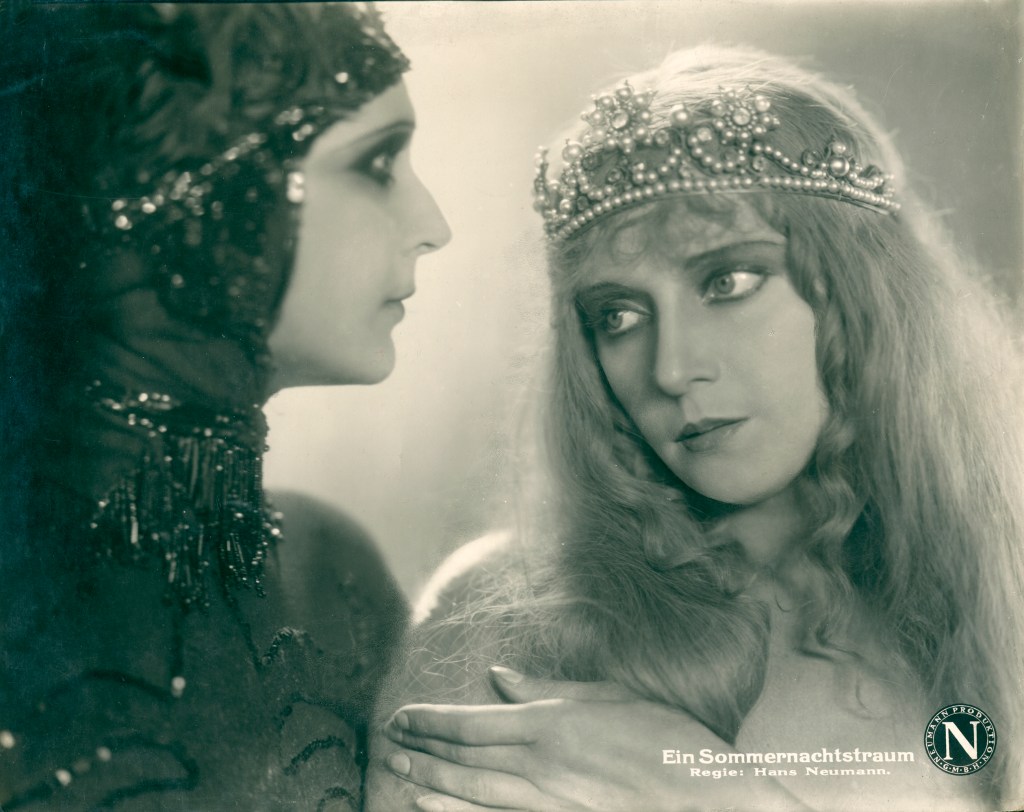
Valeska Gert in Ein sommernachtstraum (1925, Hans Neumann)

One of the films I was most looking forward to at the San Francisco Silent Film Festival was the world premiere of the previously lost German film, A Mid-Summer Night’s Dream (1925) because I had as Director of UCLA Film & Television Archive initiated the project. Another bonus was the screening on Thursday of Die groβe Liebe einer kleinen Tänzerin (1924), a short puppet film that premiered in Bonn last year, then screened in Pordenone, and was co-directed by Alfred Zeisler, who coincidentally I have been researching for the past several months. Both films reverberate in different ways with the legacy of German Expressionism, which by the mid-1920s had given way to New Realism. Zeisler would go on to be a semi-important commercial director and one of four producers at UFA in the early 1930s, on par with Pommer, Stapnenhorst, and Duday, before emigrating to America.

Die groβe Liebe einer kleinen Tänzerin (1924)

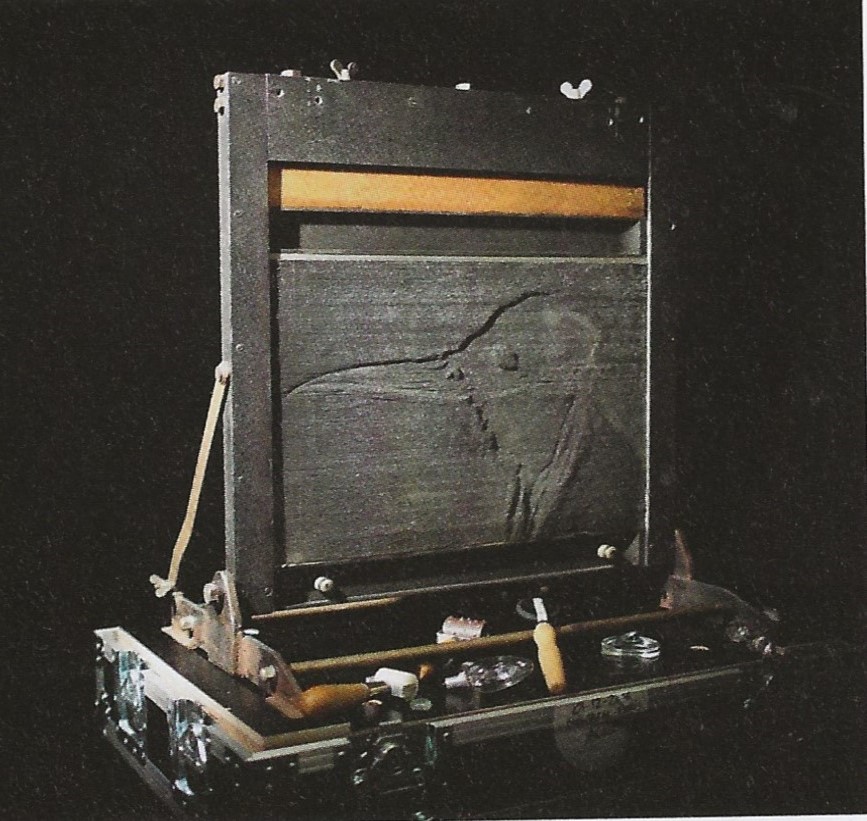
The puppet short, The Great Love of a Little Dancer was originally to be called “The Cabinet of Dr. Larifari,” a title which more directly references, The Cabinet of Dr. Caligari (1920), which the film satirizes. Like Caligari, the story takes place on a fairground where Dr. Larifari, a magician, is in love with Esmarelda, the little dancer whose heart belongs to the lion tamer, Leonidas (who looks suspiciously like Harry Piel). Rebuked, Larifari puts a curse on any man who looks at Esmarelda, literally turning their heads around. Like Caligari who morphs into the head psychiatrist in the asylum, Larifari and Dr. Crymurder (to whom Esmarelda flees) are one and the same. The film seemingly ends tragically: Leonidas without a head, Larifai eaten by the lion, and Esmarelda committing suicide by falling off a bench and breaking into pieces but it’s only a dream. To make sure the audience understands the faux happy end, the film ends self-reflexively with the lovers being packed in a box by the puppeteer’s hands. Both the set design and the animated inter-titles, likewise pay homage to Caligari‘s Expressionism.

The Great Love of a Little Dancer

The film was the first of two short puppet films made by Picolo-Film Co,. which was founded by Zeisler and his co-director Viktor Abel, who had previously been Zeisler’s writing partner on a couple Harry Piel adventure films and would sporadically work with Zeisler at UFA. The puppets were from the famous Paul Schwiegerling Puppet Theater which Walter Benjamin had seen in Bern in 1918, then never heard of again: “It was more beautiful than anything you could imagine. Schwiegerling invented the so-called ‘transformation puppets,’ or ‘metamorphoses.’ His marionette theater was actually more of a magician’s den.” Transformation meant the puppets could split into separate body parts, as well as change shapes. The digital restoration from the only surviving nitrate print was handled by the Deutsches Filminstitut in Frankfurt.

In Summer of 2011, the UCLA film archive got a call from the family of a deceased film collector in Oregon who had amassed over 220,000 feet of nitrate film, much of it from the silent era. His idea to preserve the material was to pack it in machine oil, like sardines, which miraculously worked, since we found only some nitrate decomposition. Ralph Sargent’s Film Technology cleaned the reels by hand several times before putting the films through their sonic cleaner; a first pass of a single oil-soaked reel had rendered the machine’s cleaning fluid useless. One particular title, Wood Love (1928), turned out to be the long-lost American release version of Ein Sommernachtstraum/A Midsummer Night’s Dream, directed by Hans Neumann.

Max Reinhardt made theatre history at the Neues Theater in 1905 with his staging of Shakespeare’s play, the forest on a revolving stage, reviving the production thirteen times in Berlin and Salzburg. In America, Reinhardt’s Hollywood Bowl production in 1934 was then adapted by Reinhardt and William Dieterle for Warner Brothers and released the next year.  Here now was an earlier filmed version that featured numerous Reinhardt actors, as well as Reinhardt’s costuming and mise en scene, based on the visual evidence of the 1934 film.   

Valeska Gert as shakespear’s Puck

Even though the German Historical Museum in Berlin had turned up a fragment of A Midsummer Night’s Dream in the 1990s, and even though the role of Puck was played by the eccentric dancer, Valeska Gert, whose legendary stage performances were not documented on film – she had appeared in most famously in The Joyless Street (1925) and The Diary of a Lost Girl (1929) – I spent several years unsuccessfully trying to get the Germans to consider financing a restoration. They were not interested. Happily, the Film Foundation eventually funded the project, which was started by Scott MacQueen and finished by Miki Schannon after my own departure from the Archive.
A Midsummer Night’s Dream

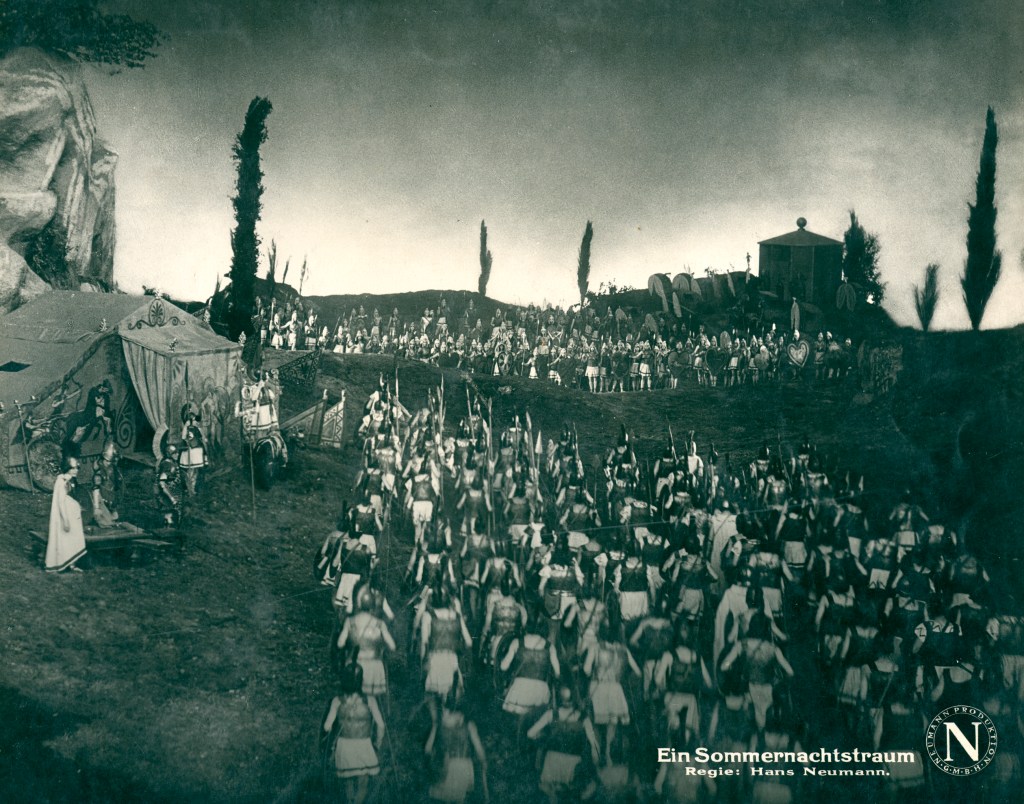
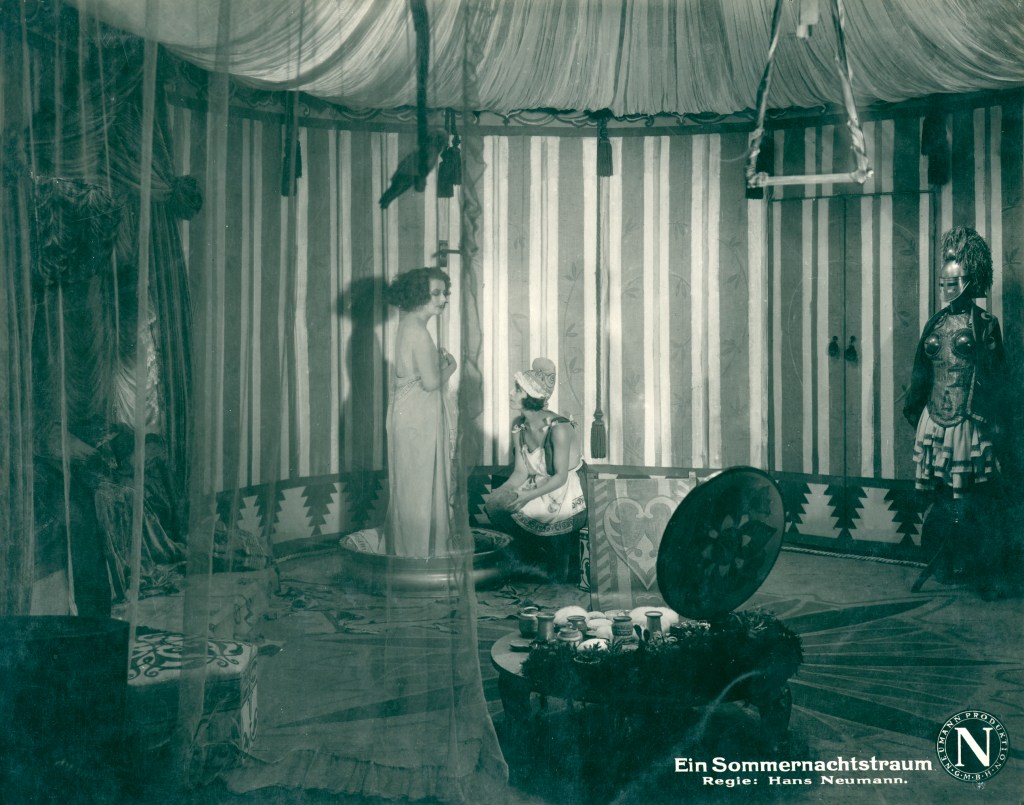
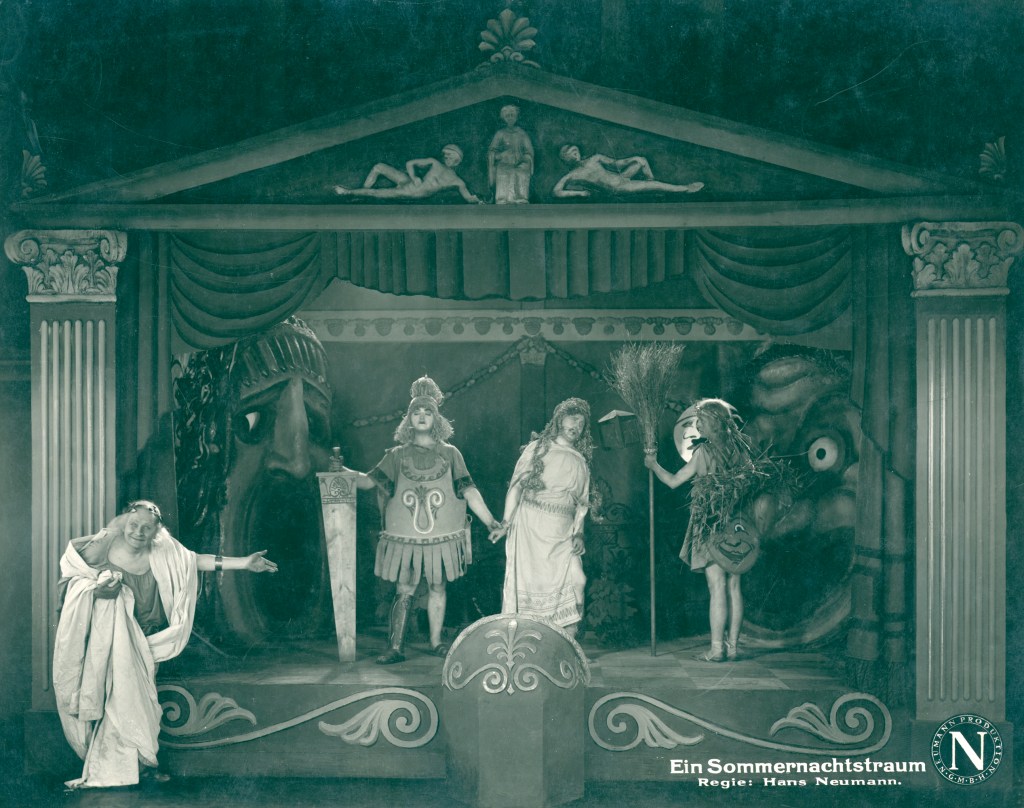
Unfortunately, Reinhardt’s satirical prologue – not in Shakespeare – of Hippolyta’s Amazonians attacking the Athenian Army of Theseus was removed from the Anglo-American release, so it has been hinted at with surviving publicity stills from the German release. Also removed from the American version were many of Reinhardt’s modernisms, including the use of telephones, since the impresario had tried to make the play more accessible by adding humor and reworking A.W. Schlegel’s archaic German translation into a modern idiom. The preservationists were able to use the German censorship records to reconstruct the satiric modernity of the original titles, rather than the Shakespearean titles of the American release. Among the A-List actors in the film, all of whom had acted in Reinhardt’s Deutsches Theater: Hans Albers, Tamara Geva, Werner Krauss, Fritz Rasp, Ruth Weyher, Paul Biensfeld, and Alexander Granach.

Joseph Noël Patonn, Reconciliation of Oberon and Titania (1847)

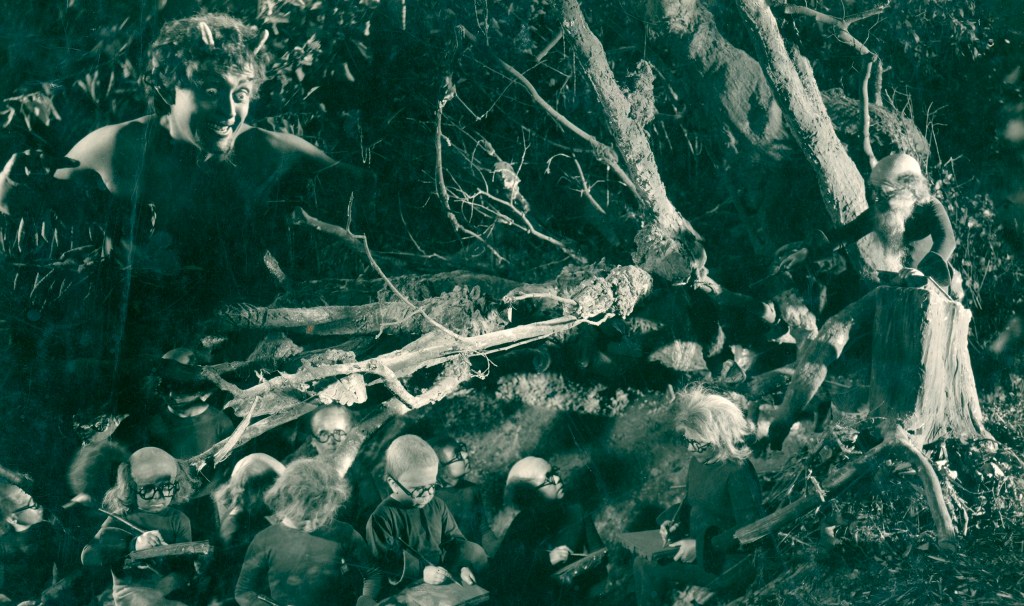
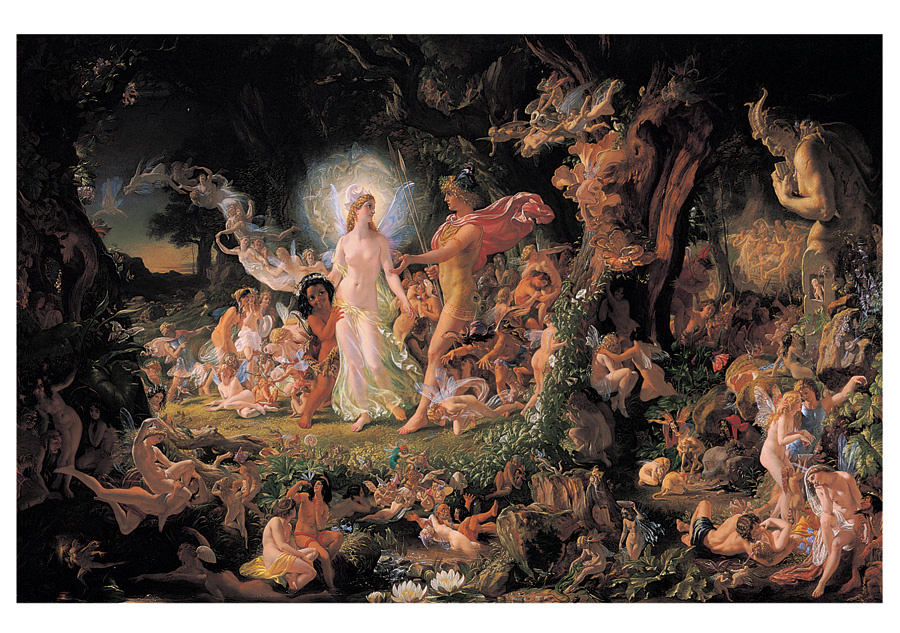
However, what stood out for me was the technical achievement of cameramen Guido Seeber and Reimer Kuntze. Nearly half the film consists of double exposures, as the wood nymphs, satyrs, and spirits frolic in the night, their bodies and flowing gowns visible but also translucent. Such super-impositions would have had to be done in-camera – optical printers had not yet been invented – so it must have taken a huge amount of trial and error with lighting on the Staken Studio’s massive forest set. It is also a specifically cinematic device that would not have been possible in Reinhardt’s theatre staging of the play. As Jay Weissberg notes in his catalog entry, set designer Ernö Metzner’s art direction also references 19th-century fairy paintings by Léon Frédéric, John Anster Fitzgerald, and Joseph Noël Paton.

Tamara (Dorothea Thiele), Lori Leux

Another thoroughly modern aspect of the production was its gender-bending. While Oberon, the King of the Fairies, played by female dancer Tamara Geva – wearing a headdress that would reappear in the 1934 film – is mysteriously androgynous, just as Valeska Gert’s Puck is played as gay and Hippolyta is more interested in women than in the pursuing Theseus;  Gert was of course openly lesbian, even in the 1920s. Then, there are the actors in the play within a play who appear in female dress with mustaches, proudly in drag. Indeed, much of the frolicking by gender-unspecific spirits read as gay.

Charlotte Ander as Hyppolyta

This may not be Fritz Lang but we are truly fortunate to now have this Reinhardt-inspired A Midsummer Night’s Dream, which documents the spirit of 1920s Berlin as much as Dr. Mabuse.   

Werner Kraus as Bottom

326: San Francisco Silent Film Festival

Archival Spaces 326

San Francisco Silent Film Festival

Uploaded 21 July 2023

The San Francisco Silent Film Festival opened on the evening of 12 July with a screening of Douglas Fairbanks’s The Iron Mask (1929) at the Castro Theatre. This year’s program over four full days offered a mix of American melodramas and comedies, as well as films from Germany, the Czech Republic, Ukraine, France, and Japan. I arrived on Thursday morning in time to catch their annual archivists program, “Amazing Tales from the Archives.” The dense program of six films per day was exhausting, but the Festival’s hospitality. meeting many colleagues and old friends, and the general excellence of the program made it worth the trip.

Nicholas White at “Amazing Tales from the Archives”

Despite being a student of silent cinema for decades, I had never heard the term “trap drummer,” which according to musical instrument collector, Nicholas White, refers to the sound effects made by musicians who accompanied silent films, along with the piano player or orchestra. White discussed the profession and demonstrated sound effects – everything from Model T autos to lions roaring, using archaic contraptions, some purchased, some homemade. It was a revelation. Equally interesting was Kyle Westphal’s (Chicago Film Society) presentation of a previously lost short film, Doll Messengers of Friendship (1927), which documented a unique exchange of dolls between American and Japanese children at a time when relations between the two countries were very strained, due to Republicans passing the Immigration Act of 1924, which prohibited immigration from Asia and Japan into the United States and was specifically designed to maintain white supremacy in the United States. In a well-structured presentation, Westphal enumerated the many steps necessary to identify the film, and, finally, contact its Japanese sponsors.

Johnstown Flood (1926)
Stark Love (1927)
Stark Love (1927)

The rest of Thursday was dedicated to the American films, Man and Wife (1923), The Johnstown Flood (1926), Up in Mabel’s Room (1926), and Stella Maris (1925), which were mostly mid-grade Hollywood programmers, although Johnstown Flood offered spectacular disaster scenes, accompanied by the Mont Alto Orchestra, and Up in Mabel’s Room proved to be a light boudoir comedy of errors that had learned much from Ernst Lubitsch and was an obvious audience pleaser.

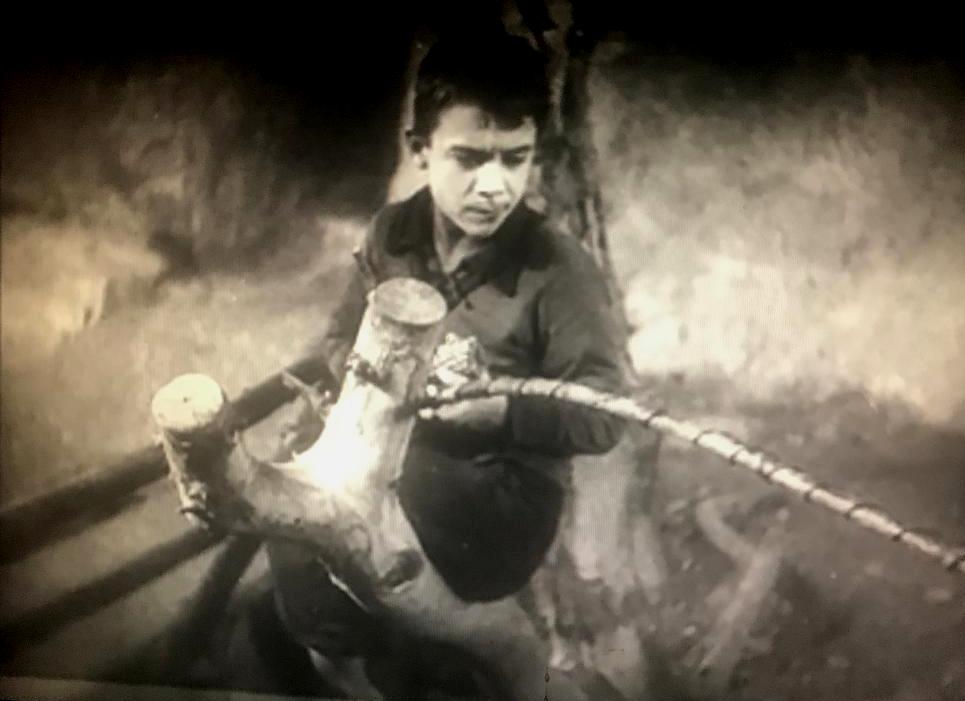
Friday began with the first unqualified masterpiece, Karl Brown’s little-seen Stark Love (1927), which I first viewed at Eastman Museum as an intern in 1976 and had never forgotten. Shot in the Smoky Mountains of Appalachia with amateur actors, Brown’s film may be the only truly neo-realist film of Hollywood’s silent era, a film that prettifies nothing in its depiction of poor mountain folk. The rugged mountains, inaccessible valleys, and primitive living conditions are in full view, as is the close-knit community of former Anglo-Saxon pioneers, whose women are treated as beasts of burden and sent to early graves. Meanwhile, Brown’s landscapes through various seasons avoid the picturesque while capturing a raw, often brutal nature. The Hollywood happy end – undoubtedly a concession to Paramount – allows one young woman, promised to a neighboring widower twice her age, to escape to the city, but it doesn’t diminish the impact of the preceding narrative of hardship.

The Dragon Painter (1919)

The day continued with more American genre films, including Flowing Gold (1924), a Rex Beach take on the Texas oil boom; Padlocked (1926), Allan Dwan’s adaptation of another Rex Beach novel about moral hypocrisy; Buster Keaton’s admittedly minor first feature, Three Ages (1923), which nevertheless features some spectacular stunts; Sessue Hayakawa’s The Dragon Painter (1919) in a new restoration, shot partially in the Japanese Garden of Pasadena’s Huntington Gardens; and Paul Leni’s The Cat and the Canary (1927), which literally established Hollywood’s “old dark house genre” on horror comedy.

The Organist at St. Vitus Cathedral (1929)

Saturday’s foreign films were my favorites, and not because I prefer non-Hollywood films; give me an (American) Lubitsch, Maurice Tourneur, or John Collins and I’m in the front row. The Czech film, The Organist at St. Vitus Cathedral (1929), was an amazingly atmospheric melodrama, shot mostly in real locations around Prague’s Hradčany Castle, its magnificent Cathedral, and Alchemist’s Alley. For me a particular please, because I recognize almost all the Mala strana locations. It was Martin Frič’s sophomore effort as a director, whose career would continue through the 1960s and well over 100 films. The film concerned an aging organist and a nun who returns to a secular life, brought together by the nun’s father who commits suicide in the organist’s tiny home. Featuring highly expressionist lighting and a typically Czech dark mood, the film ultimately caters to popular taste with a happy end. Czech films in the 1920s were all about national identity, – given that before 1918, all films had to be in German – so St. Vitus Cathedral is rich with cultural meaning for the Czech audience.

In a change of mood, the Ukrainian absurdist comedy, Pigs Will Be Pigs (1931), was a full frontal attack on Communist bureaucracy, as indolent railroad officials lose a vital grain seed shipment, and hinder the delivery of two guinea pigs, because there are no regulations for such a shipment. While succeeding levels of bureaucrats deny responsibility, the guinea pigs multiply into the hundreds in a rural whistle-stop and are ultimately fed the lost grain, while Communist slogans proclaim the victory of the five-year plan and form a commission to study the guinea pig problem. Given that Stalin instituted the Holodomor, Ukraine’s man-made famine a year after this film’s production, which led to the death of millions of Ukrainians, the film’s aborted planting of grain, due to the lost seed, is particularly poignant.

Crainquebille (1922)

Another dark poetic masterpiece, Jacque Feyder’s Crainquebille (1922) became for historians a central work of the first French film avant-garde. The story of an elderly but energetic push-cart vegetable vendor who gets caught in the machinations of the French legal system after supposedly insulting a cop, Monsieur Crainquebille descends after a short prison sentence into alcoholism and the Lumpenproletariat, abandoned by his former bourgeois customers. Shot on location in Paris, in particular around the now long-gone Les Halles markets, Feyder’s film highly realist film remains steadfastly unsentimental.

Walk Cheerfully (1930)

Saturday closed with another one of Yasujiro Ozu’s American-influenced Tokyo gangster films, Walk Cheerfully (1930), which, like Gangster Girl (1933), involves a small-time wise guy trying to go straight after falling in love with a middle-class woman. While featuring numerous moving camera shots and quick cutting, unlike the later static camera images of his later “Japanese” films, Ozu’s control of the medium is already wholly developed, while the film’s final shot of a clothesline not only foreshadows a stable domesticity for its protagonists but also presages what would become a signature image in his later films.


Finally, I want to mention Sunday’s Voglio a Tte!, aka La Fanciulla di Amalfi (1922), directed by Roberto Roberti (Sergio Leone’s father), and starring Francesca Bertini, Italy’s most famous silent film diva. While the film’s story of a wealthy young Englishman suffering from mental issues who falls in love with an Amalfi Coast fisherwoman stretches credulity – the film only works because silence hides the linguistic and cultural divide – Bertini and the Italian scenery are luminous. However, the Italian censorship authorities determined the image of a poverty-stricken fisherman’s community to be detrimental to Italy’s honor, so the 1925 released film states these are Spaniards, a move undermined by accompanist Stefan Horne supplying a wonderful score of Neapolitan folk songs, just as the music by Günther Buchwald, Utsav Lal, Will Lewis, Wayne Barker and Maud Nelissen provided a magnificent acoustical environment for the Festivals many other films.

P.S. I will have more to say about the German A Midsummer Night’s Dream (1925) in my next blog.

Voglio ttE! aka La Fanciulla di Amalfi (1922)

325: Mission to Moscow

Archival Spaces 325:

Mission to Moscow (1943, Michael Curtiz)

Uploaded 7 July 2023

For much of cinema’s history, the U.S. government has engaged in various forms of political film propaganda. In the modern era film and video have communicated soft power, rather than the nation’s actual military might, producing public service messages, educational, and documentary films. Except for the periods of World War I & II, and Viet Nam, U.S. information agencies have seldom engaged in outright war propaganda. Eighty years ago, Michael Curtiz directed Mission to Moscow (1943), a film that openly regurgitated Stalinist Russian political agendas, the way today Trump World and many rightwing television broadcasters, transport Putin’s war strategy to an American audience. The Warner Brothers film’s wholly Communist view of the causes and aims of World War II, especially regarding the Stalinist Show Trials, stood in direct contradiction to prevalent American majority attitudes. Yet, President Franklin D. Roosevelt himself advocated for the film’s production. Based on a book by Joseph E. Davies, a book many American diplomats dismissed, Mission to Moscow was the only World War II narrative propaganda feature made with the direct participation of the Roosevelt Administration, the former Ambassador to Moscow, Joseph E. Davies, the wartime Office of War Information (OWI), and the Soviet Russian Ambassador in Washington, Maxim Litvinov; Litvinov had originally negotiated American’s recognition of the Soviet Union in 1933, fallen out of grace because he opposed the Hitler-Stalin Pact in the late 1930s, then sent by Stalin to Washington in 1941.
Conceived as a pro-Soviet, Anti-Nazi film, it was one of Hollywood’s many contributions to WWII’s cinematic war propaganda and an act of friendship with the present ally, the Union of Soviet Socialist Republics. Yet Mission to Moscow also released a storm of criticism for its falsification of recent history. Even OWI conceded in their evaluation (OWI No. 447, 19 May 1943) of the film: “The whole is a controversial topic… Some think that the film is excellent propaganda and will greatly help our relations with Russia, while others feel that the film does a great deal of harm… World events of great significance have been simplified or condensed.” John Dewey (Columbia University), ex-chair of the” Moscow Show Trials Commission, was more direct: “The film Mission to Moscow is the first instance in our country of totalitarian propaganda for mass consumption – a propaganda which falsifies history through distortion, omission or pure invention of acts…”

Mission to Moscow’s show trial
Photo of the actual show trial in Moscow 1938

Director Michael Curtiz and scriptwriter Howard Koch portray Stalinist Russia as a democratic, almost capitalist country in which the common man is king, and Comrade Stalin rules as a benevolent, courageous, pipe-smoking defender of the Russian people. Mission to Moscow sought to counteract 25 years of anti-Communist propaganda, clearing the way for the average American’s support of Russia in the war against German fascism. The frame story has Ambassador Davies traveling through the Soviet Union, emphasizing he is a capitalist and a businessman who is skeptical of the Soviet Union, but learning that private initiative in the Russian workplace leads to workers earning more money. Capitalism at work. Copying the March of Time method, Mission to Moscow utilizes rapid montages, frame wipes, multiple exposures, quick dissolves, and a voice of god off-screen narrator to construct a fast-moving narrative that justifies the Moscow show trials as necessary to eliminate fascist fifth columnists in Russia, strengthen democracy and support the war against Nazi Germany while excusing the Hitler-Stalin Pact as a cunning maneuver to prepare for war.

Oscar Homolka as Maxim Livinov.
Mission to Moscow, Maria Palmer, Richard Travis, Eleanor Parker, 1943

I first became interested in Mission to Moscow while writing my dissertation on anti-Nazi films in Hollywood made by German-Jewish refugees, and actually wrote a chapter about the film, but eventually discarded it. My focus was on the film’s anti-Nazi elements which argued that during much of the 1930s, only the Soviet Union – Litvinov – pleaded with the West to stop Hitler. That was true. Indeed, the film opens on the League of Nations in June 1936, when the German Ambassador leaves in protest after Litvinov calls for collective security; in fact, Germany left the League three years earlier. It then cuts to newsreel footage of Hitler riding through the streets of Nuremberg, while the narrator intones: “The world began to listen to a new voice.” President Franklin  D. Roosevelt sends Davies on a fact-finding mission to Russia, since “Hitler seems bent on conquest, not only of Europe but the whole world.” 

Eleonore Parker, AnnHarding, and Walter Huston as the Davies family
Ambassador Joseph E. Davies and his wife, Marjorie in Moscow, 1937

Traveling by ship, Davies disembarks in Hamburg where he sees a completely militarized society, dominated by Swastikas, marching soldiers, Hitler Youth, and Mein Kampf in every bookstore. In Berlin, he meets Hjalmar Schacht, the Nazi Economics Minister – he trusts bankers – but waits in vain for two weeks to see Hitler, while Foreign Minister von Ribbentrop undermines Davies’s efforts. In the Soviet Union, Davies travels throughout the country inspecting efficient factories, ready to be converted to war, but there are intimations of sabotage. Returning to Moscow and a white tie and tails reception, where the Spanish Fifth Column is invoked, Davies sees Nikolai Bukharin whispering to von Ribbentrop, setting the stage for his arrest and the subsequent trials of Bukharin, Karel Radek, Genrikh Yagoda, and Nikolay Krestinsky, also seen huddling at the reception.    
German-American Bund meeting in Madison Square Garden, 1939

Minutes later, the film cuts to a Nazi Party rally with huge Swastikas in the frame, while we hear: “No this is not in Germany. This is a Bund meeting in New York City where Americans were brutally beaten for daring to interrupt the Führer’s friend.” Like the Soviet Union, America will be targeted by the Nazis. The subsequent show trials then “prove” that a Trotskyite conspiracy was helping Nazi Germany dismember the Soviet Union, just as the German-American Bund was undermining American democracy. Mission to Moscow then offers proof of Nazi aggression with the Austrian Anschluβ, the “tragic mistake” of Munich, and the Blitzkrieg. It further propagates Roosevelt’s signing of the Lend-Lease Act for Russian and British war aid, and for opening a “second front” against Germany, to relieve Russia’s war burden. D-Day, the second front, would only arrive a year after Mission’s release.

In the film, the Germans are stereotyped, conforming to the anti-Nazi film’s visual codes as unequivocal supporters of Nazism. Schacht and von Ribbentrop, the capitalist, and Junker appear with Nazi symbols in the frame, supporting left-wing political theories that explicated the rise of fascism as an alliance between big capital and the Prussian (militarized) aristocracy. Ordinary Germans speak too loud, click their heels, wear Swastikas, and espouse the New Order, as evidenced in the film by Hamburg’s Mayor, a uniformed party member, the train station master, a small businessman, and a diplomat. Ironically, while Davies is impersonated by Walter Huston, the Nazis are played almost exclusively by German-Jewish refugee actors, including Louis V. Arco, Felix Bash, Ernst and Lisa Golm, Erwin Kalser, Lionel Royce, Richard Ryen, and Alfred Zeisler, just as they had played similar roles in most Holywood anti-Nazi films because they had the right accent. It was a strange fate: the victims of Nazi terror were paid to imitate their persecutors in the movies.

Soviet Poster for Mission to Moscow.

324: RIP Hans Helmut Prinzler

Archival Spaces 324:

RIP Hans Helmut Prinzler

23 June 2023

On Tuesday, a friend in Berlin sent me a German newspaper digital clipping with the news that the former director of the Deutsche Kinemathek in Berlin, Hans Helmut Prinzler, had died on Sunday 18 June.  During the day I kept thinking about how our lives had intersected over more than forty years, during which I experienced him as an influential film historian, then as an extremely well-respected colleague, and finally as a fellow blogger. When I was the director of the Munich Filmmuseum in the late 1990s he was a trusted advisor, indeed he was partially responsible for me getting the job in Munich. He liked to call me “der Amerikaner.” Hans Helmut was the gentlest of souls, who understood that helping his staff excel only enhanced his own reputation, a kind man who never raised his voice as far as I know, and who with his calm demeanor always sought compromise even in heated debates. His staff at the Kinemathek and many others in the field worshiped him.    

I first met Hans Helmut in 1980 when as a Ph.D. candidate in Münster I was asked by the German Kinemathek to join the team screening “Prussian” films for the city of Berlin’s major exhibition and catalog. He had joined the staff of the Kinemathek under Director Heinz Rathsack less than two years before. I was already well acquainted with his name, having read his work on Luis Buñuel, Luchino Visconti, Robert Bresson, and others, in Hanser’s monograph series, as well as his book, Cinema in the Federal Republic of Germany (1979). Knowing of my doctoral research on German Jewish Exiles, he asked me in 1981 to contribute to the Berlinale retrospective on Curtis Bernhardt (1982). I was only one of many young scholars Hans Helmut consistently promoted by offering them a chance to publish.

Hans Helmut Prinzler att the DFFB, early 1970s

Born in Berlin on 23 September 1938, Hans Helmut Prinzler began studying Journalism, Theatre, and German in 1958 at the universities of Munich and Berlin, joining the Department of Journalism at the Free University in 1966 as a graduate student with what would become an unfinished dissertation project on West German films screened in the GDR. Three years later he joined the administration of the German Film and Television Academy (DFFB) under Dr. Heinz Rathsack, as the newly created Director of Studies, after student protests had rocked the institution. Hans Helmut was not only responsible for organizing admissions and coordinating film courses but also established a publications program and encouraged students to write about film topics, because, as he later admitted, he had “an obsessive relationship to printed paper and was always concerned that students write about their own work and that of the Academy.” (Quoted by Frederick Lang in a DFFB history).
That wish to document film history would continue once Prinzler moved to the Kinemathek as the department head responsible for exhibitions and publications. While keeping his DFFB duties, Rathsack had become Kinemathek’s Chairman of the Board, a position Prinzler inherited when Rathsack passed away in 1990. From the 1980s through the early 2000s, Hans Helmut Prinzler was responsible for an amazing series of Berlinale retrospectives: German exile actors (1983), Ernst Lubitsch (1984), Rouben Mamoullian (1987), Erich Pommer (1989), Erich von Stroheim (1994), William Wyler (1996), G.W. Pabst (1997), the Siodmak Brothers (1998), Fritz Lang (2001), and F.W. Murnau (2003), always accompanied by serious books that consistently broke new film historical ground. During his time at the Kinemathek, when his administrative duties were substantial, Prinzler’s productivity as an editor and writer was staggering, publishing over forty books. His History of German Cinema (1993) brought together many scholars, has remained a standard German-language work, and included my essay, “German Exile Cinema.” On top of all that, Prinzler also founded the Kinemathek’s newsletter Film Geschichte (1996-2005) and the journal FilmExil (1992-2005).  

After becoming Head of the Deutsche Kinemathek, Prinzler continued Rathsack’s long-planned project to build a new home for the Kinemathek. It was a Herculean task that took twenty years, finally succeeding when in 2000 the Kinemakek, as well as the DFFB and the Arsenal Cinema moved to Berlin’s Sony Center on Potsdamer Platz. At the same time, the Kinemathek opened the German Filmmuseum, certainly one of Hans Helmut’s crowning achievements. The 25-year lease Prinzler signed will unfortunately expire in 2024. See my blog No. 319 (https://archivalspaces.com/…/14/319-deutsche-kinemathek/)

Meanwhile, I had become Film Curator at the George Eastman Museum and regularly saw Prinzler at the Berlinale, in particular at the fabulous parties he and his wife Antje Goldau – herself a well-respected film critic – would host at their Berlin Sybel Str.  flat. It was a who’s who of German film historians and critics, with an occasional star thrown in, and they lasted until late in the night. It was at one of those parties in February 1994 that Hans Helmut introduced me to Lothar Just, a film journalist who worked for Eberhard Hauff, the director of the Munich Film Festival. Knowing I was a candidate for Director of the Munich Fillmmuseum, Lother grilled me for two hours at the party, then reported back to Hauff who politicked for my appointment. Hans Helmut became my most important mentor once I got the position and had to negotiate minefields, like the annual Kinemathek Association meetings of the German film archives.

After Prinzler’s retirement from the Kinemathek in 2006, he continued his publications activity, as well as being appointed Director of the Film Section of the Berlin Academy of Arts. Starting in 2007 until the week before his death, Prinzler published a blog (https://www.hhprinzler.de/) with reviews of new film books. I always looked forward to the monthly emails announcing his latest reviews which were never judgmental but always strove to describe as objectively as possible the contents and goals of the book. His former colleague, Martin Koerber, wrote to me after Hans Helmut’s passing: “This website alone is a life’s work which will hopefully survive. One can use it as a lexicon in order to research relevant film literature.”  

R.I. P. Hans Helmut. I will miss you, as will your colleagues and friends. 

Hans Helmut Prinzler, Curator of the Exhibition “Light and Shadow, Films of the Weimar Republic, 01.22.2014.