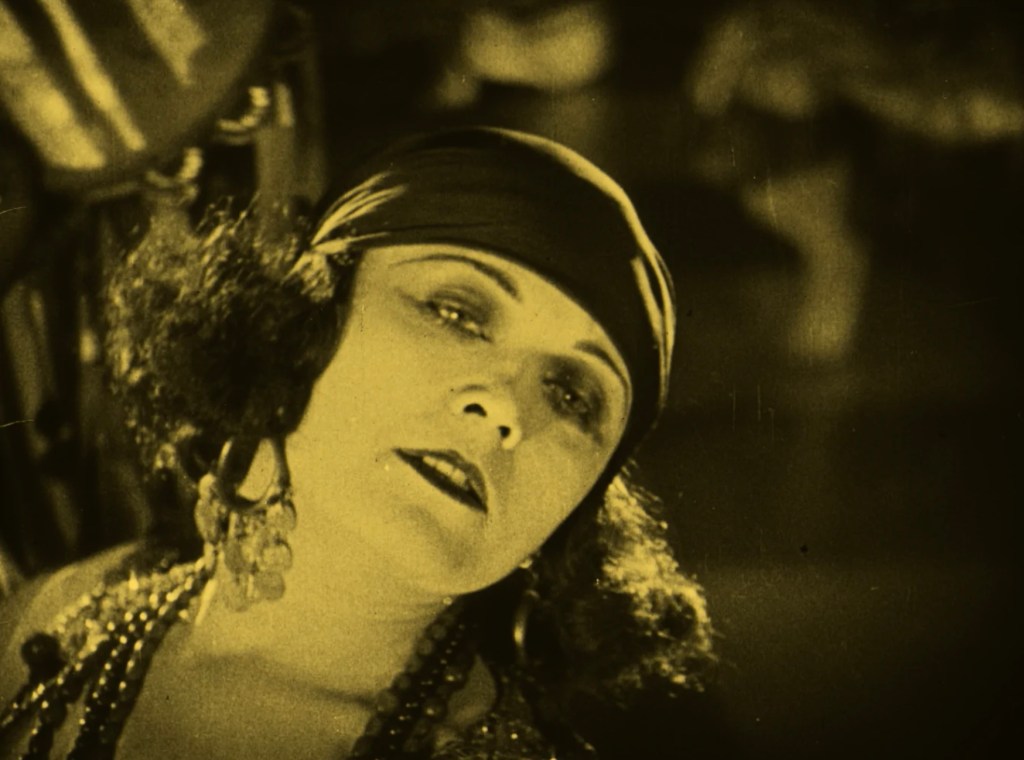
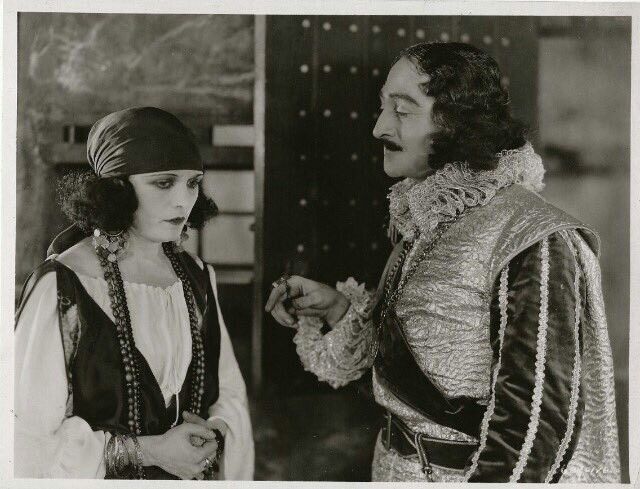
325: Mission to Moscow

Archival Spaces 325:

Mission to Moscow (1943, Michael Curtiz)

Uploaded 7 July 2023

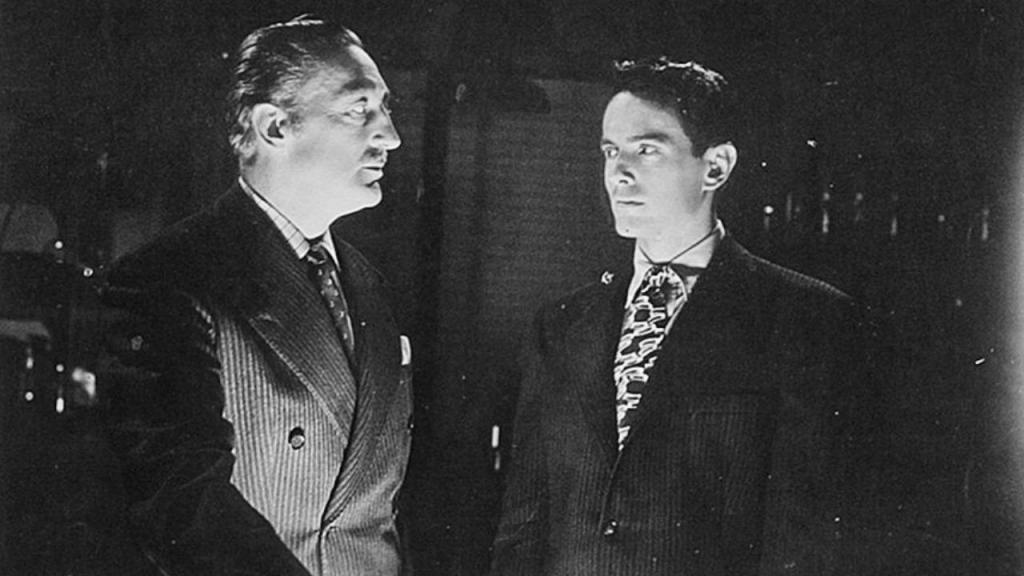
For much of cinema’s history, the U.S. government has engaged in various forms of political film propaganda. In the modern era film and video have communicated soft power, rather than the nation’s actual military might, producing public service messages, educational, and documentary films. Except for the periods of World War I & II, and Viet Nam, U.S. information agencies have seldom engaged in outright war propaganda. Eighty years ago, Michael Curtiz directed Mission to Moscow (1943), a film that openly regurgitated Stalinist Russian political agendas, the way today Trump World and many rightwing television broadcasters, transport Putin’s war strategy to an American audience. The Warner Brothers film’s wholly Communist view of the causes and aims of World War II, especially regarding the Stalinist Show Trials, stood in direct contradiction to prevalent American majority attitudes. Yet, President Franklin D. Roosevelt himself advocated for the film’s production. Based on a book by Joseph E. Davies, a book many American diplomats dismissed, Mission to Moscow was the only World War II narrative propaganda feature made with the direct participation of the Roosevelt Administration, the former Ambassador to Moscow, Joseph E. Davies, the wartime Office of War Information (OWI), and the Soviet Russian Ambassador in Washington, Maxim Litvinov; Litvinov had originally negotiated American’s recognition of the Soviet Union in 1933, fallen out of grace because he opposed the Hitler-Stalin Pact in the late 1930s, then sent by Stalin to Washington in 1941.

Conceived as a pro-Soviet, Anti-Nazi film, it was one of Hollywood’s many contributions to WWII’s cinematic war propaganda and an act of friendship with the present ally, the Union of Soviet Socialist Republics. Yet Mission to Moscow also released a storm of criticism for its falsification of recent history. Even OWI conceded in their evaluation (OWI No. 447, 19 May 1943) of the film: “The whole is a controversial topic… Some think that the film is excellent propaganda and will greatly help our relations with Russia, while others feel that the film does a great deal of harm… World events of great significance have been simplified or condensed.” John Dewey (Columbia University), ex-chair of the” Moscow Show Trials Commission, was more direct: “The film Mission to Moscow is the first instance in our country of totalitarian propaganda for mass consumption – a propaganda which falsifies history through distortion, omission or pure invention of acts…”

Mission to Moscow’s show trial
Photo of the actual show trial in Moscow 1938

Director Michael Curtiz and scriptwriter Howard Koch portray Stalinist Russia as a democratic, almost capitalist country in which the common man is king, and Comrade Stalin rules as a benevolent, courageous, pipe-smoking defender of the Russian people. Mission to Moscow sought to counteract 25 years of anti-Communist propaganda, clearing the way for the average American’s support of Russia in the war against German fascism. The frame story has Ambassador Davies traveling through the Soviet Union, emphasizing he is a capitalist and a businessman who is skeptical of the Soviet Union, but learning that private initiative in the Russian workplace leads to workers earning more money. Capitalism at work. Copying the March of Time method, Mission to Moscow utilizes rapid montages, frame wipes, multiple exposures, quick dissolves, and a voice of god off-screen narrator to construct a fast-moving narrative that justifies the Moscow show trials as necessary to eliminate fascist fifth columnists in Russia, strengthen democracy and support the war against Nazi Germany while excusing the Hitler-Stalin Pact as a cunning maneuver to prepare for war.

Oscar Homolka as Maxim Livinov.
Mission to Moscow, Maria Palmer, Richard Travis, Eleanor Parker, 1943

I first became interested in Mission to Moscow while writing my dissertation on anti-Nazi films in Hollywood made by German-Jewish refugees, and actually wrote a chapter about the film, but eventually discarded it. My focus was on the film’s anti-Nazi elements which argued that during much of the 1930s, only the Soviet Union – Litvinov – pleaded with the West to stop Hitler. That was true. Indeed, the film opens on the League of Nations in June 1936, when the German Ambassador leaves in protest after Litvinov calls for collective security; in fact, Germany left the League three years earlier. It then cuts to newsreel footage of Hitler riding through the streets of Nuremberg, while the narrator intones: “The world began to listen to a new voice.” President Franklin  D. Roosevelt sends Davies on a fact-finding mission to Russia, since “Hitler seems bent on conquest, not only of Europe but the whole world.” 

Eleonore Parker, AnnHarding, and Walter Huston as the Davies family
Ambassador Joseph E. Davies and his wife, Marjorie in Moscow, 1937

Traveling by ship, Davies disembarks in Hamburg where he sees a completely militarized society, dominated by Swastikas, marching soldiers, Hitler Youth, and Mein Kampf in every bookstore. In Berlin, he meets Hjalmar Schacht, the Nazi Economics Minister – he trusts bankers – but waits in vain for two weeks to see Hitler, while Foreign Minister von Ribbentrop undermines Davies’s efforts. In the Soviet Union, Davies travels throughout the country inspecting efficient factories, ready to be converted to war, but there are intimations of sabotage. Returning to Moscow and a white tie and tails reception, where the Spanish Fifth Column is invoked, Davies sees Nikolai Bukharin whispering to von Ribbentrop, setting the stage for his arrest and the subsequent trials of Bukharin, Karel Radek, Genrikh Yagoda, and Nikolay Krestinsky, also seen huddling at the reception.    

German-American Bund meeting in Madison Square Garden, 1939

Minutes later, the film cuts to a Nazi Party rally with huge Swastikas in the frame, while we hear: “No this is not in Germany. This is a Bund meeting in New York City where Americans were brutally beaten for daring to interrupt the Führer’s friend.” Like the Soviet Union, America will be targeted by the Nazis. The subsequent show trials then “prove” that a Trotskyite conspiracy was helping Nazi Germany dismember the Soviet Union, just as the German-American Bund was undermining American democracy. Mission to Moscow then offers proof of Nazi aggression with the Austrian Anschluβ, the “tragic mistake” of Munich, and the Blitzkrieg. It further propagates Roosevelt’s signing of the Lend-Lease Act for Russian and British war aid, and for opening a “second front” against Germany, to relieve Russia’s war burden. D-Day, the second front, would only arrive a year after Mission’s release.

In the film, the Germans are stereotyped, conforming to the anti-Nazi film’s visual codes as unequivocal supporters of Nazism. Schacht and von Ribbentrop, the capitalist, and Junker appear with Nazi symbols in the frame, supporting left-wing political theories that explicated the rise of fascism as an alliance between big capital and the Prussian (militarized) aristocracy. Ordinary Germans speak too loud, click their heels, wear Swastikas, and espouse the New Order, as evidenced in the film by Hamburg’s Mayor, a uniformed party member, the train station master, a small businessman, and a diplomat. Ironically, while Davies is impersonated by Walter Huston, the Nazis are played almost exclusively by German-Jewish refugee actors, including Louis V. Arco, Felix Bash, Ernst and Lisa Golm, Erwin Kalser, Lionel Royce, Richard Ryen, and Alfred Zeisler, just as they had played similar roles in most Holywood anti-Nazi films because they had the right accent. It was a strange fate: the victims of Nazi terror were paid to imitate their persecutors in the movies.

Soviet Poster for Mission to Moscow.

324: RIP Hans Helmut Prinzler

Archival Spaces 324:

RIP Hans Helmut Prinzler

23 June 2023

On Tuesday, a friend in Berlin sent me a German newspaper digital clipping with the news that the former director of the Deutsche Kinemathek in Berlin, Hans Helmut Prinzler, had died on Sunday 18 June.  During the day I kept thinking about how our lives had intersected over more than forty years, during which I experienced him as an influential film historian, then as an extremely well-respected colleague, and finally as a fellow blogger. When I was the director of the Munich Filmmuseum in the late 1990s he was a trusted advisor, indeed he was partially responsible for me getting the job in Munich. He liked to call me “der Amerikaner.” Hans Helmut was the gentlest of souls, who understood that helping his staff excel only enhanced his own reputation, a kind man who never raised his voice as far as I know, and who with his calm demeanor always sought compromise even in heated debates. His staff at the Kinemathek and many others in the field worshiped him.    
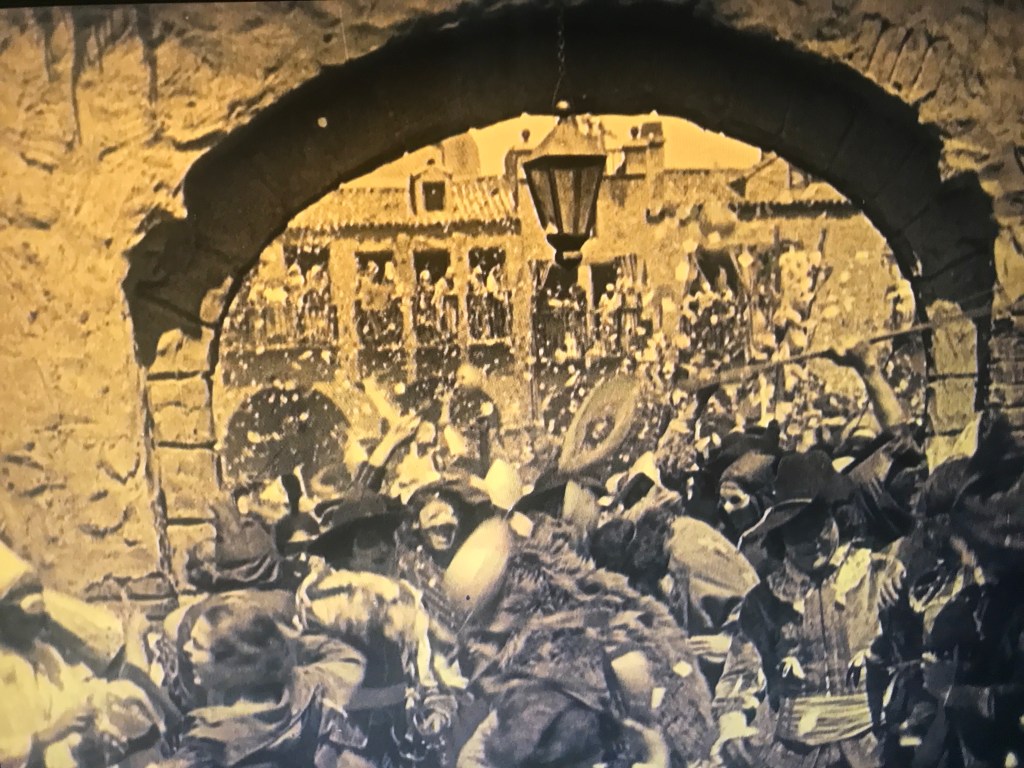
I first met Hans Helmut in 1980 when as a Ph.D. candidate in Münster I was asked by the German Kinemathek to join the team screening “Prussian” films for the city of Berlin’s major exhibition and catalog. He had joined the staff of the Kinemathek under Director Heinz Rathsack less than two years before. I was already well acquainted with his name, having read his work on Luis Buñuel, Luchino Visconti, Robert Bresson, and others, in Hanser’s monograph series, as well as his book, Cinema in the Federal Republic of Germany (1979). Knowing of my doctoral research on German Jewish Exiles, he asked me in 1981 to contribute to the Berlinale retrospective on Curtis Bernhardt (1982). I was only one of many young scholars Hans Helmut consistently promoted by offering them a chance to publish.

Hans Helmut Prinzler att the DFFB, early 1970s

Born in Berlin on 23 September 1938, Hans Helmut Prinzler began studying Journalism, Theatre, and German in 1958 at the universities of Munich and Berlin, joining the Department of Journalism at the Free University in 1966 as a graduate student with what would become an unfinished dissertation project on West German films screened in the GDR. Three years later he joined the administration of the German Film and Television Academy (DFFB) under Dr. Heinz Rathsack, as the newly created Director of Studies, after student protests had rocked the institution. Hans Helmut was not only responsible for organizing admissions and coordinating film courses but also established a publications program and encouraged students to write about film topics, because, as he later admitted, he had “an obsessive relationship to printed paper and was always concerned that students write about their own work and that of the Academy.” (Quoted by Frederick Lang in a DFFB history).

That wish to document film history would continue once Prinzler moved to the Kinemathek as the department head responsible for exhibitions and publications. While keeping his DFFB duties, Rathsack had become Kinemathek’s Chairman of the Board, a position Prinzler inherited when Rathsack passed away in 1990. From the 1980s through the early 2000s, Hans Helmut Prinzler was responsible for an amazing series of Berlinale retrospectives: German exile actors (1983), Ernst Lubitsch (1984), Rouben Mamoullian (1987), Erich Pommer (1989), Erich von Stroheim (1994), William Wyler (1996), G.W. Pabst (1997), the Siodmak Brothers (1998), Fritz Lang (2001), and F.W. Murnau (2003), always accompanied by serious books that consistently broke new film historical ground. During his time at the Kinemathek, when his administrative duties were substantial, Prinzler’s productivity as an editor and writer was staggering, publishing over forty books. His History of German Cinema (1993) brought together many scholars, has remained a standard German-language work, and included my essay, “German Exile Cinema.” On top of all that, Prinzler also founded the Kinemathek’s newsletter Film Geschichte (1996-2005) and the journal FilmExil (1992-2005).  

After becoming Head of the Deutsche Kinemathek, Prinzler continued Rathsack’s long-planned project to build a new home for the Kinemathek. It was a Herculean task that took twenty years, finally succeeding when in 2000 the Kinemakek, as well as the DFFB and the Arsenal Cinema moved to Berlin’s Sony Center on Potsdamer Platz. At the same time, the Kinemathek opened the German Filmmuseum, certainly one of Hans Helmut’s crowning achievements. The 25-year lease Prinzler signed will unfortunately expire in 2024. See my blog No. 319 (https://archivalspaces.com/…/14/319-deutsche-kinemathek/)

Meanwhile, I had become Film Curator at the George Eastman Museum and regularly saw Prinzler at the Berlinale, in particular at the fabulous parties he and his wife Antje Goldau – herself a well-respected film critic – would host at their Berlin Sybel Str.  flat. It was a who’s who of German film historians and critics, with an occasional star thrown in, and they lasted until late in the night. It was at one of those parties in February 1994 that Hans Helmut introduced me to Lothar Just, a film journalist who worked for Eberhard Hauff, the director of the Munich Film Festival. Knowing I was a candidate for Director of the Munich Fillmmuseum, Lother grilled me for two hours at the party, then reported back to Hauff who politicked for my appointment. Hans Helmut became my most important mentor once I got the position and had to negotiate minefields, like the annual Kinemathek Association meetings of the German film archives.

After Prinzler’s retirement from the Kinemathek in 2006, he continued his publications activity, as well as being appointed Director of the Film Section of the Berlin Academy of Arts. Starting in 2007 until the week before his death, Prinzler published a blog (https://www.hhprinzler.de/) with reviews of new film books. I always looked forward to the monthly emails announcing his latest reviews which were never judgmental but always strove to describe as objectively as possible the contents and goals of the book. His former colleague, Martin Koerber, wrote to me after Hans Helmut’s passing: “This website alone is a life’s work which will hopefully survive. One can use it as a lexicon in order to research relevant film literature.”  

R.I. P. Hans Helmut. I will miss you, as will your colleagues and friends. 

Hans Helmut Prinzler, Curator of the Exhibition “Light and Shadow, Films of the Weimar Republic, 01.22.2014.

323:  Hugo Haas

Archival Spaces 323

Hugo Haas Exhibition

Uploaded 9 June 2023

A new small but informative exhibition on the Czech-American actor-director, Hugo Haas, opened on 25 May in the waiting room of the Consulate General of the Czech Republic in Los Angeles. While several recent Consul Generals have been active in promoting Czech Film Culture – the annual “Czech That Film” Festival recently completed its 11th iteration – Consul Jaroslav Olša, Jr. has been particularly active, being himself an avid and active film historian and collector. He has mounted several exhibitions, including now “Hugo Haas in the US 40-62,” which includes film stills, posters, and letters from the collection of Milan Hain, a Professor of Film Studies at Palacký University who recently published a biography of Haas in Czech.

Hugo Haas with Pavel Haas and their parents
Hugo Haas, Ivan Haas, Maria Bibikoff-Haas, ca. 1947

The thesis of the exhibition is that Jewish-born Haas was traumatized by both his exile from Czechoslovakia in 1939 and the murder of his beloved brother, the gifted composer Pavel Haas, and father in Auschwitz and Theresienstadt, respectively. As a result of that trauma and depression, the director’s wife, Maria Bibikoff, eventually left him, after he became infatuated with his leading actress, more than twenty years his junior, Cleo Moore. Most of his independently produced melodramas are variations on the theme of older men, played by Haas himself who form liaisons with much younger, often amoral, very blonde and buxom women.

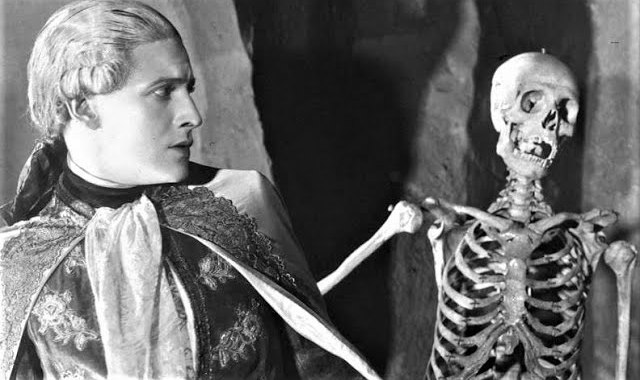
Hugo Haas in Bílá nemoc (Skeleton on Horseback)

Born in Brno in 1901, the second son of Lipmann (Zikmund) Haas and his wife Elka (Olga), née Epstein, Haas’s Jewish family was Czech speaking, rather than German, the lingua franca of most Czech Jews. He began his career as an actor at the National Theatre in Brno in 1920. Four years later, after stops in Ostrava and Olomouc, still in the Moravian hinterlands, he moved to Prague to the Vinorhady Theatre, and in 1929 to Prague’s National Theatre, where he remained until his abrupt firing in March 1939, after the Nazis had invaded Czechoslovakia. He appeared mostly in classics by Strindberg, Ibsen, Dostoyevsky, Shakespeare, Marcel Pagnol, and Shaw, but his most famous role was in Karel Čapek’s  “The White Sickness,” in the pivotal role of Dr. Galén, which the author had written specifically for him. Haas also starred in the film version, Skeleton on Horseback (1937), which he also directed. (See my blog about the film https://archivalspaces.com/2021/12/04/242-hugo-haas-the-white-sickness/) When one night, a drunken Nazi took a shot at him, he knew it was time to leave the country.
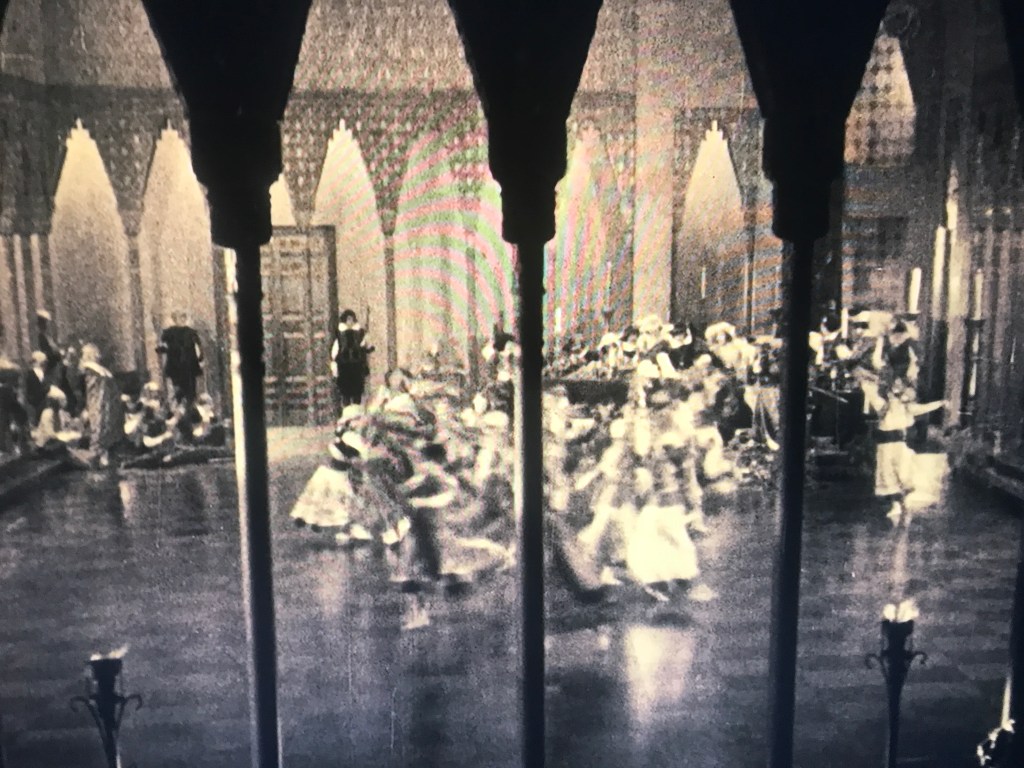
Odénko (1933, Hugo Haas)
Paradise Road/Ulicka v ráji (1936, Martin Frič)

Haas’s film career began in Czech silent films in 1925, appearing in a bit part in a bio-pic of the Czech national dramatist, Josef Kajetán Tyl (1926, Svatopluk Innemann), before starring in a comedy, The 11th Commandment (1925). However, Haas only hit his stride with the coming of sound, playing a supporting role as the chief physician in the first sound version of Hašek’s classic novel, The Good Soldier Svejk (1931, Martin Frič), and also starring in more than two dozen comedies, including Sister Angelika  (1933), Life is a Dog (1933), and Long Live the Deceased! (1935). Haas played mostly mature characters, often professors, and factory owners, even when he was the romantic lead, given his stocky build and a face that could hardly compete with the matinee pretty Francis Lederer; in two films he is a generation older than his love interest. By 1933, Haas was also working behind the camera, completing fourteen films as scriptwriter, and six as director, including Screen (1937), Skeleton, and Girls, Stand Fast (1937), before exile cut his career short. As in that last-named film, Haas functioned as director, writer, and star in his remaining late-30s Czech films. Forced to flee his home, Haas worked to return to that rare cinematic trifecta; it would take him twelve years.

Hugo Haas was 39 years old when he reached New York on 6 November 1940 on the S.S. Cambion, after traveling the Jewish refugee trail from Prague to Paris to Lisbon with his wife, Bibi, but without their child Ivan who was too small to travel and left with Bibikoff’s sister. They would be reunited only after the war but remained estranged, the sickly boy calling his aunt “mother.”. In New York, Haas tried to work in theatre, appearing in “The First Crocus” in New York, which closed after five days on Broadway in January 1942, but it got him an acting job in Hollywood.  

Days of Glory (1944, Jacques Tourneur)
Jealousy (1945, Gustav Machatý with Jane Randolph, Nils Asther

His first role was in a supporting role as a Russian resistance fighter in the anti-Nazi film, Days of Glory (1944, Jacques Tourneur), opposite Gregory Peck in his first role. Haas played another Russian in the adaptation of a Chekhov novel, independently produced by German émigré Seymour Nebenzahl, Summer Storm (1944, Douglas Sirk). Slipping into smaller, accented character roles the rest of the 1940s, Haas played a Caribbean innkeeper in The Princess and the Pirate, an Italian priest in A Bell for Adano, a friend of the murdered exiled writer in Jealousy (1945) – directed by fellow Czech Gustav Machetý -,  a French village Mayor in What Next, Corporal Hargrove (1945),  a film director in Merton of the Movies (1947), etc. By 1951, he had apparently earned and saved enough money to produce, direct, and star in Pickup, a low-budget melodrama from a story by his Czech friend, Josef Kopta, shot for a song ($85,000).

The Girl on the Bridge (1951) with Beverly Michaels

Unexpectedly, the film was sold to Columbia more than a year after its completion, earning Haas a tidy profit, while the studio grossed over $ a million. German émigrés Arnold Phillips (script), Douglas Bagier (editor), and Rudi Feld (set design) also worked on the film, the last named becoming a member of Haas’s team on nine films.  Starring Beverly Michaels as the platinum blonde femme fatale out to murder her much older husband, Pickup made the unknown actress a minor star, leading to a rematch with Haas in The Girl on the Bridge (1952), where she plays a suicide rescued by an older Holocaust survivor who then marries her. Phillips, Bagier, and Feld also worked on the second film, as did Robert Erlik, a Czech refugee who would co-produce eleven films with Haas. Many consider The Girl on the Bridge a minor masterpiece, which, like Pickup was made for under $100,000 and thereby turned a profit.

With Strange Fascination (1952) Haas discovers Cleo Moore, another buxom blonde whose only claims to fame were starring in a poverty row serial, Congo Bill (1948), and being briefly married to Louisiana Fascist Huey Long’s son; the marriage lasted six weeks. Haas plays a European pianist who is seduced and wed by tramp Moore, mutilating one of his hands when she leaves him for a younger man.  Haas made seven films with Moore, all variations on the same theme, although in some cases, the director is not the victim but a perpetrator, as in the case of Bait (1954).

Before retiring to Vienna in 1961, Haas completed no less than fourteen films, invariable producing them himself before selling the distribution rights. Many were variations on the same old theme, not all of them successful, despite the low budget.  He returned to comedies only once with Paradise Alley (1962), which flopped after sitting on the shelf for four years. His best late film was Lizzie (1957), which starred the great Eleanor Parker as a woman with multiple personality disorder, was distributed by MGM, while Parker was expected to be an Oscar nominee; unfortunately, Joanne Woodward was nominated for the similar The Three Faces of Eve (1957) and Haas’s film was forgotten. He died in Vienna in 1968, having returned to his homeland only once for a brief visit.  

Hugo Haas 1964 (1965, Rudolf Adler)

322: Batwoman

Archival Spaces 322

La mujer murcielago (1968) restored

Uploaded 26 May 2023

On Friday, 14 April 2023, I attended a midnight screening at the TCM Film Festival of the newly restored La mujer murcielago/Batwoman (1968), directed by Cuban-Mexican director, René Cardona, and produced by Guillermo Calderón (1919-2018). The producer was the son of Rafael Calderón who with his brother Jose was one of the founders of the Mexican film industry. Viviana García-Besné, director of Permancia Voluntaria, has been restoring the films of her Calderón family. Back in 2015, while preparing our UCLA exhibition, “Recuerdos de un cine en espagñol: Latin American Cinema in Los Angeles” (2017), I visited the Calderón Archive and wrote this blog (https://www.cinema.ucla.edu/blogs/archival-spaces/2015/08/28/permanencia-voluntaria). 

The first time we see actress Maura Monti as the Batwoman is in a cutaway montage as friend Tony Roca describes her many talents to the Mexican inspector investigating a series of murders of professional wrestlers (luchadors). First, she appears in a full-length white evening gown with mink stole  – she’s wealthy -, then with her blue bat woman luchadora mask shooting bulls eyes with a pistol, followed by her in western costume on horseback, shooting more bulls eyes, then scuba diving with a harpoon, and finally in the ring woman-handling a luchadora. She is a phallic femme, endowed with the visual symbols of male power, but still trapped in the iconography and visual style of the male gaze. Batwoman is the long dark-haired answer to the 1960s icon, Emma Peel in “The Avengers,” smart, sexy, highly athletic, and tough. As a flyer at the screening tells me, Monti did all her own stunts, except in the wrestling sequences which used a body double. Through much of the film she wears the tiniest of bikinis with her luchadora mask and azure blue cape, another prototypical 1960s American comic book image, part Batman, part Mexican wrestler, all male fantisized erotic object. But this is a guilty pleasure because the cultural melange can be read as pure camp.     

Contrasted to the blue sea, and Bat Woman’s blue mask and cape, is the coral red of the Fishman, a Frankenstein-like amphibious creature created by a mad scientist in the laboratory on his yacht, trying to rule the world. The creature, produced by injecting the pineal-gland fluid of murdered wrestlers into a fish which through some atomic force is then turned underwater into a human-sized Fishman who is guided by radio signals from the madman. Given that Guillermo del Toro has named La mujer murcielago one of his favorite films, it is clear Batwoman’s monster was one of his inspirations for The Shape of Water (2017), just as The Creature from the Black Lagoon (1957) inspired Bat Woman. This film is proud of its pop-cultural origins, with its tongue in cheek.

Viviana Garcia Besne, Marianne da Silva, Peter Conheim
Charles Horak

The new 4K restoration of Batwoman pops in bright Technicolor colors. It was made possible thanks to a team of restorationists, working far below scale in what is obviously a labor of love. Heading the team is Viviana García-Besné, a niece of the film’s producer, who remembers spending vacations in the Acapulco villa at the center of the narrative, and who for the past decade has gathered together the dispersed films of her family through her Permancia Voluntaria. Past restorations have included El fantasma del convento (1934, Fernando de Fuentes) and Santo contra Cerebro del Mal (1958,
Joselito Rodríguez), the first of numerous Santo films produced by the Calderón family. Working with Viviana was film collector and restorationist Peter Conheim (http://peterconheim.com/ ) and colorist Andrew Drapkin. However, before preservation could begin, there had to be a multi-year fundraising effort.

Working with film producer Charles Horak (no relation), Permanencia Voluntaria set up a fund through the Paseo del Norte Foundation in El Paso, Texas. Horak also organized at least two fundraising screenings at the Plaza Theatre in El Paso in 2018 and 2019 of Santo vs. the Evil Brain (1958), the first Santo film. and a smaller private event that raised money from hundreds of local citizens. El Paso was of course one of the ancestral homes of the Calderón film empire, which operated the Colón Theatre (now gone) in El Paso and numerous cinemas in the Texas-Chihuahua border area, before also moving into distribution. and film production in 1932 with Santa, the first Mexican sound feature film. Various members continued producing films continuously into the 1990s, including Batwoman’s Guillermo Calderon Stell. The screenings raised $ 27,000 and  $37,000, respectively. Charles Horak was particularly proud of his crowd-sourcing without going through internet sites. Further funding for Batwoman was provided by the Academy of Motion Picture Arts and Sciences/Academy Film Archive and the Cinema Preservation Alliance.    
Happily, the digital restorations had access to the original 35mm Eastmancolor camera negative and optical sound. Unfortunately, the camera negative had been badly damaged through overuse and the effects of a recent earthquake that demolished parts of the Archive, necessitating literally hundreds of hours of digital clean-up by hand. Their only guide was a badly faded to magenta 35mm projection print, also in possession of Permanencia Voluntaria. While the sound was mastered by Audio Mechanics in Burbank, the digital clean-up was handled by Conheim on his home desktop. Viviana and Peter went through four different versions before they were happy with the final result, which was on view at TCM and which will be available on DVD soon.

For those interested in supporting Permanencia Voluntaria’s efforts to restore popular Mexican cinema, you can make a tax-deductible donation to https://pdnfoundation.org.