Archival Spaces 325:
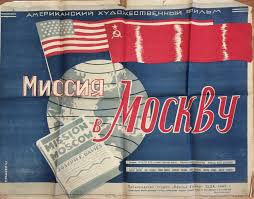
Mission to Moscow (1943, Michael Curtiz)
Uploaded 7 July 2023
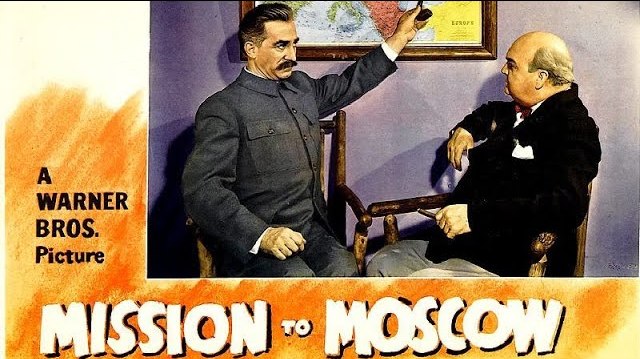
For much of cinema’s history, the U.S. government has engaged in various forms of political film propaganda. In the modern era film and video have communicated soft power, rather than the nation’s actual military might, producing public service messages, educational, and documentary films. Except for the periods of World War I & II, and Viet Nam, U.S. information agencies have seldom engaged in outright war propaganda. Eighty years ago, Michael Curtiz directed Mission to Moscow (1943), a film that openly regurgitated Stalinist Russian political agendas, the way today Trump World and many rightwing television broadcasters, transport Putin’s war strategy to an American audience. The Warner Brothers film’s wholly Communist view of the causes and aims of World War II, especially regarding the Stalinist Show Trials, stood in direct contradiction to prevalent American majority attitudes. Yet, President Franklin D. Roosevelt himself advocated for the film’s production. Based on a book by Joseph E. Davies, a book many American diplomats dismissed, Mission to Moscow was the only World War II narrative propaganda feature made with the direct participation of the Roosevelt Administration, the former Ambassador to Moscow, Joseph E. Davies, the wartime Office of War Information (OWI), and the Soviet Russian Ambassador in Washington, Maxim Litvinov; Litvinov had originally negotiated American’s recognition of the Soviet Union in 1933, fallen out of grace because he opposed the Hitler-Stalin Pact in the late 1930s, then sent by Stalin to Washington in 1941.
Conceived as a pro-Soviet, Anti-Nazi film, it was one of Hollywood’s many contributions to WWII’s cinematic war propaganda and an act of friendship with the present ally, the Union of Soviet Socialist Republics. Yet Mission to Moscow also released a storm of criticism for its falsification of recent history. Even OWI conceded in their evaluation (OWI No. 447, 19 May 1943) of the film: “The whole is a controversial topic… Some think that the film is excellent propaganda and will greatly help our relations with Russia, while others feel that the film does a great deal of harm… World events of great significance have been simplified or condensed.” John Dewey (Columbia University), ex-chair of the” Moscow Show Trials Commission, was more direct: “The film Mission to Moscow is the first instance in our country of totalitarian propaganda for mass consumption – a propaganda which falsifies history through distortion, omission or pure invention of acts…”
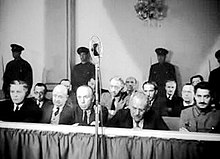
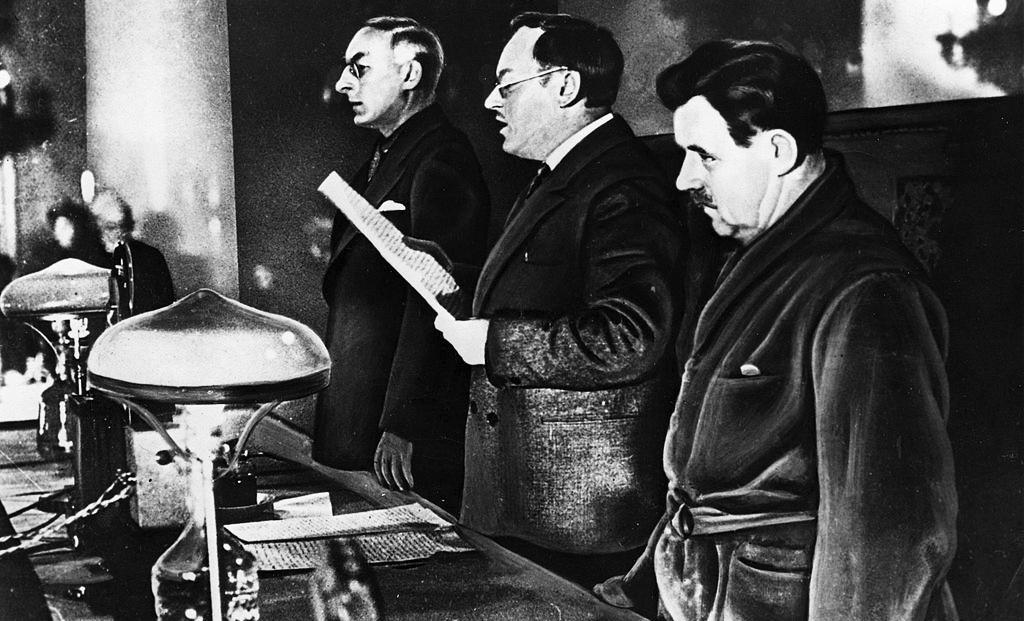
Director Michael Curtiz and scriptwriter Howard Koch portray Stalinist Russia as a democratic, almost capitalist country in which the common man is king, and Comrade Stalin rules as a benevolent, courageous, pipe-smoking defender of the Russian people. Mission to Moscow sought to counteract 25 years of anti-Communist propaganda, clearing the way for the average American’s support of Russia in the war against German fascism. The frame story has Ambassador Davies traveling through the Soviet Union, emphasizing he is a capitalist and a businessman who is skeptical of the Soviet Union, but learning that private initiative in the Russian workplace leads to workers earning more money. Capitalism at work. Copying the March of Time method, Mission to Moscow utilizes rapid montages, frame wipes, multiple exposures, quick dissolves, and a voice of god off-screen narrator to construct a fast-moving narrative that justifies the Moscow show trials as necessary to eliminate fascist fifth columnists in Russia, strengthen democracy and support the war against Nazi Germany while excusing the Hitler-Stalin Pact as a cunning maneuver to prepare for war.
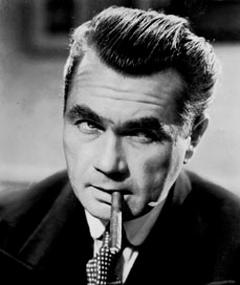
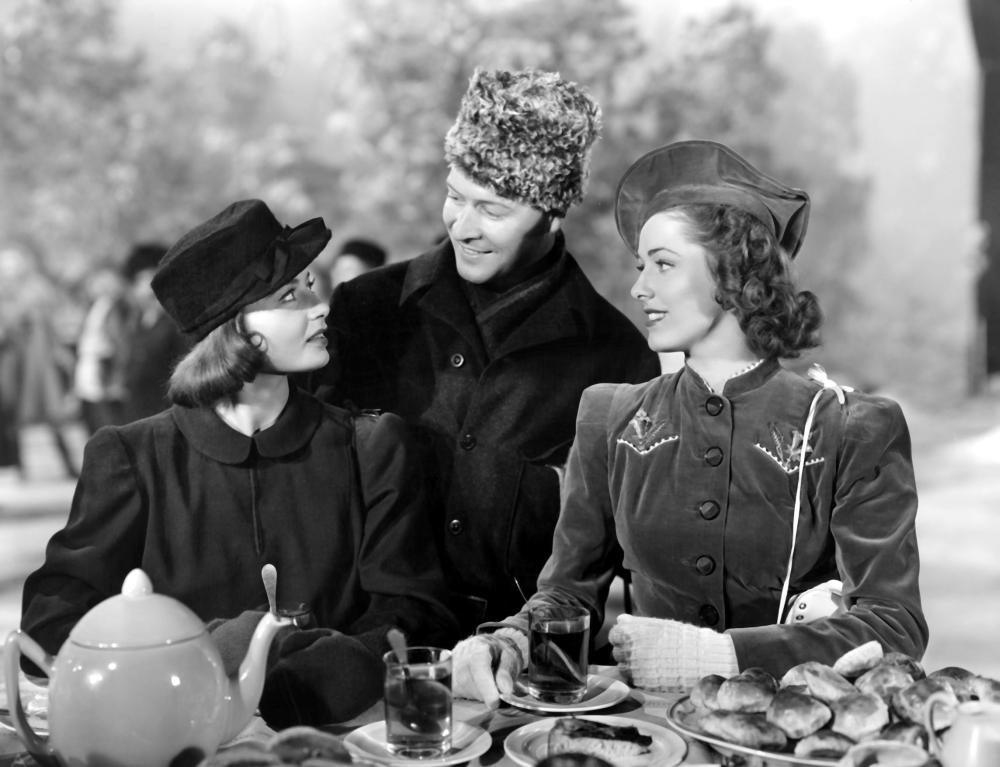
I first became interested in Mission to Moscow while writing my dissertation on anti-Nazi films in Hollywood made by German-Jewish refugees, and actually wrote a chapter about the film, but eventually discarded it. My focus was on the film’s anti-Nazi elements which argued that during much of the 1930s, only the Soviet Union – Litvinov – pleaded with the West to stop Hitler. That was true. Indeed, the film opens on the League of Nations in June 1936, when the German Ambassador leaves in protest after Litvinov calls for collective security; in fact, Germany left the League three years earlier. It then cuts to newsreel footage of Hitler riding through the streets of Nuremberg, while the narrator intones: “The world began to listen to a new voice.” President Franklin D. Roosevelt sends Davies on a fact-finding mission to Russia, since “Hitler seems bent on conquest, not only of Europe but the whole world.”
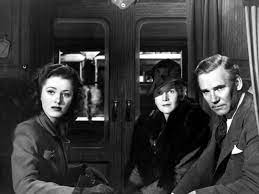
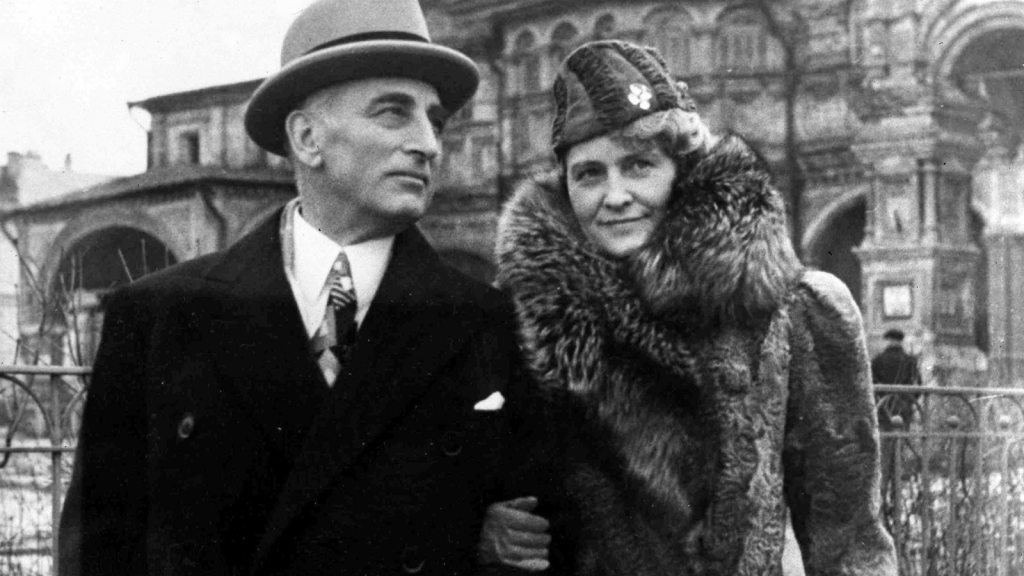
Traveling by ship, Davies disembarks in Hamburg where he sees a completely militarized society, dominated by Swastikas, marching soldiers, Hitler Youth, and Mein Kampf in every bookstore. In Berlin, he meets Hjalmar Schacht, the Nazi Economics Minister – he trusts bankers – but waits in vain for two weeks to see Hitler, while Foreign Minister von Ribbentrop undermines Davies’s efforts. In the Soviet Union, Davies travels throughout the country inspecting efficient factories, ready to be converted to war, but there are intimations of sabotage. Returning to Moscow and a white tie and tails reception, where the Spanish Fifth Column is invoked, Davies sees Nikolai Bukharin whispering to von Ribbentrop, setting the stage for his arrest and the subsequent trials of Bukharin, Karel Radek, Genrikh Yagoda, and Nikolay Krestinsky, also seen huddling at the reception.
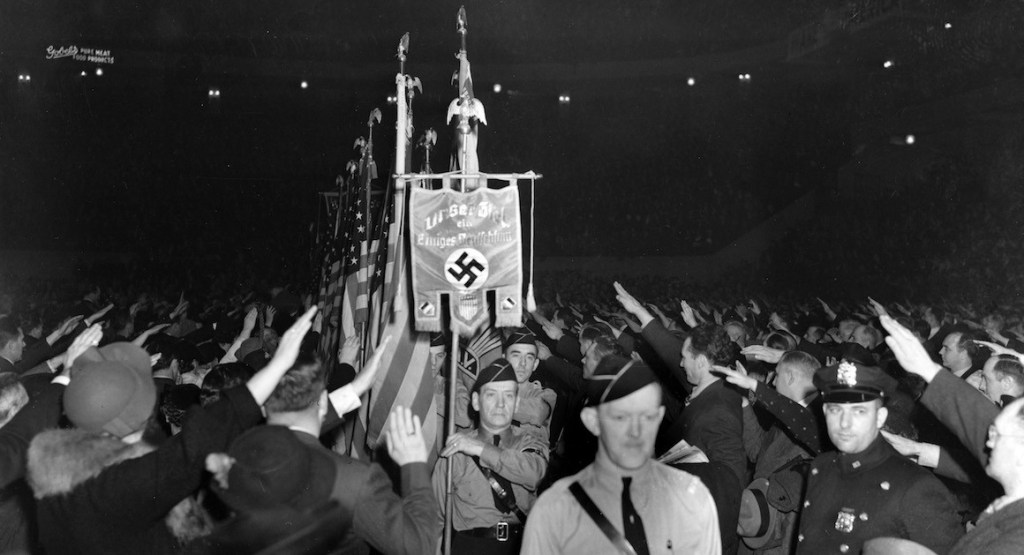
Minutes later, the film cuts to a Nazi Party rally with huge Swastikas in the frame, while we hear: “No this is not in Germany. This is a Bund meeting in New York City where Americans were brutally beaten for daring to interrupt the Führer’s friend.” Like the Soviet Union, America will be targeted by the Nazis. The subsequent show trials then “prove” that a Trotskyite conspiracy was helping Nazi Germany dismember the Soviet Union, just as the German-American Bund was undermining American democracy. Mission to Moscow then offers proof of Nazi aggression with the Austrian Anschluβ, the “tragic mistake” of Munich, and the Blitzkrieg. It further propagates Roosevelt’s signing of the Lend-Lease Act for Russian and British war aid, and for opening a “second front” against Germany, to relieve Russia’s war burden. D-Day, the second front, would only arrive a year after Mission’s release.
In the film, the Germans are stereotyped, conforming to the anti-Nazi film’s visual codes as unequivocal supporters of Nazism. Schacht and von Ribbentrop, the capitalist, and Junker appear with Nazi symbols in the frame, supporting left-wing political theories that explicated the rise of fascism as an alliance between big capital and the Prussian (militarized) aristocracy. Ordinary Germans speak too loud, click their heels, wear Swastikas, and espouse the New Order, as evidenced in the film by Hamburg’s Mayor, a uniformed party member, the train station master, a small businessman, and a diplomat. Ironically, while Davies is impersonated by Walter Huston, the Nazis are played almost exclusively by German-Jewish refugee actors, including Louis V. Arco, Felix Bash, Ernst and Lisa Golm, Erwin Kalser, Lionel Royce, Richard Ryen, and Alfred Zeisler, just as they had played similar roles in most Holywood anti-Nazi films because they had the right accent. It was a strange fate: the victims of Nazi terror were paid to imitate their persecutors in the movies.