359:   Pordenone Silent Films

Archival Spaces 359

Giornate del cinema muto/online

Uploaded 1 November 2024

This year’s Giornate del cinema muto again offered a small selection of ten feature films from the festival, as well as selected shorts, mostly little or never seen films from countries as diverse as France, Uzbekistan, Cuba, Germany, Mexico, and the USA. The films were available online for 48 hours through the MyMovies/It portal and presented for fans of silent film, a rare opportunity to see works that will probably never make it to your neighborhood theatre or even anywhere else online.

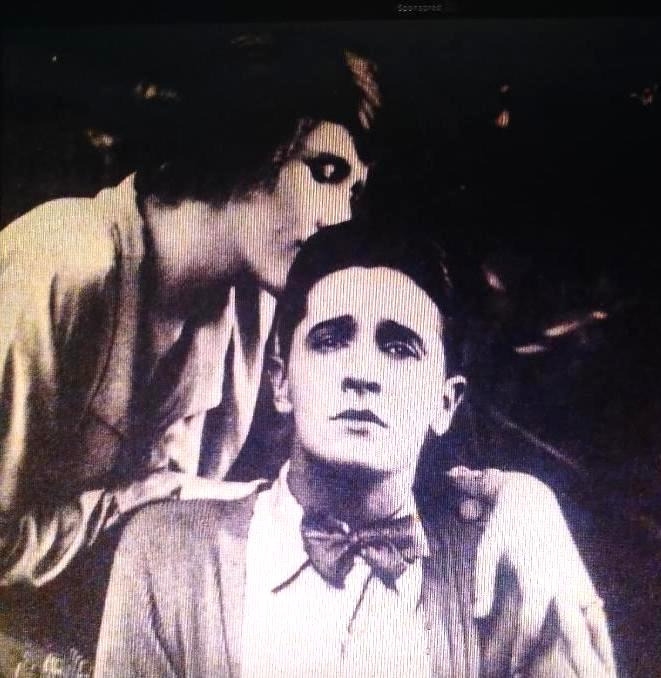
Phyllis Nielson-Terry, Ivor Novello
Ivor Novello

The online program opened with L’appel du sang/Call of the Blood (1919), a French film by Louis Mercanton, but included in the festival as part of the Sicily program of travelogues.  The film debut of British actor Ivor Novello, the work features incredible vistas of early 20th century Taormina, as well as documents of many local dances, costumes, and customs. Based on a 1906 novel by Robert Hitchens, the film concerns a wealthy English woman, Hermione Lester (Phyllis Nielson-Terry), who travels from her home in Rome to Sicily on holiday with her younger lover, Maurice (Novello), while maintaining an intense epistolary relationship with Emile Artois. Maurice becomes infatuated with a Sicilian peasant girl, Maddalena, while Hermione travels to North Africa, where her friend Artois has fallen gravely ill. After he seduces the girl, Maurice is murdered by the girl’s father, who then accidentally kills his own daughter. At graveside, Hermione realizes the truth. A wild melodrama for sure, but beautifully photographed with magnificent multi-color tints and tones and views of an Italy long gone.

Nadezhda Vendelin in Minaret of Death
Andrey Fayat, Ra Messerer in The Leper

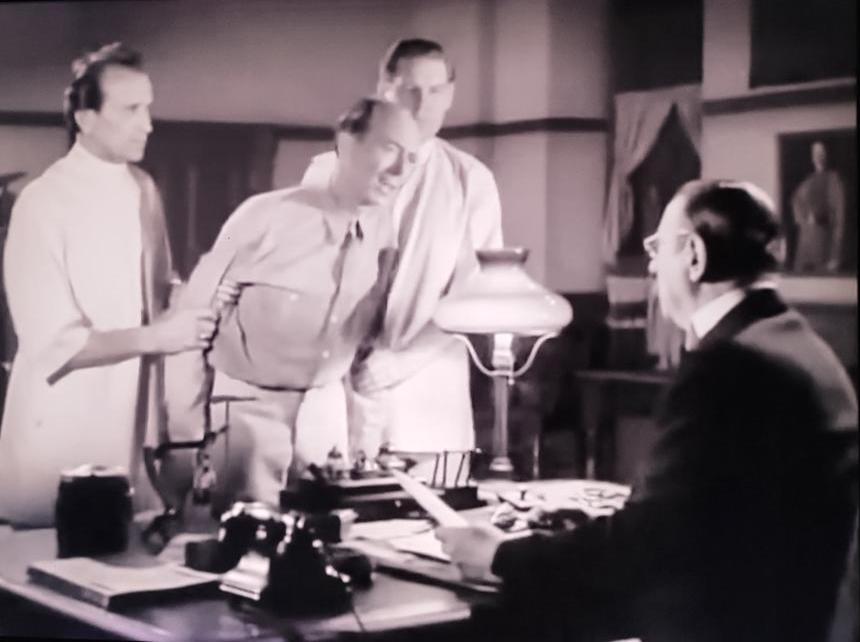
The first of two films from the Soviet Republic of Uzbekistan, Minaret Smerti/The Minaret of Death (1924, Vyacheslav Viskovsky) is nothing like the revolutionary films of the period, but rather a romantic adventure epic. Loosely based on a 15th-century Bukharan legend, a young woman, Dzhemal, and her foster sister are abducted by robbers when their caravan is attacked; they manage to escape and are eventually accompanied to their father’s house by Sadyk, a young nobleman. However, they are then captured by the Emir of Bukhara who offers Dzhemal as a prize in a competition which Sadyk wins, but she is then kidnapped by the Emir’s son who kills his father, leading to a revolution. There’s lots of fighting around the ancient walls of Bukhara, and many harem scenes with scantily dressed maidens, and exquisite costumes, but the Soviet authorities were apparently not happy with the film.

One wonders if the Soviets were any happier with the second Uzbeki film, Moxov Qiz/The Leper (1928). Directed by Oleg Frelikh, and based on a French novel,  Kamir. Roman d’une femme arabe, the film is extremely sophisticated in its narrative and montage:  Taking place in Czarist-controlled Turkestan, a beautiful young woman marries a wealthy merchant who beats her regularly, leading her to fall prey to a seduction by a decadent Russian officer. When her husband finds out, he sues her father in a Muslim Sharia court, leading to her abandonment. She is beaten to death on a country road after mistakenly entering a leper colony. The film implies that once a Muslim woman is divorced she is good as a leper. No revolutionary optimism here, although the film does attack the extreme patriarchy and misogyny of Uzbek/Muslim culture, e.g. when the father cruelly takes a young wife because the mother of his daughter is too old, or when it shows corrupt Czarist judges taking bribes. Frelikh likely fell prey to Stalin’s anti-Semitic and anti-ethnic cultural policy, since his last directed film was a Uzbeck production in 1931.

Ricardo Beltri, Elena Sánchez Valenzuela in Santa (1918)

Based on the famous novel by Federico Gamboa, Santa (1932) was Mexico’s first sound film, but there was an earlier version from 1918, directed by Luis Peredo. It is the age-old story of Santa, a young girl, seduced and abandoned, forced to move to Mexico City to become a prostitute, where she slowly sinks into the morass, despite the love of a blind pianist. The starring actress would become a pioneering journalist and founder of Mexico’s first film archive. While the sound version with Lupita Tovar is much more cinematically polished, the silent version retains the novel’s modernist focus on cityscapes but suffers from intertitles that overlong quotations from the novel.   

Miguel Santos, Diane Marde
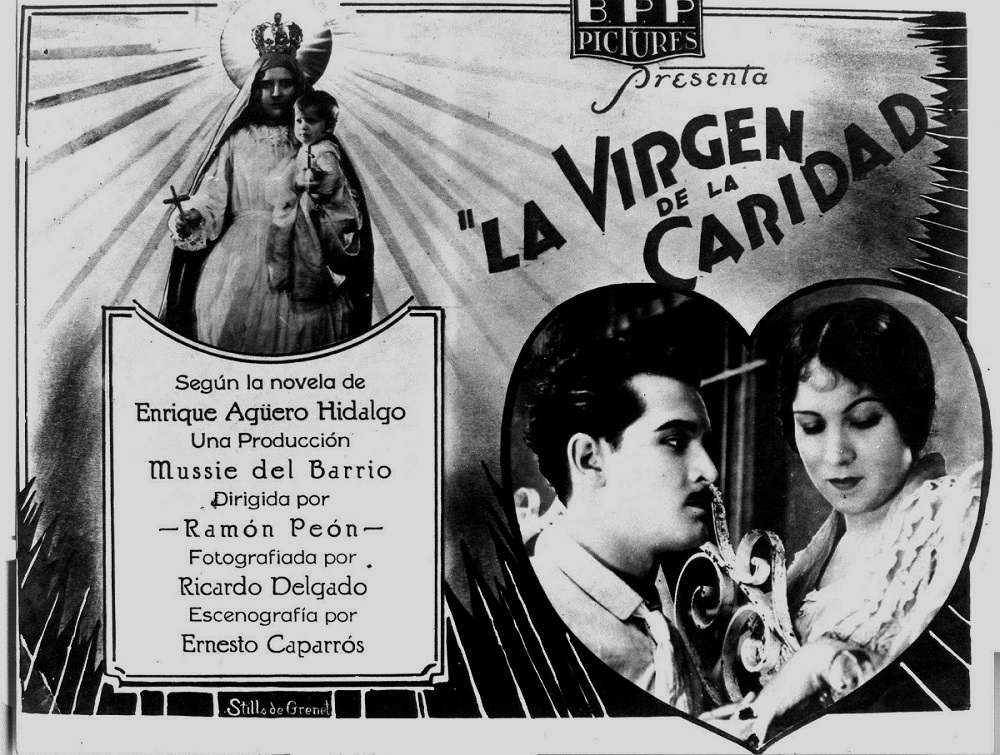
Francisco Herrero, Miguel Santos in La virgen de la caridad

The last Cuban film to be shot without sound, La Virgen de la caridad (1930, Ramón Peón) is a socially critical melodrama. Yeyo, a young peasant is in love with Trina, the daughter of a local landowner, but her father objects to her marrying below her station; a more “suitable” middle-class husband turns out to be a swindler who attempts to dispossess Yeyo from his farm. Happily, the “Virgin of Charity” intervenes, falling off the wall to reveal the original deed that proves the grift. A Griffithian chase on horseback brings the film to its climax. Highly praised at the time of release, the film’s leftist politics are manifested in a critical view of the plight of Cuban peasants – its hero the son of a dead revolutionary – and a distrust of the bourgeoisie, yet it is also infused with a belief in the power of prayer.  

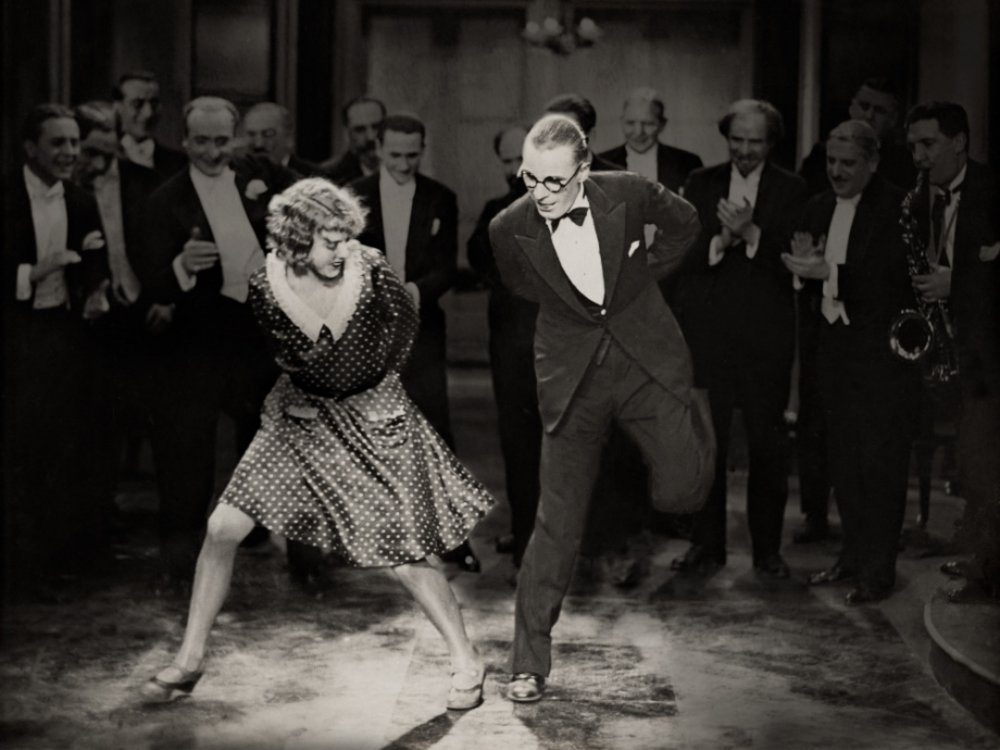
Anny Ondra, John Franklyn in Saxophon-Susi
Hans Albers, Anny Ondra

Starring Czech actress Anny Ondra, and directed in Berlin by boyfriend Carl Lamač, Saxophon-Susi (1928) is the kind of fluff Hollywood usually excelled in. She plays a baroness who would rather be a vaudeville dancer, so she trades places with her girlfriend who is being sent to the “Triller School” in London. The internationally famous Tiller-Girls, also prominent in many German films, practiced the kind of syncopated chorus line that became a staple of Flo Ziegfeld and later the Rockettes. On the boat train to London Anny meets a young British Lord who thinks she is a chorus girl, falls in love, and you can figure out the rest. There is a moment of unconscious racism when Anny and another dancer do an “ape dance” recognizable to contemporary audiences as a conscious parody of Josephine Baker’s 1920s dance routines. 

Mary Kidd, Heinrich George, Hans-Adelbert von Schlettow, Anna May Wong in Song (1928)
Anna May Wong

Song. Die Liebes eines armen Menschenkindes/ Show Life (1928) was the first of five films German director Richard Eichberg would make with Anna May Wong, and one of her most successful, making her a European star. Jack Houben, a former vaudeville knife-thrower saves Song from a rape and she becomes his partner, caretaker, and want-to-be-lover but he is still in love with his old partner, Gloria, while the impresario Prager pines after Song. A well-financed UFA-B.I.P. co-production, the melodrama is situated between the squalor of a port city’s slums and low-life cafés, and the upper-class milieu of classical ballet and fancy nightclubs, each of the characters trapped in a different erotic obsession. However, as an Asian woman of color, Wong is doomed to play the Madame Butterfly role, sacrificing herself repeatedly for the white man she loves.

While I loved seeing these films online, I hope to be in Pordenone next year, given that the on-site program is much richer.

Betty Blythe, Billie Dove, Jack Mulhall in Folly of Vanity (1924, Maurice Elvey)

358: Robert Rosen, R.I.P.

Archival Spaces 358

Robert Rosen (1940-2024)

Uploaded  18 October 2024

Robert Rosen at the 2017 FIAF Congress in Los Angeles (photo: Mikko Kuutti)

Robert Rosen, the former Dean of UCLA’s School of Theatre Film and Television(TFT), and Director of UCLA Film & Television Archive (FTVA), passed away on 2 October in Los Angeles. I owed a huge debt of gratitude to Bob, who hired me as Director of the Archive, against intense resistance from the archive’s staff and the Archive’s major funder, David W. Packard. I first met Rosen at the Brighton FIAF Conference in June 1978, when he was still a newbie to the International Federation of Film Archives and I had started a PhD. in Germany. After I moved to George Eastman Museum in 1984, our paths crossed continually, at FIAF, at the Film Archives Advisory Committee, and at other film archive events. At the 1987 FIAF Congress in Berlin, I strongly supported UCLA’s application for full membership and Rosen’s candidacy for the Executive Committee, which had met with resistance from the Eastern European Archives who supported a candidate from the Soviet block. It was still the Cold War. Bob never forgot that help and remained a loyal colleague. When I was out of a job in 2006, he named me administrator of the fledging Moving Image Archives (MIAS) program at TFT, while I in turn invited him after he had retired to attend the FIAF Beijing Congress in 2012, where he was able to renew contacts with old Chinese friends he had made in the early 1980s.

STelton School in Francisco Ferrer Colony, Stelton, N.J.

Rosen’s early life is shrouded a bit in mystery. He was born near Piscataway, N.J. on 29 December 1940 to Nathan and Fay Rosen, a carpenter and housewife. The second of three sons, Bob’s family had moved from New York to what he liked to tell people was the anarchist colony of Francisco Ferrer, where he spent twelve formative years; he often addressed me as Compañero. He received his B.A. in political science from Rutgers University and an M.A. from Stanford University in history.  In 1969 he entered the PhD. Program in history at Columbia University, where he also started teaching, then transferred a year later to the University of Pennsylvania, where a colleague eventually asked him to teach a film course. The course drew 500 students, and Bob had found his calling, according to Mary Daily, a journalist at UCLA.

Bob at early years at UCLA
Mary Lea Bandy, Bob, Chris Horak at FIAF Cartegena, 1997

In the Fall quarter of 1974, Rosen moved to UCLA for a one-year appointment at the Department of Film and Television in the School of Fine Arts. Almost a year later in June 1975, Rosen unified the Television Archive, which had been founded in 1965 by the Academy of Television Arts and Sciences, and the Film Department’s nitrate film collections under Howard Suber to become the first director of UCLA Film & Television Archive. Under Bob’s leadership, the Archive soon became the second largest moving image archive in the United States, its phenomenal growth accelerated by its close proximity to Hollywood and an enthusiastic staff of initially amateur preservationists.

Bob Rosen, Martin Scorsese at DGA Awards in 2008

Becoming a champion for film preservation, Rosen took a leave of absence in 1985 to become the founding director of the National Center for Film and Video Preservation at the American Film Institute, a short-lived organization that faltered due to funding issues and political resistance from the other major American film archives. Undeterred, Rosen next teamed up with Martin Scorsese in 1990 to found the Film Foundation, chairing its Archivist’s Advisory Council, which has had a lasting effect to this day on film preservation. He also became UCLA’s delegate for the National Film Preservation Board, after Congress appropriated funds for the National Film Registry in 1988. In 2008, Rosen received The Film Foundation’s John Huston Award for his significant contributions and commitment to film preservation and restoration.  He was also a mover and shaker in the development of Outfest and the Outfest Collection at UCLA. 

Robert Rosen at the 1984 FIAF Congress in Vienna (photo: Eva Orbanz/FIAF)

Two characteristics stand out in my mind about Bob. First, he was a tireless advocate for his many students and protégés. Among his flock, Geoffrey Gilmore moved from programmer at UCLA to head Sundance in the 1990s, Greg Lukow became head of the National Film Preservation Center, then to MPBRS at the Library of Congress, Michael Friend also worked at the NFPC, then moved to Sony, Steve Ricci became the first director of the Moving Image Archives Studies program. And it was Bob’s concern for training the next generation of film archivists that led him to support the establishment of MIAS, the first program of its kind, which was so successful that it had a 90% placement rate. Unfortunately, Rosen’s successor as Dean at TFT eliminated the program as part of her effort to erase all traces of Bob’s legacy; one can also argue that her lack of support for Bob’s FTVA eventually led to its restructuring as a mere department within UCLA Library.

Finally, Bob was an excellent negotiator, mediator, and compromiser.  It was thanks to Bob that David Packard became a major funder of the Archive, first purchasing the Hearst Metrotone Newsfilm Collection, then eventually funding a film preservation lab. When I took over FTVA, a staff member poisoned the well with Packard, even though we had had a good relationship when I was at Eastman. Six months after starting, Bob traveled with me up to Silicon Valley to visit with David and calm the waters; we returned to L.A. with a major funding grant to cover the significant deficit the Archive had incurred before my arrival. Bob just knew how to get along with anyone, even an eccentric. R.I.P. Bob Rosen.

Bob, Francis Ford Coppola, at Tetro (2009) premiere

357:  Babylon Berlin, Season 4

Archival Spaces 358

Babylon Berlin, Season 4 (2024)

Uploaded 4 October 2024

After Netflix canceled the excellent German TV series Babylon Berlin, at the end of Season 3, I purchased a DVD of Season 4. In the meantime, it has actually become available on MHz Choice, but dubbed into English (as are the previous 3 seasons),
so I’m happy I can watch the DVD because I love hearing the Berlin dialect although Inspector Gereon Rath’s Cologne accent is barely audible, except for a few soft Gs. The series is very loosely based on three best-selling Gereon Rath detective novels by Volker Kutscher, but while the novels are relatively realistic crime dramas, the TV series sensationalizes the novels into an expansive phantasmagoria of Weimer Republic tropes about popular culture and politics.

Liv Lisa Fries as Charlotte Ritter

For example, the central character of Charlotte Ritter, Rath’s love interest, is in the novels first a secretary with the police, then returns to college to study law, while helping Gereon solve cases; in the TV series “Lotte” starts out as a part-time prostitute and It girl, who joins the police force as an assistant, gets kicked off for helping her juvenile delinquent sister to escape custody but is finally asked to return (Ep. 12, S. 4) after almost single-handedly rounding up a criminal conspiracy of vigilantes. Gereon, on the other hand, has in the novels a brother in America and suffers under the shadow of his father who is a police commissioner in Cologne, and his accidental killing of a suspect, but he is neither haunted by his World War I experience and his supposedly dead brother in the trenches who morphs into Dr. Schmidt (or does he?), nor is he a cocaine addict, as in the tv-series. Finally, as a pastiche of popular culture and historical politics, Babylon Berlin freely mixes genres: political thrillers, detective/gangster films, sci-fi, medical films, musicals, and even avant-garde cinema.

Referencing 1920s avant-garde film techniques, the title sequence is itself a post-modern montage of German Expressionism, kaleidoscope images, and flashing views from history, seemingly culled from newsreels, but actually recreating the feel of the late Weimar Republic through digital technology. Each episode begins with an iris, a silent film anachronism that calls attention to its own artifice. With the story of Toni Ritter, Lotte’s sister, the film takes us into the slums of Berlin, recalling late Weimar proletarian films, like Mother Krausens Trip to Heaven (1929). Episode 11 includes a flashback that employs Lotte Reininger’s cut paper silhouette animation in The Adventures of Prince Achmed (1926), a signature film of the Weimar film avant-garde, to reveal the origin of the “Blue Rothschild” diamond. All episodes end with the credits scrolling over a clever computer-generated recreation of Walter Ruttmann’s Opus 1 (1921), the director’s first abstract animation.

Meret Becker as Esther Kasabian, aka Esther Korda

Throughout the series, choreographed musical numbers are interpolated for both spectacle and entertainment; Season 4 begins with a New Year’s Eve Party given by the psychopathic industrialist Nyssen, a reference to steel magnet Fritz Thyssen who was incarcerated in an insane asylum by the Nazis, but was not insane. Two episodes show Charlotte participating in a dance marathon, a phenomenon which was hugely popular in America in the 1930s, but unknown in Weimar; numerous other musical numbers also take place at the “Moka Efti” nightclub, shot in the former Delphi Cinema in Berlin. Later, Esther Korda, a gangster’s wife, auditions at a smaller club, after the Moka Efti is closed, where she served as star attraction and proprietress.

Mungo, der Schlanentöter (1927)

Dr. Schmidt’s numerous experiments, executed on Rath and others, reference Dr. Mabuse and the UFA’s first medical films, as well as Fritz Lang’s sci-fi epics, like Metropolis. In Episode 1, Schmidt immerses Rath in clear fluids, hooking him up to electrodes, like some Dr. Frankenstein monster; later Schmidt has a small weasel attack a wolf four times its size and kills it after it has been shot full of amphetamines. He next tries the same “speed” experiment on the diminutive Rath, who proceeds to beat a much larger man to a pulp, both sequences referencing Mungo, der Schlanentöter/Killing the Killer (1927), in which a mongoose kills a deadly cobra. One of the last images of the Season is of a courtyard full of war veterans who have been transformed into an army of grey-clad automatons, ready to conquer the world, another Metropolis reference.

Volker Bruch as Gereon Rath
Mark Ivanir as Abraham Gold, aka Goldstein

While Kutscher’s third novel, Goldstein, has a Jewish-American gangster possibly inciting a gang war in Berlin though actually only trying to help his terminally ill uncle, Season 4’s Goldstein is trying to recover the blue diamond stolen from his orthodox grandfather by the Nyssen family. Like classic American gangster films, the series features a St. Valentine’s Day-like massacre with Tommy guns, incited by the rivalry between two gangster bosses who also happen to be amorous rivals for the affection of Esther Korda. Rath is partially responsible for the massacre because he had attempted to negotiate a peace treaty between rival gangs at police headquarters. While crooked cops, standard in any American gangster film, also make an appearance here, they are part of a vigilante conspiracy, while lining their own pockets. Finally, these German crime families, as well as Alfred Nyssen dress like American gangsters. Boxing, a popular sport in Weimar, like indoor bicycle races, is also controlled by gangsters.

Lars Eidinger as Alfred Nyssen, Hannah Herzsprung as Helga Rath, Holger Handtke as Wegener
Joachim Meyerhoff as Judge Voss

While previous seasons had exposed a Reichswehr conspiracy to undermine the Republic through secret rearmament, Weimar is threatened here by a secret vigilante organization, “the White Hand,” made up of reactionary judges, prosecutors, and police. The White Hand is pure fiction in this political thriller but the judiciary in Germany indeed contributed mightily to the end of the Republic by consistently coddling right-wing assassins, including Hitler, while mercilessly hounding perceived leftists. Shockingly, we see Gereon Rath in a Nazi S.A. uniform – the German police was riddled with Nazis, despite legal prohibitions – but learn he is working undercover to ignite a gang war between the rival Stennes and Hellldorf S.A. factions of the Nazi Party. Indeed, a revolt of the Berlin S.A. against Hitler by Walter Stennes had in fact occurred in August 1930 and again in March 1931. Nyssen who supports the Nazis, as did Thyssen, Krupp, and many other German industrialists, is developing an offensive missile as a weapon of mass destruction, something that would not actually occur until the 1940s with the V-2 rockets, although Werner von Braun’s experiments had begun in 1930 when he was a doctoral student.

Gereon Rath in uniform
Saskia Rosendahl as Malu Seegs, Benno Fuermann as Col. Gottfried Wendt

German producer/director Tom Tykwer has announced a final and fifth season of Babylon Berlin, which should please fans of this engaging potpourri of Weimar history and cinema.

Pit Bukoski as Erich Ritter

356 Bonn Silent Film Fest

Archival Spaces 356

Bonn Silent Film Festival

Uploaded 20 September 2024

Johannes Meyer, Astrid Holm in Master of the House (1925, Carl Theodor Dreyer)

The 40th iteration of the Bonn International Silent Film Festival took place from 8 – 18 August 2024. Over eleven Summer evenings, the open-air festival screened twenty-two silent features and shorts from eleven countries, always accompanied by live musical performances. As in the past few years, the festival under the curatorship of Eva Hielscher and Oliver Hanley is also streaming about half the program, which has greatly increased the reach and fame of the festival. Ten films were available for 48 hours online, beginning 10 August.

Streaming began with Du skal ære din hustru/Master of the House (1925), Carl Theodore Dreyer’s feminist Kammerspiel screened in an excellent print/file with a beautiful score by Sabrina Zimmermann and Mark Pogolski. Strangely, Bonn’s program notes downplay the film’s status in the Dreyer oeuvre, saying it “cannot be considered a great film,” even though many film historians now rank it among Dreyer’s silent masterpieces. Confined almost exclusively to a small lower middle class flat, the film portrays an authoritarian pater familias who treats his wife and children as personal slaves. With the help of an old nanny, wonderfully played by Mathilde Nielsen, the husband is knocked off his high horse, while the wife escapes to a much-needed rest in the countryside. Dreyer’s actors walk a fine line between comedy and melodrama, while George Schnéevoigt’s documentary camera roves through the flat, capturing minute details and the mise en scene tracks the shifting power relations within the family. Like La Passion de Jeanne d”Arc and later Dreyer films, Master of the House exploits the formal device of confined spaces to invariably entrap its subject.

Crossways (1928)
Akiko Chihaya, Junosuke Bando in Crossways (1928)

Teinosuke Kinugasa, best known for his Oscar-winning color film, Gate of Hell (1953), directed Jûjiro/Crossways (1928), two years after his expressionist masterpiece, A Page of Madness (1926). Like the latter film, Kinugusa employs expressionist techniques and a complete catalog of cinematic tricks to portray the fever dream-like madness of Yoshiwara, the red-light district of ancient Tokyo, where a brother and sister attempt to survive in squalor. The brother falls prey to a l’amour fou with the district’s most famous courtesan, is temporarily blinded by a rival, forcing his sister into prostitution to raise money for his recovery, all for naught. Kinugasa’s sympathies lie with his poor protagonists, surrounded by the false glitter of Yoshiwara’s non-stop carnival.  Kinugusa stages the red-light district as just another kind of insane asylum, with the queen of the prostitutes and her minions laughing hysterically through much of the film.

Organist of St. Vitus (1929)
Suzanne Merville in Organist of St. Vitus (1929)

I had previously seen the Czech film, The Organist at St. Vitus Cathedral (1929) at the San Francisco Silent Film Festival, but it was worth a second look. Both film noir and atmospheric melodrama, shot mostly in real locations around Prague’s Hradčany Castle, its magnificent Cathedral, and Alchemist’s Alley. The film concerns an aging organist and a nun who leaves the order, brought together by her father’s suicide in the organist’s tiny home, complicated by a neighbor’s blackmail scheme. Martin Frič privileges spaces with floor and ceiling visible, i.e. realism, yet mixes in expressionistic imagery to communicate emotional content, and despite heading towards tragedy, offers an over-determined American style happy ending that almost seems parody in its excess. 

Seeta Devi, Himansu Rai in Die Leuchte Asiens (1925, Franz Osten)

 In 1924 the Bavarian film director, Franz Osten, the brother of Emelka Studios founder Peter Ostermeyer, traveled to India to shoot The Light of Asia (1925), a filmed biography of the founder of Buddhism, co-financed by the Indian actor Himansu Rai, who also played the starring role. Shot exclusively on location in India, the film presents both an extended tourist view of India and its ancient monuments, as well as the story of Siddhartha, based on the epic poem by Edwin Arnold (1879) and Hermann Hesse’s eponymous novella, published in Germany in 1925. The first two-thirds of the narrative illustrate the Buddha’s growing disenchantment with the material world (he is a prince), while in the final third, we see his wife Gopa (Seeta Devi)  search for him, as he casts off all signs of wealth to become a beggar and teacher. Apart from the sumptuous images, the film’s amazing score of Indian music by Willy Schwarz and Riccardo Castagnola made the film an unforgettable experience.

Werner Kraus, Lya de Puti in Eifersucht (1925)
Schüfftan process shot in Eifersucht (1925, Karl Grune)

Karl Grune’s Eifersucht/Jealousy (1925) moves from the lower middle-class expressionist milieu of Grune’s Die Strasse (1925) to the drawing rooms of the wealthy, where a marriage (Werner Krauss, Lya de Putti) is sorely tested by bouts of jealousy. Except for a street lamp scene, and the husband’s subjective view of his wife dancing with a stranger in a crowded ballroom, expressionism has been replaced here by Neue Sachlichkeit, sumptuous décors and UFA-studio designed cityscapes that seem influenced by Lubitsch’s and DeMille’s social comedies, however, without the irony. Produced by Erich Pommer, Jealousy‘s privileged milieu is in keeping with Weimar’s economic recovery after the Dawes Plan and the end of inflation. The film’s happy end, despite a near murder, reflects briefly both New Realism’s and the German Republic’s optimism about the future.

The Swedish film, Thora van Deken (1920, John W. Brunius) begins seemingly with an inheritance swindle, when a corrupt lawyer and estate manager dupe a wealthy landowner to change his will on his death bed in their favor, but morphs then into a melodrama involving a widow’s perjury, when she claims falsely to have destroyed her husband’s last will, to secure her daughter’s inheritance.  Pauline Brunius as the protective mother gives an amazingly nuanced performance, caught between her allegiance to her daughter and her sense of morality. Unfortunately, in trying to capture the expansive novel by Henrik Pontoppidan, the director inserts too many flashbacks, complicating the narrative flow. Nevertheless, the film reveals many of the atmospheric qualities of Seastom and Stiller.

Maria do mar (1930, José Leitão de Barros)

The Portuguese Maria do mar (1930, José Leitão de Barros) is an avant-garde film from the political right, experimenting with film technology, down to the Vertovian climactic chase to save a child, but embodying conservative cultural values.  It also freely mixes film genres. Part documentary about the hard life of fishermen, made a year after John Grierson’s Drifters, part ethnographic film in its documentation of village dances and funerals, part melodramatic Romeo and Juliet story with a little situation comedy to lighten things up, given that the central drama concerns a blood feud between two mothers, begun when a fisherman drowns and his wife blames the boat’s skipper. Utilizing amateur actors, the film’s performances are more than credible, visualizing the viciousness of the ancient village gossips, ending in two old women beating each other up on the street.

The international scope and aesthetic quality of Bonn’s silent film program is exceptional, as are the musical performances by such musical stars as Maude Nielsen,  Stephen Horne, and Neil Brand.

La femme et le pantin (1929, Jacques de Baroncelli)