363: M&K Controversy

Archival Spaces 363

Mitchell and Kenyon Discovery in Dispute

Uploaded 27 December 2024

Blackpool Pier (1904, Mitchell & Kenyon)

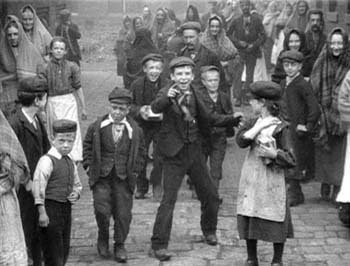
I can’t quite remember when I first saw the Mitchell and Kenyon films but Andrea Leigh tells me it was at the AMIA Conference in 2001 when the British Film Institute first began circulating 35mm prints of their restorations. I was truly astounded by the clarity and detail of these non-fiction actualités, so unlike most of the washed-out and grey Edison and Lumiere films I had seen from the turn of the last century. It was as if you were actually looking through a window onto the world of 1900, the clothing and the faces looking back at you felt tactile, immediate, real. Sagar Mitchell and James Kenyon had operated a local film production company between 1897 and 1913 in Blackburn, England but had previously warranted only a footnote in British film history, the glory going to Brighton filmmakers, like G.A. Smith and James Williamson. Their films of workers leaving factories, local processions, and parades, shot in the small towns of the industrial North of England and Ireland were often produced on spec for fairground operators so that local audiences could see themselves in the movies. As founding editor of The Moving Image, I published a piece in Fall 2003, co-authored by Vanessa Toulmin, which argued that the discovery of the M&K films in June 1994 forever changed our sense of British cinema history.

Sagar Mitchell, n.d.
Original M & K negatives, purchased by Cinema Museum

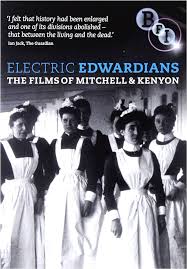
According to Toulmin, workmen demolishing Mercers Toy Shop in Blackburn, an establishment previously owned by Mitchell until 1960, had found three metal drums filled with 826 short camera negatives. Toulmin, now a professor at Sheffield University, and founder of the National Fairgrounds and Circus Archive, as well as the academic most responsible for disseminating the collection in the modern era, goes on to quote Peter Worden, after whom the M&K Collection at the BFI is now named: “All were crammed solid with film, and if I didn’t ‘rate’ them, they were going into the skip.” I contacted the foreman of the work gang and, curbing my excitement, arranged for them to be delivered to me.” (p. 5) In July 2000, the collection was turned over to the BFI for restoration, resulting in a host of book publications and DVDs, including Electric Edwardians. The Films of Mitchell and Kenyon (2005), available in America through Milestone.

On the Beach, (n.d., M&K)

So much for the official story. But why had it taken six years before restoration began? Toulmin noted in an email to me (12-16-24) that Worden had spent £ 20,000 trying to restore the films himself, before turning them over to the BFI and that Anne Fleming at BFI and Janet McBain at North West Film Archive had negotiated with Worden for much of that period. But Nigel Garth Gregory, owner of Gregory Audiovisual in Blackburn, tells a different story in an undated blog (maybe 2005) on his website (https://gregoryav.co.uk/the-mitchell-and-kenyon-film-collection/). According to Gregory, the Irish workman who found the churns, first brought them to his video store to see if they were valuable. Not being a film historian, but a video techie, Gregory called Peter Worden, his optometrist who he knew to collect old films. When he heard where the films had been found, he almost immediately identified them as Mitchell and Kenyon films and asked Gregory to negotiate a price of £50 for their purchase. Worden placed the films in a freezer, then registered himself as a finder with his solicitor – a property that is not claimed after six years becomes the legal asset of the finder. Gregory never heard from Worden again and when the films began circulating, it was under the guise of the Peter Worden Collection.

Cildren of Factory Workers (n.d., M&K)
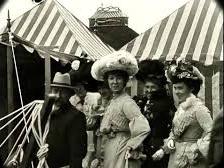
On the Fairgrounds (n.d., M&K)

How true is this story? I have no idea. Worden has disputed Gregory’s claim. But the timeline does give one pause, and it’s interesting to note that Worden is no longer identified as the discoverer, e.g. in  the Giornate del Cinema Muto program in 2003 when an 80-minute program of Mitchell and Kenyon films screened, the wording is as follows: “They were not rediscovered until the 1990s when Blackburn businessman and local historian Peter Worden retrieved them” 

To be clear, Worden never tried to financially profit from the collection, but in my long experience as a film archivist, film collectors are a jealous lot, and many have rightly or wrongly claimed to have discovered lost films or owned the best surviving material. Sometimes did, sometimes they didn’t. Every film collector dreams of finding Lon Chaney’s London After Midnight (1927).

Procession (n.d., M&K)

What seems more important is that the impact of that discovery has changed our notion not only of early British film production but also of early film exhibition. Before this discovery, film historians of early cinema tended to follow the American line that vaudeville and music halls were the primary sites of exhibition, followed by Nickelodeons.  With the work of Vanessa Toulmin in Britain and Claude Bertemes and Martin Loiperdinger in Germany, we now know that ambulatory tent cinemas at fairgrounds and carnivals were much more important in Europe in disseminating this new medium of the 20th century. It was no accident that so many of the M&K films were produced for fairground operators.

English Bourgeoisie leaving Chapel (n.d. M&K)

362: Ufa Musicals 2

Archival Spaces 362

Kurt Gerron’s Ein toller Einfall (1932)

Uploaded 13 December 2024

Ein toller Einfall (1932, Kurt Gerron)

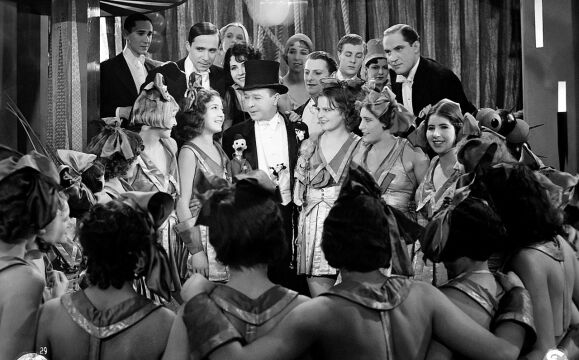
Back in June, I wrote about the UFA film operettas of the early 1930s, noting that many resisted the move to classical Hollywood narrative, displaying instead a high degree of self-reflexivity, employing direct address, featuring both song and dance, and emphasizing the artificiality of their settings in a mythical Europe. The cohort of UFA directors included Kurt Gerron, the German-Jewish actor-director and cabaret performer, whose films completely jettison any semblance of plot to create a cabaret of music, dance, and comedy. This was especially true for his 1932 production, Ein toller Einfall (A Mad Idea), which was loosely based on a boulevard farce (1890) by Carl Laufs, and scripted by Philipp Lothar Mayring and Fritz Zeckendorf. The film starred Willy Fritsch, Dorothea Wieck, Ellen Schwanneke, Rosy Barsody, and a host of character actors, including Max Adelbert, Jakob Tiedtke, Paul Hörbiger, Theo Lingen, Adele Sandrock, Oskar Sima, and Wilhelm Bendow.

Willi Fritsch, Ellen Schwanneke
Harry Halm, Fritsch, Dorothea Wieck

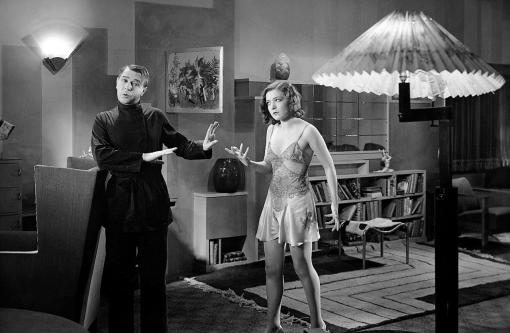
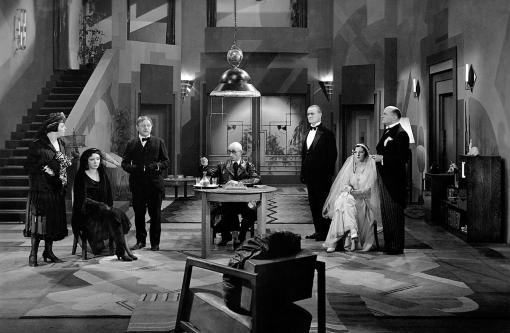
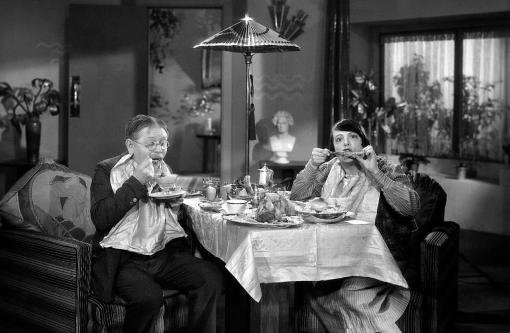
A Mad Idea takes place in an unnamed Swiss ski resort (location: St. Moritz), where Paul Lüders (Fritsch), an artist and nephew of a cash-poor millionaire, Michael Lüders (Tiedtke), moves into his uncle’s villa to escape his many ex-lovers. There, his art dealer sidekick, Birnstiel (Adelbert), begins inadvertently renting out rooms. Soon they are running a hotel, while a gaggle of ladies pursues Paul, including ex-girlfriend Anita (Barsony), Evelyn Müller (Schwanneke), the daughter of the head of the “Miller Girls” dance troupe (Leo Slezak), Mabel Miller (Wieck), the daughter of a prospective buyer for the villa, Marga (Genia Nikolajewa), the wife of a composer, and, of course, the Miller Girls. Paul falls for Evelyn but thinks she is Mabel, all the while fighting off Anita. Other couples form and split. Apart from the romance threads, there are subplots and running gags reinforcing the insanity. Like Gerron himself, of whom the critic Paul Marcs (PEM) wrote, “He shoots sentences. Words are whipped. Their rhythm electrifies, allowing no resistance. Speed and agitation breath down his back,” the film is frenetic, e.g. Borsody manically dancing in almost every scene, even alone in the hotel corridor. Indeed, numerous plot confusions highlight its carnivalesque narrative structure, a cabaret with musical and comedic sketches, set pieces around Alpine tourism, spiced with plenty of visual barbs against the wealthy.

Jakob Tiedke

Indeed, the film begins with a visual joke re: the rich: Following panoramic images of the Alps behind the credits, Uncle Lüders enters a neo-classical building (the tax authorities) from his limousine, then he and a dozen others leave in their underwear and ride away on scooters. It’s a dream, but then a taxman arrives. In another scene, Birntiel rants about the rich, who he expects to “bathe in champagne and spend money,” not haggle over the price of a hotel room, as does Evelyn. Birnstiel likes order, so he throws the framed photos of Paul’s harem in the trash and cancels his dates with dozens of women, dutifully checking them off the list. Birnstiel introduces the St. Moritz location with a self-reflexive description of Alpine stereotypes, a visual parody of travelogues. In a similar vein, Gerron references Ernst Lubitsch’s door fetish with an extended final scene in the hotel’s long corridor, as guests frantically search for their desired or real mates in the chaos of doors slamming.  

Rose Barsony, Fritsch
The Miiller Girls (otherwise uncredited)
Schwanneke, Miller Girls

Born Kurt Gerson, Gerron had started his career on the legitimate stage – he played Tiger Brown in Brecht’s “Three Penny Opera,” – then gravitated to cabaret in the late 1920s, forming the Jewish comic duo “Beef and Steak” with Sig Arno in their own short-lived cabaret. In 1931, UFA hired him to direct a series of six cabaret short films for producer Bruno Duday, the latter also producing Ein toller Einfall. The film’s two hit songs were written by Fritz Rotter (music by Walter Jurman and Bronislav Kaper), who all specialized in cabaret Schlager. Small wonder that Gerron gives a wide berth to his comedians and their Schticks. For example, Wilhelm Bendow who plays a guest allergic to noise of any kind is constantly confronting loud guests, then gets drunk and becomes himself a nuisance. Paul Hörbiger plays a dim-witted butler but spends most of the film sampling the villa’s wine cellar and holding drunken soliloquies. The head waiter, Theo Lingen, continuously insults the guests, his smarminess in keeping with his star persona. Max Adelbert as Birnstiel is fast-talking throughout with an acid wit.  Finally, I recognized Julius Falkenstein in a cameo as a pedantic hotel guest who pointedly corrects Paul’s grammar in the hotel corridor before disappearing. He is not credited in the print, nor in any filmographies but the tall, lanky Falkenstein was under contract at UFA. The actor was featured in no less than 26 films in 1932, many of them cameos, after appearing in The Congress Dances and Berlin Alexanderplatz, two major successes. He had also played a major supporting role in Lubitsch’s The Oyster Princess (1919), as had Jakob Tiedke, reminding viewers again that Jewish humor was very much at work here.

Julius Falkenstein, Fritsch

Ein toller Einfall opened in Berlin in May 1932. Within a year, tragically, numerous participants would be blacklisted by the Nazis for being Jewish, including Falkenstein, Barsony, Schwanneke, Nikolajewa, Rotter, Jurmann, Kaper, Harry Halm, and Ferdinand Hart. Even before the official Nazi blacklist was in place, Gerron and writer Fritz Zeckendorf were fired from the UFA on 1 April 1933; both were later murdered in Auschwitz.   

Friysch, Barsony

361: Accidental Archivism

Archival Spaces 361

Accidental Archivism: Shaping Cinema’s Futures with Remnants of the Past

Uploaded 29 November 2024

Decomposing 16mm film

As anyone knows, who has been following the fortunes of AMIA (Association of Moving Images), film preservation before the 1980s was the purview of major, mostly state-funded, national film archives, which felt responsible mainly for fiction feature films. Since then, countless smaller often privately financed moving image archives have sprung up, which are more concerned with previously neglected genres, like industrial and amateur films, TV news programming medical films, etc. making them accessible through digitization. Recently, Stefanie Schulte Strathaus and Vinzenz Hediger published AccidentalArchivism: Shaping  Cinema’s Futures With Remnants of the Past (Meson Press, 2023), which presents not only the preservation efforts of many smaller international archives, but also of individual filmmakers, critics, and historians, especially in the so-called Third World. Most of the projects introduced here originated in and around the Berliner Arsenal-Institut für Film und Videokunst, which since 1963, has gathered together an impressive collection of experimental, documentary, and art films, many the only surviving copies, usually in connection with its long-standing film programming (including its annual “Film Forum” at the Berlinale).    

The title, Accidental Archivism refers not only to the preservation and accessibility of historic film material, but also to the accidental discovery and recovery of such films/videos, and their preservation in political and social contexts, where the major national archives have apparently failed. Sonia Campanini writes, e.g. in her essay: “Such fortuitous discoveries are often followed by a moment when the accidental encounter unfolds in incidental care, a point in which a single person, collective group, or institution decides to take in charge that object, to claim responsibility over that document, to deal with the memory inscribed in its material“ (p. 74). With no less than 45 contributors, the monograph is less a critical or historical analysis, than a contemporary survey, plaidoyer, and manifesto of a new generation of media archivists.

   SOLEIL Ô (1970, Med Hondo, Mauritania)
Manilla in the Claws of Light (1975, Lino Bracka, Phillippines)

Several theses about film/video archiving history can be culled from the collected essays. Some authors accuse European archives of „the global North“ of practicing a form of neocolonialism because they have collected films from Africa, South America, and Asia, but prevent or severely curtail through legal restrictions their circulation in the countries of origin (p. 399). This thesis is at the very least debatable, given for example the work of Martin Scorsese’s Film Foundation which for years has restored important films from the Third World and made them digitally accessible through commercial partners.  Furthermore, the Berlin Arsenal and this publication also counter that assertion.

Gay Turkish Women protesting

Another thesis can be formulated as follows: Since the established film archives employ aesthetic criteria in their selection process, they neglect unfinished films, outtakes, uncut or unidentified material which Vincent Hediger calls „scrap films“(p. 49). Just how important such material can be for the identity and history of repressed communities is illustrated in numerous essays, whether in Nigeria, in the queer communities of Turkey, in the women’s collectives of Indonesia, or the film estates of documentary filmmakers, like Harun Farocki. Such material can serve as raw material for other films.

Ellen Harrington (DFF), Edmund Peters (NFC), graduate National Film Institute, Prof. Tor Iorapuu (University Jos), Stefanie Schulte Strathaus (Arsenal), Prof. Vinzenz Hediger (Goethe-University), Didi Cheeka (Lagos Film Society) and unidentified journalist. (Photo: Fabienne Wolf)

Especially film archives in Africa and Asia suffer from inadequate funding, infrastructure, and expertise, to properly store and digitize their patrimony while humid climates also do their part to decompose collections. In such cases, accidental archivists sometimes move in, e.g. in Nigeria, where with the help of the Arsenal a film archiving training course was established. In some countries, where the original film producers are politically under attack, even forced to emigrate, films disappear completely and are only reconstructed years later.

Cinemateca Brasiliana fire, 29 July 2021

What unifies all of the contributors in the volume is an activist archival politic, which sees the work of archivists not only as a passive or reactive collecting of moving image media, but also considers film preservation, film programming, and historical criticism as inseparable activities. Thus, curators become archivists, and film archivists become historians so that the visual record is not only preserved but also points to the future.

Accidental Archivism is therefore highly recommended reading for media archivists, curators, and film historians alike, while bibliographies at the end of every chapter encourage further reading.

Film vaults of Berlin Arsenal

360:  Euthanasia in Film

Archival Spaces 360

Ich klage an / I accuse (1941)

Uploaded 15 November 2024

Documentary image of patients being loaded into busses for T4-Aktion (1939-41)

My German-born mother once confessed to me that she was in favor of mercy killing if someone was terminally ill because as a teenager in Cologne, she had seen Ich klage an (1941), Wolfgang Liebeneiner’s propagandistic endorsement of euthanasia, lavishly produced under close supervision of Joseph Goebbels. Having just reviewed Barbara Hales’ excellent new monograph, Transmitted Disease. Eugenics and Film in Weimar and Nazi Germany (Berghahn, 2024) for Medienwissenschaft, I had to think about my mother who told me that story when she was dying of cancer. I had rewatched Ich klage an after finishing the review but I wasn’t going to blog about it, until, by total accident, I viewed Berlin Correspondent (1942, Sidney Lanfield) on YouTube, a film I had not previously seen in my anti_nazi film research. Made less than a year after Ich klage an’s German premiere the American film directly responded to the prior film with an expose on Nazi euthanasia.

Ich klage an (1941) with Heidemarie Hatheyer, Paul Hartmann

Ich klage an pursues two separate narratives. In the first, Hanna, a beautiful, young, and vivacious woman, played by Heidemarie Hatheyer, is married to a famous research Professor of Medicine (Paul Hartmann). She contracts multiple sclerosis, finally asking her husband to poison her before she suffocates in the disease’s final stage. She dies a wonderful, romantic death in the arms of her husband, happy and pain-free. It is implied that both are aetheists, as was the National Socialist state. The Professor is put on trial but is acquitted when his close friend (Mathias Wiemann), a doctor who had turned down Hanna’s request for assisted suicide on moral grounds, has a change of heart about euthanasia. He has been treating little Tude, a baby who contracted meningitis and was now “blind, deaf and idiotic,” their parents wishing a mercy death for her.

Mathias Wiemann in front of Children’s Ward
Ich klage an (1941) Behind the door one finds the horror

In contrast to the first plot, the second story of the child’s birth, her treatment for the disease, and final vegetative state take only a few minutes of screen time, the stricken baby remaining invisible behind a closed door, her state only verbalized by the doctor as hopeless, a cross intimating her death. Ich klage an thus briefly mentions the possibility of a state-sponsored euthanasia program, but only abstractly, without revealing real human bodies, while allowing the viewer to bathe in the warm glow of a star-studded, romanticized euthanasia, based on personal choice. I’m not surprised my mom fell for the ploy, although she was otherwise anything but a Nazi.

T4 Aktion hospital Bernburg
Hermann Pfannmueller, Doctor of Death

The reality of the Nazi’s T-4 Program, implemented even before Ich klage an opened, was that 70,000 physically or mentally impaired German citizens were gassed, poisoned, or starved to death. Before May 1945, everyday German doctors, working conscientiously in public hospitals and institutions murdered another 130-180,000 helpless victims, doing their “patriotic” duty, for which virtually no one was prosecuted after the war.  Only the Catholic Church, especially the pastoral letter and sermon of the Bishop of Münster, later Cardinal Clemens August Graf von Galen, in the fall of 1941, indicated there was passive resistance to the notion of state-sponsored euthanasia.

Women in Bondage (1944, Alfred Zeisler)
Gisela Werbesirk in Women in Bondage (1944)

In my dissertation, I wrote about an anti-Nazi film, Women in Bondage (1943), which alluded to the Nazi euthanasia program. It was a low-budget Monogram film, produced by Herman Millakowsky, directed by Steve Sekely, and written Frank Wisbar, all three German-speaking émigrés. In visualizing the Nazi education of young women to become loyal child-birthing machines, Bondage shows an SS officer in an insane asylum preparing a deadly injection for a rebellious girl, then quotes her grandmother (the great Gisela Werbesirk): “I’m waiting to be led away to my death. Mercy killing they call it…”

The subject was possibly familiar to American readers through the New York Times which reported on Count von Galen’s condemnation (6-8-42) of “unauthorized killings of invalids and the insane,” and at least one non-fiction book had exposed these Nazi policies, Gergor Ziemer’s Education for Death (1941) noted: “The Hitler chamber was a little white hospital, where underprivileged weaklings went to sleep.”(p. 77). Otherwise, Nazi euthanasia remained virtually unreported in the American press during the war years.

Bewrlin Corresponndent (1942) w/ Mona Marius, Martin Kosleck
Paul Andor, Sig Ruman in Berlin Correspondent (1942,

Less than a year after the September 1941 release of Ich klage an, 20th Century-Fox released Berlin Correspondent, which specifically addressed Nazi euthanasia. When an American radio reporter (Dana Andrews) sneaks information out of Nazi Germany, his German contact Mr. Hauen is arrested and sent to an insane asylum; his Nazi daughter (Virginia Gilmore) who had denounced him, complains to her Nazi boyfriend (Martin Kosleck): “I’ve heard of the Gründorf Asylum. He’ll be murdered there. People who are sick, crippled or puny, they send them there and they don’t come back.” In a later scene in the Gründorf facility, the head doctor (Sig Ruman) tries to convince a patient (Paul Andor) to sign a release, so they can operate/kill him, when he is interrupted by the reporter, disguised as a high-level Wehrmacht psychiatrist, who inquires about methods of mercy killing. The doctor admits that many inmates are not really insane, but deserve to disappear, like one very young girl in a cell with polio. He also shows him a cell with Hauen, explaining that sometimes politicals are sent to be disposed of.

Berlin Correspondent w/ Sig Ruman as Nazi Doctor of Death
Patient marked for euthanasia in Berlin Correspondent

Thus, while Berlin Correspondent’snarrative is highly improbable, even silly at times, it is worth noting that it is a rare example of a Hollywood anti-Nazi film directly addressing Nazi euthanasia when most mainstream media in America avoided discussion of these Nazi atrocities.

Berlin Correspondent w/ Martin Kosleck and Erwin Kalser