251: Thanhouser Collection

Archival Spaces 251

The Thanhouser Collection DVD, Vols. 13, 14 & 15 (1911-1916)

Uploaded 11 September 2020

Ned Thanhouser, the grandson of the founder of the Thanhouser Film Company, Edwin Thanhouser, has been busy over the past decade, finding lost films and preserving them in conjunction with various film archives, including the British Film Institute, the Library of Congress, the Academy, UCLA and George Eastman Museum. He has now released a three-DVD set that includes twenty one-reel films, made by the Thanhouser Company between 1911-1916, which American film historians consider the “transitional era” from a cottage industry of individual producers of short films to the vertically integrated studio era, uniting production, distribution, and exhibition. The Thanhouser DVD Collection, Volumes 1 through 12 with 57 films from 1909 to 1917, had been previously made available. Releasing them also online (https://www.thanhouser.org/index.html), makes Thanhouser one of the best-documented film companies of the period. The DVD sets can be ordered at the same site.

Edwin and Gertrude Thanhouser, ca. 1951

Founded in New York in 1909 by Edwin Thanhouser, his wife, Gertrude, and brother-in-law Lloyd Lonergan (the company’s chief writer), the Thanhouser film Company evolved from Edwin’s work in legitimate and vaudeville theatres in Milwaukee and Chicago. The studio began producing films in New Rochelle at the very end of 1909, quickly establishing a stock company of actors who would appear repeatedly in the Company’s films over the next seven years, including Marie Eline, Florence LaBadie, James Cruze, Muriel Ostriche, William Russell, Marguerite Snow, and Harry Benham, among others. In 1912, Thanhouser was absorbed by the Mutual Film Corp., a newly formed distributor that brought together other independent producers, like Keystone, Majestic, and Kay-Bee, in order to protect them from the monopolization efforts of the Motion Picture Patents Trust.  After the New Rochelle studio burned to the ground in January 1913, Thanhouser moved operations to Florida and Los Angeles, before returning in May 1913 to a rebuilt studio in New Rochelle, with other films were still being shot in Florida/California and in Chicago.

Thanhouser Film Studio Fire, January 1913

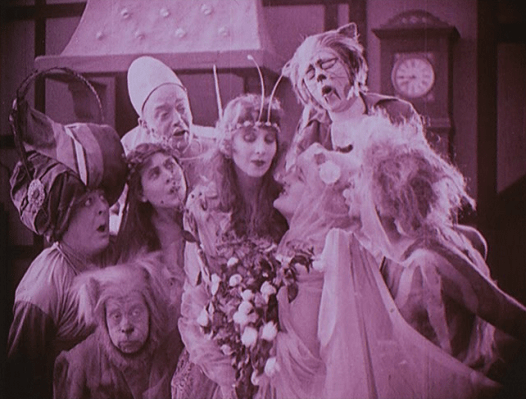
Vol. 13 opens with two adaptations of Henrik Ibsen’s plays, The Pillars of Society (1911) and A Doll’s House (1911); produced on tiny stages in medium-long shots with actors and furniture crowded together, both short films reduce complex dramas to melodrama. The adaptation of literary works by Charles Dickens, Shakespeare, George Elliot, Robert Louis Stevenson, and Oscar Wilde, etc. became a specialty for Thanhouser. Next, The Austin Flood (1911), one of Thanhouser’s few actualités, documented the complete destruction of the town of Austin, PA., Northeast of Pittsburgh, a day after the Bayless Dam broke,  killing 78 inhabitants. While the great majority of Thanhouser films portrayed members of the middle class, The Star of the Side Show (1912) is a somewhat perverse look at “freaks” in a circus sideshow, including a romance between little people. Shot in a Florida orange grove, The Girl of the Grove (1912) is a melodrama with a feminist twist, in which a philandering husband is sent packing by a young woman he attempts to seduce after she has rescued his wife from suicide. In The Thunderbolt (1912), money embezzled by a broker finally makes it back to its owner after lightning reveals its hidden location.

Star of the SIde Show, (1912)

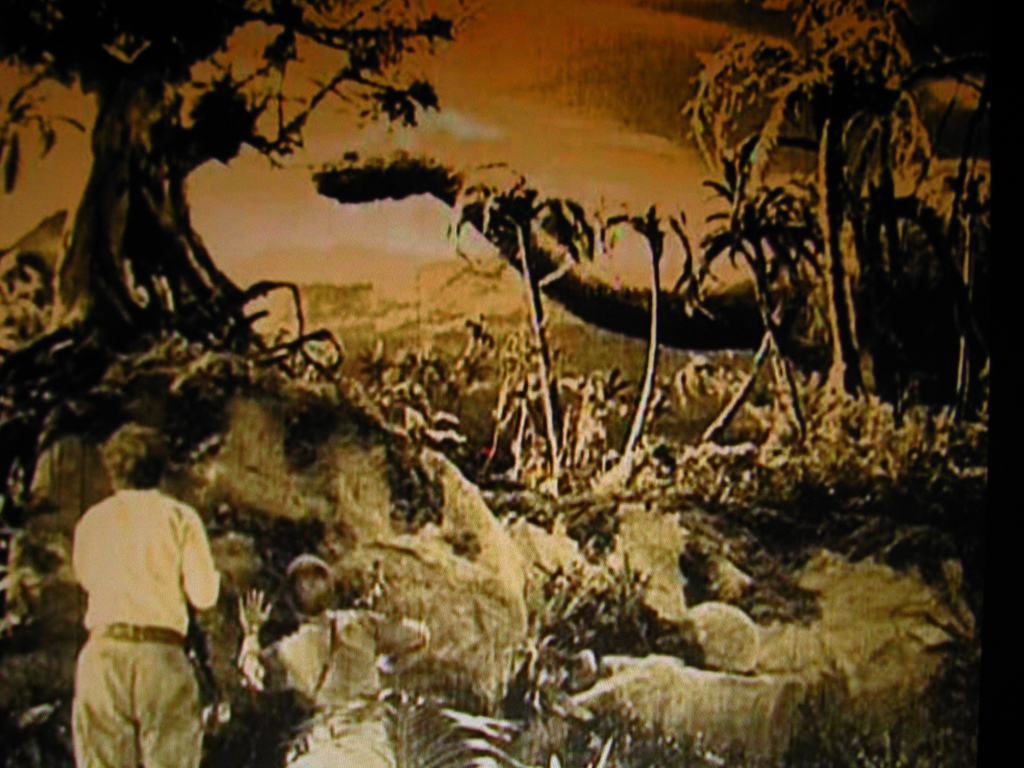
Vol. 14 continues with the melodramas, Cross Your Heart (1912), Idol of the Hour (1913), The Girl in the Cabaret (1913), Coals of Fire (1914), and Their Best Friend (1914), all of which involve middle-class families, often children, threatened by greed, avarice, and lust.  All are ultimately resolved happily, the exception being Idol, which follows the slow decline of an artist model from toast of the town to charwoman.  No longer stage-bound, these films include many outdoor scenes in city and country that visualize American life before World War I. One of the great pleasures of these films is really seeing the fashions, the faces, the cars, architecture, body language, and other signs of modernism. Far from modernist, but charming, the DVD also includes the fairy tale, Jack and the Beanstalk (1913).

Toodles, Tom and Trouble (1915)

The final DVD, Volume 15, begins with The Mother of Her Dreams (1915), a touching  melodrama of an orphan girl who yearns to find a family. She dreams of a fairy mother who guides her to a real lost little rich boy in the woods. In the missing final scene, the boy’s family adopts the girl. Thanhouser’s success rested on its policy of good cheer, a policy directed specifically at the American middle classes, who were beginning to venture into the cinema in ever greater numbers. The Twins of the GL Ranch (1915) is a western that visualizes a robbery/rescue and features the famous “Thanhouser Twins,” Madeline and Marion Fairbanks, who appeared in over thirty films between 1912 and 1916.  The volume continues with three comedies, John T. Rocks and the Flivver (1915), Toodles, Tom and Trouble (1915), and Guiders (1916). Like Twins, the first two comedies feature extended chase sequences, while a gaggle of Keystone-like cops make an appearance in Guiders, shot in Florida, partially on ostrich and alligator farms.

The DVD concludes with a “bonus,” An American in the Making (1913)part industrial, part immigrant story. Financed by U.S. Steel with scenes shot in Chicago (e.g. at Berghoff’s famous German restaurant, where I ate as a kid) and at a steel mill in Gary, IN., the film highlights safety features in industrial work, while showing a young European immigrant establishing a family in America, thanks to his job in the steel industry.

An American in the Making (1913)

Given the fact that these films have been digitized from preserved analog sources, without a significant amount of digital clean-up, the visual quality of the films is generally good with nitrate decomposition only marring a single early title. All the films are accompanied by well-known silent film musicians, Nathan Avakian, Stephen Horne, and Ben Model, making this collection a delightful journey into a past, now over 100 years gone

250: Volker Schlöndorff’s Baal 

Archival Spaces 250

Volker Schlöndorff’s Baal  (1970)

Uploaded 28 August 2020

Rainer Werner Fassbinder in Baal (1970)

When I was a teenager, I was fascinated with Bertolt Brecht. I saw my first Brecht play, “The Rise and Fall of Arturo Ui” at the Ruhr Festspiele in 1965, which featured 20 foot high puppets. For my senior thesis in Betty Nichols’ English honors class at Frankfurt American High School, I wrote about Brecht’s “Epic Theater.” I did the research at the Goethe University Library in German and English sources. During my sophomore year at the University of Delaware, I finished a paper on “the young Brecht” of “Baal” and “Man is Man” for a graduate level German course. That same year 1970, Volker Schöndorff’s television film, Baal, starring Rainer Werner Fassbinder, was broadcast on German television exactly once, then immediately disappeared when Helene Weigel, Brecht’s widow, filed an injunction against the film. It was not released again until 2014, when Brecht’s granddaughter finally granted permission for public exhibition, leading to a restoration by the Criterion Collection; it is now also available on Kanopy.

Bertolt Brecht, Berlin, 1920s

That fate somewhat mirrors the original German production of “Baal” in Weimar Germany. Brecht’s first play was written in 1918, in just four days, according to Martin Esslin, when Brecht was a student in Munich. A first version was performed in Leipzig in 1923 after Brecht had received the prestigious Kleist Prize for his first three plays. But Brecht was unhappy with it, and completed a revised version, which was performed exactly once in 1926 in Max Reinhardt’s Junge Bühne, when it ignited a near riot in the theater. Influenced by Brecht’s evolving conception of epic theater, “Baal” featured a Rimbaud-like poet who speaks in free verse, ravages both men and women, whom he discards like toilet paper, and ultimately drinks himself to death. No one could have realized in 1970 that Rainer Werner Fassbinder was playing what would become his own biography down to the t, but today it is not possible to see the film except through that lens.

Financed by German television, Baal is a quintessential 60s-70s German art film from the Munich film scene, populated with then mostly unknown actors who would define Fassbinder’s and New German Cinema. Shot in 16mm color in contemporary dress with a roving camera by Dietrich Lohmann, who filmed almost all of Fassbinder’s 1970s films, Baal opens with the poet hero walking through a wheat field, reciting verse, before getting thoroughly drunk at a reception in his honor. Lohmann often smears Vaseline around the edges of his lens, leaving only Baal in focus in center frame, thus mirroring the poet’s blindness to his surroundings. The remainder of the film follows Baal drinking, insulting patrons, mistreating women (including raping one), reciting poetry, and ultimately crawling into the bushes to die. In keeping with the alienation techniques of epic theater, Schlöndorff retains Brecht’s poetic verse, the actors reciting expressionlessly, often directly to the camera. Non-synchronous musical interludes feature Fassbinder reciting poetry (off-camera) over Klaus Doldinger’s iconic jazz-rock score.

Miriam Spoerri, Guenther Kauffmann, Fassbinder, Hanna Schuygulla in Baal

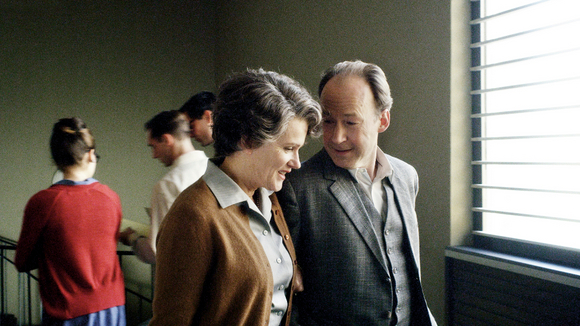
Many of the actors in the film were or would become familiar to audiences through Fassbinder’s 1970s work. There is Hanna Schygulla, playing a pretty waitress and lover of Baal, who would star in no less than nineteen Fassbinder films, including Effie Briest (1974), The Marriage of Maria Braun (1979), and Lili Marleen (1981). We see tall and thin as a rail in a walk-on as a land-lady, the late Irm Hermann, her inevitably dour presence graced eighteen Fassbinder films, almost always as an impression-making secondary character, but starring memorably as the embittered house wife in RWF’s masterpiece, The Merchant of Four Seasons  (1972).  It was the first film for Günther Kaufmann, a black German actor who was to become one of the director’s discarded lovers, appeared in fourteen Fassbinder films, and starred in Whitey (1971) and had a major supporting role in Berlin Alexanderplatz (1980). Another supporting actor, Walter Sedlmayr, already had a long career in Bavarian roles, before playing in eight Fassbinder films, as well as several Schlöndorff films. Finally, Margarete von Trotta plays one of Baal’s abused lovers, but not a victim, rather she chooses out of strength to sacrifice herself, an interesting interpretation in the light of her subsequent work. Starring in several Schlöndorff films, as well as being his wife, von Trotta would go on to become one of Germany’s most important explicitly feminist directors with films, like The Lost Honor of Katarina Blum (1975), Marianne & Juliane (1981), and Hannah Arendt (2012).

Margarete von Trotta and R.W. Fassbinder in Baal (1970)

However, Rainer Werner Fassbinder dominates every scene, just as he would in star turns in his own Fox and His Friends (1975) and his last role in Wolf Gremm’s Kamikazi 89 (1982, which co-starred Günther Kaufmann). Throughout Baal, Fassbinder wears his trademark leather jacket, an updated version of Brecht’s leather gear from the 1920s; I saw RWF in the same jacket at a press conference at the Berlinale Film Festival in 1974 after the premiere of Effie Briest, feigning indifference when he was criticized by some of the pressAt the time, I thought it was his Brecht act, echt anti-Kapitalistisch, but maybe he really was the same on screen or in person. In Baal Fassbinder is sullen, aggressive, violent, insolent, driven, pathetic, self-centered, drunk, and drunk again, totally focused on his own desires without a second thought for those around him, but also a brilliant, funny, caustic, serious lyricist. He is the romantic 1960s version of the expressionist artist who wallows for his art. In retrospect, we see Fassbinder is Baal, just as Baal was a version of Brecht, and like Rimbaud and Baal, Fassbinder died at the age of 37 after too much drink, too many drugs, too much anguish, but leaving behind an immortal body of work.            

249: Louise Brooks

Archival Spaces 249

The Last Days of Louise Brooks

Uploaded 15 August 2020

Louise Brooks died 35 years ago this week on 8 August 1985. I met Louise Brooks for the first time in 1975, long after her Hollywood career had ended, when she was living on N. Goodman Street in Rochester, N.Y., around the block from my apartment. At the time, I was a paid post-graduate intern at George Eastman House and confess that when I met her in Curator George Pratt’s office, she was to me just another silent film actress. She had come to Rochester in 1956 at the invitation of James Card, the founder of the George Eastman Museum Film Collection and my boss. Rumor had it that she had been living in poverty in New York City, working as a part-time salesgirl at Macy’s, occasionally selling herself, and drinking full-time. In 1957, James took her to Paris, where Henri Langlois celebrated her as a goddess and resurrected myth, while Jim took her as his lover. However, she still drank, and soon the legendary screaming matches between Brooks and Card became the talk of the local bar scene. When the relationship finally ended sometime in 1963, Louise began a friendship with George Pratt that only ended with her death.

James Card and Louise Brooks, Rochester, ca. late 1950s

George was gay. He loved Louise for her strength, but was also well aware of her weaknesses. It was George who encouraged her to write her memoirs, but she balked. Instead, he helped her research and write a series of articles, which were eventually collected together in Lulu in Hollywood (1982), a book that has remained in continuous print since then and established her as one of the most well-known actresses from the silent era. George told me he thought Louise’s career had ended because she was personally and professionally completely undisciplined. George had been hired by Card as an Assistant in 1953. By the time I got there, Card and Pratt had not talked for more than ten years, except through the departmental secretary, Kay McRae, possibly because of Louise’s switched allegiances.    

Louise by that time had long silver-gray hair, her face was extremely thin, almost anorexic, but with shiny eyes and still beautiful fingers. She wore a simple house dress with flats and no make-up. Her movements and speech were measured and deliberate. Had she really been a star? I saw her again a few weeks later, wearing a gray raincoat that looked like it was cut for a man, as she walked past my apartment around lunchtime; my kitchen faced the street. From then on, I saw her regularly on my lunch break, walking towards East Ave., then returning a short time later with a brown bag under her arm. George told me her diet consisted mostly of Vodka, at least until she stopped drinking a couple years later.

It was not until weeks after my first meeting that I saw my first Louise Brooks film, The Beggars of Life (1928). I now began to understand why Card had endeavored to collect every Louise Brooks film he could find. Could this wonderful young woman with black hair and a square face really be the same person I had met? After viewing all her other films at Eastman, I knew that she wasn’t. Louise Brooks in black and white existed only as a star image on the screen, in photos, and in the desire of thousands of later-born. Louise, herself, maintained a healthy skepticism about her and understood that she was not identical with the image on screen.

In September 1984, eight years after having left Rochester, I returned as George Pratt’s successor. Soon after, George suggested we visit Louise, driving to her apartment with Kay McRae. Louise opened the door, then turned around and went straight back to bed. I was flabbergasted to see that the living room décor consisted of a Formica kitchen table and two chairs, which we brought o her bedroom to sit with her. Except for her bed and a wooden nightstand, there was no other furniture, no pictures on the wall, no books. George introduced me again, but there was no conversation, because Louise wanted to write everything down. She had a little black notebook and a pencil, but her arthritic fingers were bent and shook, due to emphysema. It took her minutes just to write down my name. I asked her a question, which she had to write down, “for her next book,” before she could answer. After twenty minutes, we were all exhausted, so we decided to postpone the meeting for another day. It never came.

Louise was not as isolated as the above implies. She did have a small circle of friends who called and visited her regularly, many of them younger gay men.

Louise’s Apartment Building on N. Goodman St., Rochester, N.Y.

Her funeral service took place in a local Catholic Church with not more than thirty people: a few relatives from Kansas, local film critics and friends, and the Eastman Museum crew. Much to the surprise of her friends, Louise had converted to Catholicism at the end of her life. Jack Garner, the national Gannett Newspaper film critic and himself a devout Catholic – who passed away earlier this year – gave the funeral speech and served as an altar boy. Having had a Catholic education, I’ll never forget that image of Jack in red and white alter cassocks, almost seven feet tall and as wide as an armoire, towering over the presiding priest. Louise’s estate was donated to the Museum a few weeks later in a ceremony at Eastman. It consisted of two cardboard boxes with a few letters, some books she had been sent and her little black notebooks. The latter were completely illegible.

The late John Kuiper, Director Film Dept. and Eastman House Board member with Associate Curator at presentation of Louise Brooks estate to the Museum.

248: Kevon Brownlow’s It Happened Here

Archival Spaces 248

Kevin Brownlow’s It Happened Here (1964)

Downloaded  31 July 2020

I can’t believe it has taken me nearly fifty years to catch up with Kevin Brownlow’s first feature film, It Happened Here, which had its UK premiere at the London Film Festival on 1 November 1964. I first became aware of the film sometime in late 1971 – long before I met Kevin – having taken my first film course in Spring of that year, –  when I purchased Brownlow’s BFI monograph, How It Happened Here (1968, Doubleday & Co.).  Perused, I added it to my embryonic film book collection, but never had an opportunity to see the film, initially because it wasn’t available in America until Milestone released it theatrically and on DVD in 2000; don’t know why it took another twenty years, given that my dissertation analyzed anti-Nazi films made in Hollywood during WWII. Thanks to Amy Doros and Milestone, I finally screened the film and was frankly flabbergasted at its quality and modernity  I knew it was an amateur production that Brownlow and Andrew Mollo directed when Brownlow was a teenager; it took eight years to complete the film. Mashing up documentary, newsreel recreations, and fictional scenes in a then completely unconventional style, It Happened Here presages the alternative universes of The Man in the High Castle, down to its use of newsreels.   

Kevin Brownlow ca. 1963

The film visualizes the fictional occupation of Great Britain in 1944 after the German Wehrmacht had successfully invaded the island in 1940 and eliminated any resistance.  When the film opens, armed resistance has flared up again in the Western half of the British Isles, now supported by the Americans.  Brownlow opens with a fake German newsreel that relates the above, and not only totally convincingly mimics the Deutsche Wochenschau of World War II, but also uses a German narrator whose inflection and accent imitates exactly the Nazi original. The film then slowly focuses on Pauline, an apolitical nurse who survives a massacre when she is supposed to be evacuated to London, then slowly slips into the role of a Nazi collaborator, who may or may not have betrayed her friends to the Nazis.

It Happened Here (1964)

Throughout the film, Brownlow returns to German and British “newsreels” that are strikingly accurate in capturing the ambience of 1940s Britain under Nazi occupation. Some newsreel footage restages known historical events, e.g. the execution of refugees by  “Sonderkommandos” (recalling some of the only surviving atrocity footage in Poland), the 1914 Christmas truce along the Western Front; the snowball fight quotes Abel Gance’s Napoleon (and was at that time only to be found in Brownlow’s 9.5mm print of the film). Equally amazing is the footage of Pauline walking through the ruins of London, shot in the late 1950s, when signs of the Blitzkrieg were still visible, as well as the footage of German soldiers on leave, taking in the sights of London. Brownlow scrupulously populates his images with perfect little details, like the sidewalk sale of “Das Signal” (an important Wehrmacht bi-monthly illustrated magazine), the Picture Post advert on a London bus, sidewalk sales of household goods by ghetto inhabitants, or the German/English signage at the edge of the Jewish Ghetto.

It Happened Here (1964)

In keeping with the realism of such imagery, Brownlow stages British Nazi Party rallies, ceremonies, and lectures that reproduce both the original words of British Fascists from the 1930s and the ideology of German National Socialism. Indeed, some of this footage is actual documentary footage of British Fascists. The UK Nazis argue that the English are enjoying a high standard of living, because the “International Jewish Capitalist and Bolshevik” conspiracy has been defeated, while also blaming the Jews for the bombing of London because British politicians rejected Germany’s peace feelers. In another jaw-dropping scene, a British Fascist argues perfectly “rationally” that euthanasia is necessary because the State cannot be expected to support those individuals who cannot help support the State.    

It Happened Here (1964)

Such vile, racist content is articulated without contradiction within a filmic text that demands realism, leading critics in the 1960’s to condemn the film as fascist and anti-Semitic. One can counter that there are no anti-Semitic stereotypes visible in the film, while the arguments of the Fascists are themselves clichéd and stereotypical. When a young woman asks how Jews could be blamed for Communism and Capitalism, the instructor responds nonsensically, there are no conflicts between the Jews of the Kremlin and those in London.

Other critics thought the film unrealistic, because British people would never have accepted Hitlerian rule, without a whimper. Obviously, not even twenty years after the war, the wounds were still too fresh for such an uncomfortable truth. But as Marcel Ophuls’ film about France under the Occupation, Sorrow and the Pity (1969) and Daniel Goldhagen’s Hitler’s Willing Executioners. Ordinary Germans and the Holocaust (1997) demonstrate, mild-mannered, middle-class citizens can indeed become fascist collaborators; a lesson we have learned yet again in Texas detention camps and on the streets of Portland.

The film’s penultimate scene proves the point most shockingly. German SS troops who have surrendered under a white flag are led into a field by the resistance  and massacred, as an American Army jeep drives by without intervening. Meanwhile, Pauline, who has been captured by the Allies and identified as a Nazi fellow traveler, begins working as a nurse for the American military; like millions of collaborators (and war criminals) after 1945, she slips back into an invisible, conventional life.    

UK Premiere in Leicester Square, London, November 1964