304: Salka Viertel Biography

Archival Spaces 304

Donna Rifkind’s The Sun and Her Stars

Uploaded 16 September 2022

Sergei Eisenstein and Salka Viertel, Santa Monica Beach, 1931

I first read Salka Viertel’s autobiography, The Kindness of Strangers (1969/2019) in the late 1970s, as I was writing my first piece on German-Jewish refugees in Hollywood, “The Palm Trees Were Gently Swaying. German Refugees from Hitler in Hollywood” (1980). The wife of the poet-filmmaker, Bertold Viertel, Salka was an accomplished scriptwriter, having worked on Queen Christiana (1933) and all subsequent Greta Garbo pictures. The first of only a handful of émigré autobiographies available at that time, her very literate book presented an insider’s view of Hollywood’s German-speaking community. I was therefore quite intrigued when I met Donna Rifkind at a conference last December and heard she had published a biography of Salka Viertel and her circle, The Sun and Her Stars. Salka Viertel and Hitler’s Exiles in the Golden Age of Hollywood (2020).

Rifkind opens her book by making the extremely important point that, for the most part, women have been written out of the histories of both classic Hollywood and German anti-Hitler intellectuals, in so far as they weren’t wives, secretaries, or movie stars; she does mention that has changed in the past decade with books on Charlotte Dieterle and Liesl Frank who organized the European Film Fund (2010), and a German biography of Salka Viertel (2007). However, refugee women scriptwriters Vicki Baum, Irmgard von Cube, Lilo Dammert, Lili van Hatvany, and Gina Kaus remain terra incognita, as do other women who worked behind the camera.

Bertold Viertel with Matheson Lang and Lydia Sherwood

In detailing Salka Viertel’s life, Rifkind focuses on three areas: 1.) Her marriages, lovers, and children; 2) Her professional struggles in the American studio system; 3) Her Sunday salons in Mayberry Road (Santa Monica) that brought together the crème de la crème of Germany’s literary exile. These three areas are however not mutually exclusive, – how could they be when women were still expected to manage a household, even if they worked? – but rather intertwined, so that people appear in different contexts. For example, Christopher Isherwood first met Bertold Viertel when both worked on Little Friend in England in 1934, then became a tenant in the Viertel’s garage, confident of Salka, friend to the Viertel children, and finally, he helped edit her autobiography.  

Rifkind does not proceed chronologically, rather opens in 1963, when Salka Viertel had been living in Klosters, Switzerland, trying to survive economically, and get her autobiography published, her Hollywood career long behind her. Rifkind pointedly  notes reactions to the manuscript: “Already the few who have read her drafts – all men – have blanched at every hint of woman mess, of love affairs and menstruation and childbirth. They insisted that she take it all out.” (p. 13) Indeed, Viertel was not only independent in her career, politically out-spoken and left-leaning but also sexually liberated, carrying on an open marriage, when America’s Puritans still condemned such licentiousness.  

Anna Christie, German Version (1930) , with Garbo and Viertel
Greta Garbo and Salka Viertel at Mayberry Road

Salka and Bertold Viertel had come to Hollywood from Berlin in 1928 on F.W. Murnau’s coattails, Bertold receiving a contract to direct at Fox. At 39 and 43, respectively, both had already entered middle age and hoped their temporary stay in America would help them straighten out their finances. But after four films, Viertel was out, moving to Warners in 1930, then Paramount, before making one film in Berlin in the first months of 1933, and ending his directing career in London in 1936. Salka, meanwhile, needing to pay bills, acted in several German-language films in Hollywood, including the German version of Anna Christie (1930) with Greta Garbo; the two became close friends, and lead to Viertel working on scripts for all subsequent Garbo films. Although she was able to purchase the house on Mayberry Rd., staying economically afloat remained a challenge throughout her Hollywood years and became critical after she was grey-listed by the FBI, which harassed her and her family for years. After the Nazis took control in Berlin, any return “home” was, of course, unthinkable.

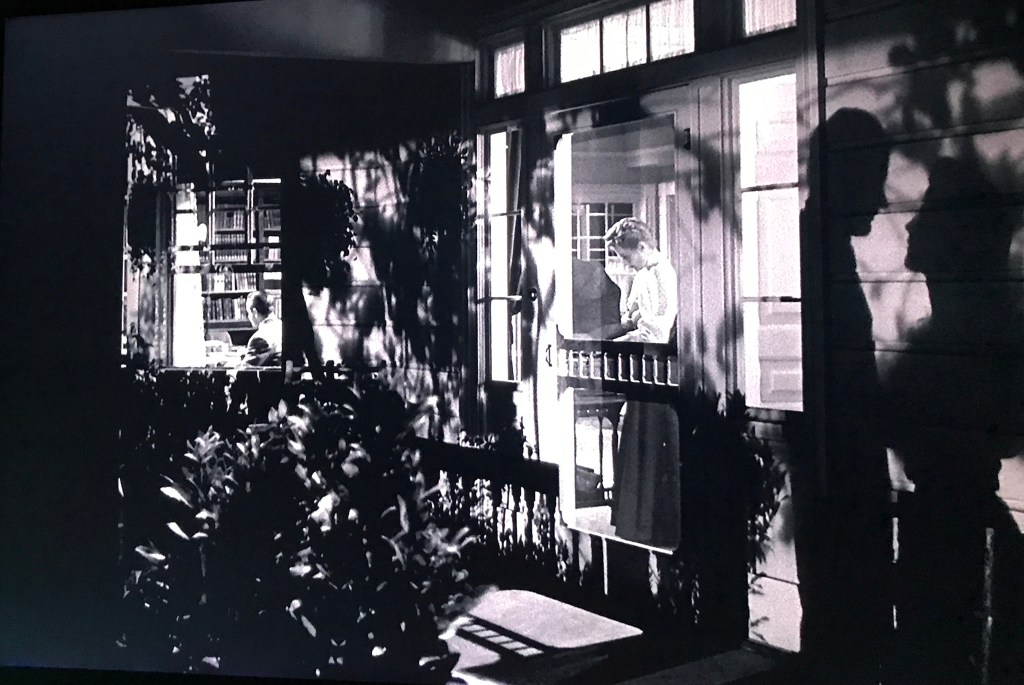
Mayberry Road Garden
Dita Parlo, B. Viertel, Arnold Schoenberg, Thomas Viertel, Heinrich George, S. Viertel, 1930

With three kids to feed, a husband to support, an endless array of house guests, and Salka’s Sunday salons, there were a lot of expenses. As Rifkind notes: “Salka continued to feed the whole town for nothing in the comfort of her own home. Every Sunday her parties continued, along with frequent smaller gatherings during the week.” (p. 249) Viertel’s Mayberry Rd. Sunday Salon became a meeting point for German refugee intellectuals that soon rivaled Rahel Varnhagen’s Jewish salon in 19th Century Berlin. Sourcing Viertel’s letters, diaries, and autobiography, Rifkind lovingly details the comings and goings of Charles and Oona Chaplin, Thomas and Katia Mann, Heinrich Mann, Bertolt Brecht, Bruno and Liesel Frank, Alma and Franz Werfel, Garbo, Aldous Huxley, Christopher Isherwood, Lion and Marta Feuchtwanger, Max Reinhardt, Irwin Shaw, Sergei Eisenstein, Arnold Schoenberg, Otto Klemperer, Franz Waxman, Fred Zinnemann, and many, many others. Mayberry Road was usually the first stop for arriving Jewish Berliners and would remain so until 1947 when a back taxes bill forced Salka to move into the garage and rent the house to screenwriter Edward Chodorov.

Ernst Lubitsch, Gottfried Reinhardt on Design for Living set, 1933.
Christopher Isherwood (?), Salka Viertel, Gottfried Reinhardt at Mayberry Rd

Writing about Salka’s personal life, Rifkind is adamant that the persistent rumors of a love affair between Garbo and Salka were false. Bertold and Salka had taken lovers repeatedly after their marriage in Berlin in 1918. Beginning in 1933, she carried on a decade-long relationship with the son of Max Reinhardt, Gottfried, twenty-two years her junior, and a budding producer at MGM. Previously she had had an affair with a neighbor, screenwriter Oliver Garrett. Other lovers remained unnamed.  But Salka also lived for her three sons, worrying about their schooling, their careers, and their marriages, their father mostly absent; Peter became a successful screenwriter, and Hans a linguistic scholar after serving as an assistant to Max Reinhardt.

Donna Rifkind’s book thus presents an in-depth, fascinating, and well-written portrait of classical Hollywood and the German-Jewish film community in exile, especially its female members, and is indispensable reading for anyone interested in the subject.

Greta Garbo in Queen Christiana (1933)

303: Three Minutes. A Lengthening  (2022)

Archival Spaces 303

Three Minutes. A Lengthening  (2022)

Uploaded 2 September 2022

Three Minutes. A Lengthening (2022)

In the Summer of 1990, after the fall of Communism, I visited Poland for the first time, training docents for a United States Information Agency exhibit on American cinema in Katowice. On a free day, I asked my driver to take me to Auschwitz which was a few hours away. We first went to Auschwitz I, which was the work camp, where both a film and all exhibition signage failed to mention the word Jew, but only the nationalities of those incarcerated and killed there. Afterward, I wanted to see Auschwitz-Birkenau, the death camp, which proved challenging, because there was no signage anywhere to give directions. When I found it, I was surprised to see that the Poles had built housing within 200 ft of the gas chambers. I was reminded of that moment, when in a new film, Three Minutes (2022, Bianca Stigter), the narrator, Helene Bonham-Carter) describes the market square in the town of Nasielsk, Poland, today, a small town where almost half of the pre-World War II population of 7,000 were Jewish, yet not a single sign, marker, or plaque marks their disappearance in December 1939, when virtually every last Jewish inhabitant was deported to Warsaw’s ghetto, before being murdered in Treblinka three years later.

A remarkable new documentary, Three Minutes recently opened in Los Angeles after a preview screening, sponsored by Hilary Helstein’s Los Angeles Jewish Film Festival. The film’s title refers to three minutes of degraded 16mm black and white and color footage, taken in the Summer of 1938 in Nasielsk’s town square by David Kurtz, a native son who had emigrated to America as a child and was now returning with his family and some friends. Kurtz’s longer film, Our Trip to Holland, Belgium, Poland, Switzerland, France, and England, produced with a Cine-Kodak camera, documented their grand European tour. Kurtz’s grandson, Glenn Kurtz, discovered the footage in 2009 in Palm Beach Gardens, Florida, and was immediately intrigued by the three minutes of Jewish people in an unidentified Polish town, but everyone who would have known was dead. Glenn Kurtz donated the footage to the Holocaust Museum in Washington, DC, which had the badly decomposed film – due to vinegar syndrome, – digitally restored at Colorlab in Rockville, MD. He then began the difficult process of trying to identify the town and its inhabitants. How do you identify something when there are no prominent landmarks or other identifying marks, like signage?

Thee Minutes. A Lengthening (20022)

Glenn Kurtz assumed it was either the town where his grandmother or grandfather were born, but it was only after finding a photo of a Synagogue door adorned with two Lions of Judah that matched the door in the film that he knew it was Nasielsk, a town about thirty miles north of Warsaw, where his grandfather had been born.  Finding survivors who might help identify the individuals in the film proved much more challenging. Two years later, he was contacted by a woman from Detroit who recognized her then 13-year-old father in the film; Maurice Chandler was still alive. Eventually, eleven of the approximately 150 persons seen in the footage were identified, of which only a few survived the Shoah. Chandler could only identify males, like his friend Chaim Talmund, because as an Orthodox Jew he was forbidden to look at girls. The story of their horrific deportation from Nasielsk’s town square that December 1939, the initial imprisonment in the town Shul of 1600 of them, their continual beatings by German troops, and their journey in cattle cars to Warsaw, was documented by a Jewish eyewitness who buried his report in the Warsaw ghetto and by a German Wehrmacht Commandant who made an official report. Another survivor tells the remarkable story of how he rescued his girlfriend from the synagogue by posing as a German officer, after an anti-Nazi German officer lent him his winter coat, both then fleeing to Russian-occupied Poland.

Three Minutes . A Lengthening (2022)
Three Minutes. A Lengthening (2022)

Before seeing the film, I was unclear how those three minutes could be turned into a feature-length documentary, but Kurtz and Stigter succeed. Using the tools of avant-garde filmmaking, the director not only repeatedly shows the three minutes in their entirety, while relating the story of the film, but crops, refocuses, reedits, and digitally manipulates the images so that the film seems at times in danger of falling into the abstract. But it doesn’t because while the film employs structuralist repetition, to stretch time, the way the 1960s avant-garde had, especially Ken Jacobs, it simultaneously focuses over and over again on the faces, their look into the camera, their movement out of the synagogue and into the street. While the ultra-Orthodox would not have wanted to be filmed, the narrator notes, the event still “scrambled social hierarchies,” mixing middle-class and working-class Jews, mostly young people and curious adults. One of the most emotional sequences is when the film digitally isolates in close-up every inhabitant visible in the film, creating a full-screen gallery of portraits of the dead. Holocaust researchers usually have names, not faces, while this film offers countenances as the only traces of their human existence, which Kurtz’s film memorialized. Finally, in questioning why so many had congregated in the film in and outside the synagogue, the film speculates that the famous cantor, Moishe Koussevitzky had performed that day: We hear the Cantor’s melodious voice on the track over an abstract image of b & w film grain, which eventually pulls back to reveal the darkness of the synagogue’s entrance, the diegetic source of the music, but also a metaphor for the film’s pulling life from the shadows.

Three Minutes. A Lengthening (2022)

Having literally seen hundreds of Holocaust documentaries, I can say Three Minutes is both unique and an amazing aesthetic experience because it personalizes the stories of six million.

A still from Three Minutes: A Lengthening by Bianca Stigter,

302: Summer of ’62

Archival Spaces 302

Summer of ‘62

Uploaded 19 August 2022

Die Pist geht ab (1962, Helmut Backhaus) with Vivi Bach

Heinz Erhardt was an extremely popular comedian in 1950s cinema of the German Federal Republic. I have been watching some of his films on YouTube because I’m writing about William Thiele’s penultimate feature film, The Last Pedestrian (1960) for a Thiele book I’m editing with Andreas-Benjamin Seyfert. In Die Post geht ab (1962), which translates as “the bus is leaving,” the actor is only seen in a supporting role. The film is really a wall-to-wall “Schlagerfilm” (German popular music genre), concerning a young jazz band, and various hangers-on who travel to Italy in a broken-down old bus. The film is completely forgettable, so my mind began to wander, its music, stuffy atmosphere, and nylon ready-wear fashions transporting me back to Germany in 1962. It was in the summer of ’62 that I took my first trip back to Germany and Europe with my parents, keeping a diary of my experiences as an eleven-year-old. The beginning of my writing career.

S.S. Ryndam (Postcard in diary)
My photo of iceberg, taken from Ryndam.

We had emigrated to the United States as displaced persons in 1951, and this was my parents’ first trip “home” to see relatives and old friends. Almost exclusively my mom’s, since Prague and Communist Czechoslovakia was not yet possible. For myself, my twin, Michael, and my younger brother, Peter, it was an adventure in cultures we had only heard about. On 31 May 1962, we left Union Station in Chicago with our mother on a night train to Montreal, embarking on the S.S. Ryndam of the Holland-America Line. Eleven days later, we arrived in Rotterdam, the highlight of the voyage being a massive storm off Newfoundland and the sighting of icebergs in the north Atlantic. Taking a city tour of the Dutch city, while waiting for our train to Cologne, I noted in my diary that the city was totally modern, “because it was destroyed during the war,” but probably didn’t understand that it had been the Nazi German Luftwaffe that had leveled the medieval city in four days in May 1940.

Bas Muenstereifel with 1200-year-old cathedral in the center
Bad Muenstereifel now defunct train station

We arrived in Münstereifel (now Bad Münstereifel) in the early evening of the same day, having taken a single-track steam locomotive train to the end of the line for the journey’s last leg. My mother’s family had fled to this medieval town in the Eifel Mountains after losing their home and dry-goods store in Cologne to Allied bombs in 1944.  I and my twin were born there, two months premature, brought on by the death of my maternal grandfather. My grandmother and a couple of great aunts still lived there. Walking from the train station to my grandma’s house, we passed Aunt Lisbeth, who greeted my mother with a matter of course, as if it hadn’t been 10 1\2 years since she last saw her. She and Aunt Sofie were both in their seventies, deeply Catholic, going to church every morning. The heavy incense at mass, in the first row at the insistence of “die Tanten.”

My first American Passport
Ruins of the “Felsennest,” Hitler’s Eiffel Mountain headquarters

Over the next three weeks, until my dad arrived, the town became a giant playground for us, exploring the ruins of the castle above the town, climbing on the medieval wall that circumvented it, walking up to the “Felsennest” high above Münstereifel, the ruins of Adolf Hitler’s headquarters during the bombing of Rotterdam, hiking through the woods to a nearby water reservoir to go swimming with the five children of my mom’s former employer, the doctor who had delivered us. We attended the local German elementary school for two weeks, so “we could compare the differences between the German and American schools,” but also relieve my mom of childcare duties for her vacation. Surprisingly, even though the other children spoke a heavy Eiffel dialect, we soon picked it up, thanks to the fact that my mother, in particular, had only spoken German to us all the years of our childhood in America. The highlight of our time in Münstereifel for my 11-year-old self was a trip to the nearby Nürburgring for the 1962 trials of the Formula 1 German Grand Prix.

Rainy Nuerburgring Grand Prix of Germany trials, August 1962

After my dad arrived, we began our European tour, literally on “5 Dollars a Day,” traveling in an ancient grey Opel station wagon dad had bought with the proviso he could return after the trip. After stops in Cologne, Heidelberg, and Munich to visit friends and relatives, and a stop in the medieval town of Rothenburg a.d. Tauber, we spent several days in Salzburg, where we swam in the Wolfgangsee, took a funicular up the mountain, and saw various castles. The next stop was a village in the shadow of Groβsglockner, Austria’s highest peak, where we stayed in a Gasthaus that had no running water and hiked in the surrounding mountains.

In Heidelberg with mom’s former boyfriend

Heading south to Venice, we almost died in a car crash when my dad underestimated the power of our little car – not like driving an American car – while passing a truck on a mountain road in a rain storm. We stayed in Mestre outside Venice, where hotels were significantly cheaper, and were treated to the spectacle of a huge Catholic procession. In the morning we drove to Venice, which was not yet overrun with tourists, a three-course lunch cost slightly more than a dollar. We kids loved the Italian Lira bills, which were the size of a handkerchief. I was impressed with the vaparetto, the Venetian boat-bus, and the iron giant banging a bell at the top of St. Mark’s Square, but the endless churches and canals tried my patience.

Rainy Grosssglockner Pass with out grey Opel.

Subsequent stops included Verona, Lago Maggiore, the Simplon Pass, Geneva, Lucerne, and the Black Forest. In Geneva, we visited an old friend of my dad’s from Prague, and Michael’s godfather, who was serving on the Unite Nations world court and gave us a tour. In Lucerne, I loved the long, covered bridge, because “on each support was a written history of Switzerland.” In St. Gallen, we stopped to see the boarding school my dad had attended in the 1930s for a year.

Chapel Bridge, Lucerne
In Darmstadt with Uncle Werner, Aunt Anita, cousin Frauke

After further visits to Darmstadt to see our cousins, we returned to Münstereifel on 22 July, my dad flying back to the States immediately, while we stayed with our grandmother for three more weeks, before embarking on the tiny S.S. Waterman for New York, a ship filled to the gills with students, professors, and Indonesian-Dutch refugees immigrating to America. During the eleven days on board, we hung out with much older kids and it was probably the first time I decided I wanted to be a professor.

Reading over my diary sixty years later, I realize I was already very interested in history, but also was too young to understand its consequences, such as the fields of rubble still visible in Cologne and Munich. Even today, I feel incredibly privileged that my parents, who were still scraping by economically, afforded us this trip to broaden our horizons. Little did I know, in my innocence, that the trip was also a trial run for my parent’s reemigration to Germany two years later. I didn’t know it yet, but I was no longer simply an American kid, but rather a somewhat schizophrenic German-American, living, thinking, dreaming in two languages, at home in Germany and America, never completely happy in either.

S.S. Waterman, Holland-America Line

301: Restoring HYPOCRITES (1915)

Archival Spaces 301

Lois Weber’s Hypocrites Restored

Uploaded 5 August 2022

Hyppocrites (1915, Lois Weber)

Several weeks ago, Phil Carli premiered his new Silent Cinema Salon (https://philipcarli.com/), presenting a new restoration of Lois Weber’s Hypocrites (1915, Lois Weber) in his Rochester living room with live piano accompaniment. Carli is, of course, very well-known in the United States and abroad as one of the premier piano accompanists for silent films. The film was streamed directly after Carli gave an introduction and is now still available on his site.

I first saw Hypocrites decades ago, when Kino International put the film out on VHS, and I was always a bit troubled by the somewhat confusing narrative structure. True, Lois Weber’s first directed feature is a pure allegory, mixing as did many films at the time, both a historical and a modern story, so continuity seems rather arbitrary. But in what order do these events occur? This becomes an extremely difficult question for film restorationists when only one original source for a film is known to exist. Without a script or other sources, archival practice prohibits changing the order of individual sequences or shots based on some film exterior logic, because of the danger of perverting film history; the most famous example being The Life of an American Fireman (1901), when a MOMA curator intercut two separate geographical spaces where none had existed, leading film historians to surmise that this was the first case of parallel editing.

Given its convoluted structure, film historians and critics for decades discussed Lois Weber’s film not only as an allegory but as a film that defies the conventions of what was to become known as classical Hollywood narrative. An original print of Hypocrites had been discovered in the 1970s at the National Film and Sound Archive in Australia and was repatriated to the Library of Congress’s American Film Institute Collection. That tinted version, which is available on YouTube was considered definitive. It opens with an allegorical image of a female nude walking through “the gate of truth,” then cuts to the minister Gabriel preaching to his congregation; after reading a newspaper article about a statue in Paris representing “Truth” that had been censored, he imagines himself a Benedictine monk who unsuccessfully leads his parishioners up a steep path of virtue, another allegorical scene. The film then flashes back to medieval times in the third reel where the monk has created a sculpture of a nude female depicting “the truth,” and is killed by an angry mob for blasphemy. The fourth reel has “the naked Truth” holding up a mirror to contemporary politics, society, etc., thus visualizing the congregation’s hypocrisy, before returning to the church where the minister expires.  

Hypocrites (1915, Lois Weber) with Margaret Edwards

However, when George Willeman, a preservationist at the Library of Congress restored the film last year, he was troubled by the film’s wonky continuity, until he realized that the first and third reels had been switched at some point, whether in the original Australian release version or later. Once he made the switch, the film made much more sense. Happily, the change was confirmed when Willeman found an original synopsis in The Motion Picture World (23 January 1915). Finally, in order to reconstruct the film’s tinting scheme, Willeman asked the Australians whether they had tinting notes and was told they had made a color negative back in the day.

Hypocrites (1915, Lois Weber) Hypocrites in church
Hypocrites (1915, Lois Weber) Holding up mirror to false love

The film is now presented in chronological order with the medieval tale coming in the first reel, followed by the church sermon, which is rejected by most of the parishioners. Afterward, the minister dreams that in the guise of the monk he is leading his flock, but most reject his more difficult path in favor of the broad road, which results in the monk, accompanied by the “naked truth,” holding up a mirror to society’s hypocrisy before the minister dies in the church.

Hypocrites: Holding up the mirror to Egoism
Hypocrites with Courtenay Foote as the Monk

While the film’s new/original structure makes more sense in terms of classical narrative, Lois Weber’s Hypocrites is still unique for its unabashed moral allegory and Weber’s aesthetic treatment, e.g. truth’s mirror is an oval iris shot that reveals politicians preaching honesty while collecting bribes in the back room. The film caused a scandal at the time of its release, because of the extensive female nudity of ‘truth,” shown in superimpositions, but still revealing specifics of the female form; it was outright banned in Ohio. But also of interest is the film’s cinematography by Dal Clawson and George W. Hill, the latter later the director of The Big House (1930), which utilizes a constantly moving camera to reveal hidden truths. Such overtly allegorical films would soon fall out of fashion, though isolated examples continued to be made, because they self-consciously called attention to their own artifice, rather than creating a seamless reality, the goal of classical Hollywood narrative..         

Lois Weber portrait at the beginning of Hypocrites