307 Lynn Spigel’s TV Snapshots

Archival Spaces 307

Lynn Spigel’s TV Snapshots Archive

Uploaded  28 October 2022

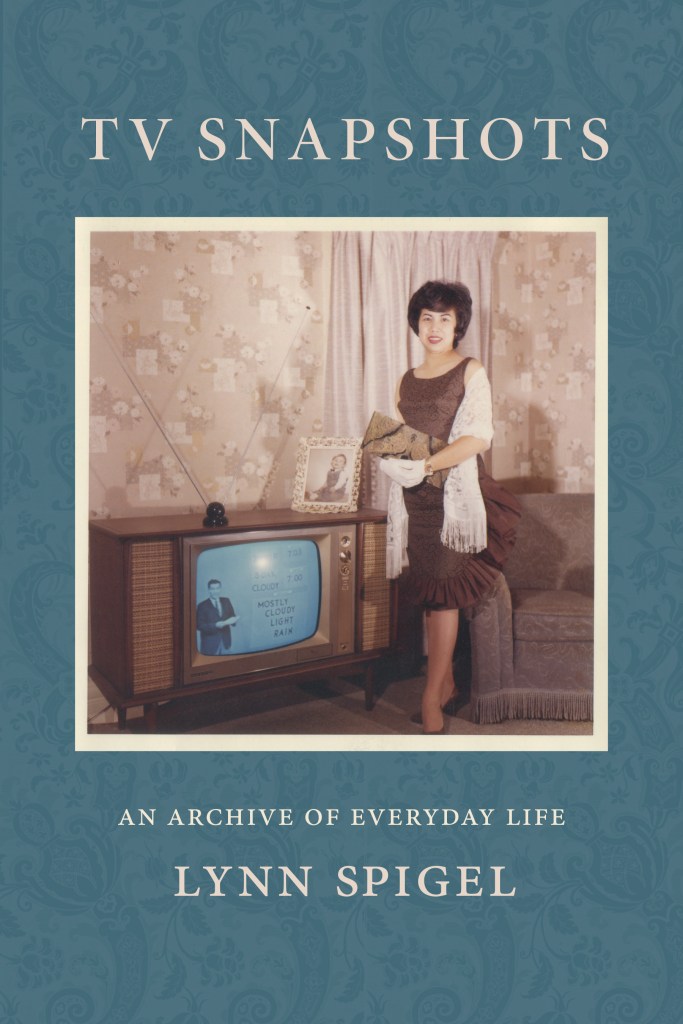
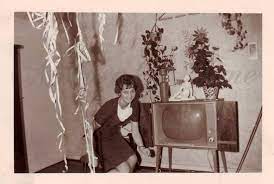
On 21 October 2022, Film Quarterly hosted a webinar with Professor Lynn Spigel (Northwestern University) to discuss her new book, TV Snapshots: An Archive of Everyday Life (Durham, NC:  Duke University Press, 2022).  Reprising an interview between Bruno Guarana and Spigel in Film Quarterly (Fall 2022, 76/1), the event was hosted by editor B. Ruby Rich. Known for her pioneering work on television, including Make Room for TV: Television and the Family Ideal in Postwar America (1992) and TV by Design: Modern Art and the Rise of Network Television (2009), Spigel has turned her sights on televisions themselves, rather than the content projected through the box. For her new book, Spigel not only amassed a huge archive of everyday snapshots of people in front of their television sets in mid-20th century America, but analyzed the images to discover why people made such photographs of themselves with their TVs, and the uses such personal social spaces engendered. As she noted, “Armed with snapshot cameras, people re-envisioned the dominant (industry-prescribed) spectator’s use of television, and made themselves the stars of their own TV scenes.”

Lynn began by noting that it was researching her previous books that she started seeing and becoming fascinated with family snapshots taken in front of the home’s television set. She first sought out flea markets to find such photos but realized that this was a too inefficient way of collecting and began to do internet searches, where she soon found thousands. In fact, there was a community of collectors specializing in such images with whom she had to compete.  And while amateur cameras and film were calibrated for white skin, these TV snapshots not only documented white middle-class American households, but also African-Americans, Asians, and other ethnicities, making them significations of class, race, gender, and even architecture.  While digital access proved a boom to her work, she explained that she gave up on using digital tools to classify, order, and analyze the images, even though computer programs had been developed for such works, choosing instead to organize them analog, placing her images in albums according to subject matter and context, as the original users would have done. I understand the impulse because the analog offers a tactile experience of materiality, reproducing the original reception, and allowing for contextual comparisons

Spigel has divided her book into five chapters, based on these categorizations: 1.) TV Portraits: Picturing Families and Household Things; 2.) TV Performers: A theatre of everyday life; 3.) TV Dress-Up: Fashion Poses and Everyday Glamour; 4.) TV Pin-Ups: Sex and the Single TV; 5.) TV Memories: Snapshots in Digital Times. 

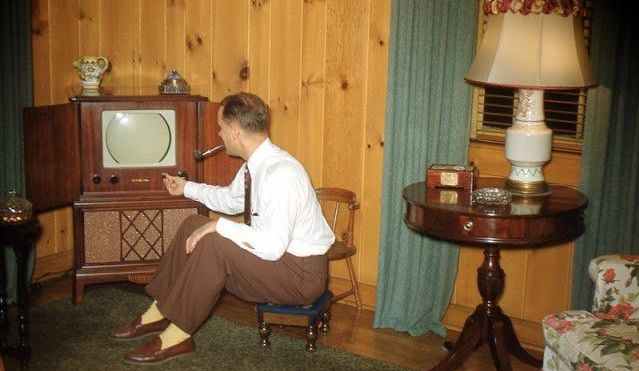
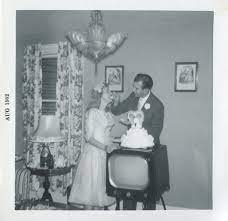
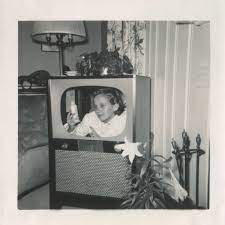
While television sets, their size, and their color capability, became a sign of affluence as the 1950s progressed, Spigel argues that consumers also used them to inhabit a space of resistance to a culture of conspicuous consumption and its prescriptions. Indeed, the television quickly became a household object integrated into the homes and lives of almost all Americans, where “people arranged and photographed the tv set in relation to other household activities and things.” (p. 28) TV snapshots not only documented a family’s technical proficiency in operating the new media tool but also “enact(ed) their relationships with each other through their mutual engagement with the new tv.” (p. 32) While images of families or just children watching tv are common, many more show families engaged in other social activities in front of the television, whether holiday parties, even weddings, reading, or playing games. For example, Christmas trees were often placed in close proximity to or even on the television set, setting the stage for the holidays. For African-Americans and other ethnic minorities, the television was a particularly ambiguous object, since on tv they were either invisible or portrayed in racist terms, but tv allowed them to perform their real identities in front of the set. 

The television room in the family home thereby became a performance space, where family members could act out their identities, or different “forbidden” identities, as in the case of a woman seen in drag. At other times family musicians performed in front of the television, or through trick photography placed themselves inside television sets as if they were really on tv. Television was thus used ritualistically as a “portal object,” according to Spigel, whereby families would often photograph themselves or their children in nice clothes before going out.   

Indeed, performances often involved women or children dressing up, creating fashion shows, and wearing clothes specially made for television viewing. Such clothes were necessary fashion magazines stated because cocktail dresses were unsuitable for sitting on the floor to watch tv. Women, i.e. family mothers, sometimes took the snaps themselves because they were actually competing with the television for the attention of their husbands who were glued to the latest sports event. As Spigel writes: “Even if the tv is turned on in these shots, the focus is not on the screen image, but on the woman’s fashion choices and her ability to strike an enticing pose.” (p. 124) When women were behind the camera, it was not just an issue of self-objectification, but rather of the presentation of personal identity. At the same time, women often complained to TV executives about the plunging necklines and overly sexualized images of glamour girls on tv, which they perceived as threats to their marriages.

Such glamour shots in front of the television set sometimes spilled over into erotic pin-up shots, even overtly erotic images. In her fourth chapter, Spigel discusses the history of the pin-up in public media in relation to television, from Kodak advertisements to magazine ads, and Playboy photos. Amateur photographs of women pin-ups in the home often mimicked or lampooned media pin-ups, and photography magazines suggested that amateur photographers actually use their wives as models for such imagery. “In these snapshots, the tv set may well have served as a backdrop for sexual flirtations between posers and camera operators.” (p. 216)

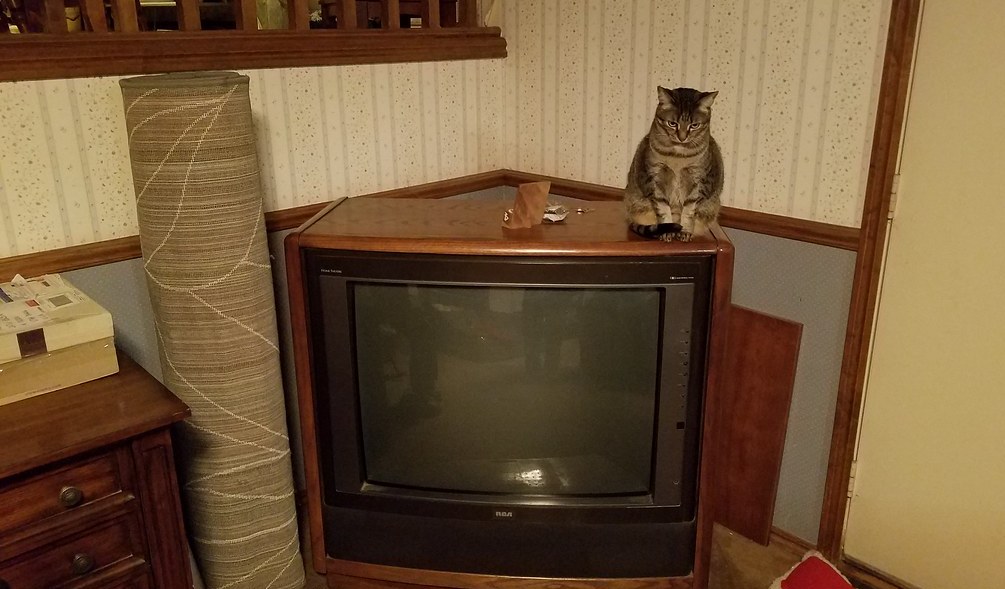
In her final chapter, Lynn Spigel discusses the after-life of these analog photographs, their media ecology, now digitized and circulating on the internet, on social media sites, and in virtual digital photo archives.  Photo sharing is seen as a form of social communication on sites like Flickr and Pinterest, but also a “big data business governed by corporate logics of viral marketing…” (p. 224). As social communication, they articulate nostalgia and memory for the individuals who post them, but they are also performative in the sense that posters are attempting to attract “likes.” A kitsch sensibility and retro aesthetics are now in play, when photographers produce new photographs that look like they are old, critically commenting on television and mid-century domestic culture. Richly illustrated with many close readings of individual snaps, Spigel’s TV Snapshots is a fascinating read for anyone interested in television culture.

306: Andrew Sarris

Archival Spaces 306

Andrew Sarris

Uploaded 14 October 2022

The Searchers (1956, John Ford)

It was fifty years ago that I first met Andrew Sarris as an undergraduate.  A film critic for The Village Voice, Sarris was the first reviewer I read regularly after becoming interested in film, even getting a subscription to the weekly paper, which also published Jonas Mekas’s weekly missives; another hero of mine. Sarris had been invited to speak at the University of Delaware by my first film professor, Gerald A. Barrett, who was also a follower of Sarris. It was also a pre-publication tour for The Primal Screen. More than just a critic, Sarris was the primary promulgator of the auteur theory in America and had already gotten into some famous spats with the likes of Pauline Kael. The auteur theory was Sarris’s interpretation of the politiques des auteurs, the critical effort of future French New Wave filmmakers, like François Truffaut and Jean-Luc Godard, to upgrade Hollywood commercial cinema and downgrade the French “cinema of quality” directors of the previous generation. After Sarris visited Newark, DE., on 17 October 1972, presenting a lecture and informally discussing his work with a small cadre of Barrett’s students, I published a piece on the visit in the University’s student newspaper, The Delaware Review,  where I had been writing my own reviews since February of the same year. Here is a reprint of that article:

“Andrew Sarris, the film critic for The Village Voice and the foremost American spokesman for the Auteur Theory of film, lectured on filmmaking and social trends and answered questions from a small but interested crowd during a Student Center Council sponsored appearance on campus Tuesday night.

After talking about his new book, The Primal Screen, Sarris spoke about filmmaking trends in the sixties. According to Sarris there developed after the death of John Kennedy a sense of absurdity, of gratuitousness in America. What became important was the existential now, because the future presented only a vision of the apocalypse.

The Last Movie (1971, Dennis Hopper)

Every film became the “last” film, packed with the essence of the universe in every shot. Films no longer served as vehicles of communication rather they became “heavy” artistic statements on the state of contemporary existence.

ALIENATION

The telephoto lens (as used in the last shots of The Graduate), showing movement without moving, became a characteristic film technique in the sixties.  The general alienation became apparent in the increasing fragmentation of film narratives and disjointed editing or jump-cutting.

The Graduate (1967, Mike Nichols) with Dustin Hoffman

The focus in cinema shifted to youth, in effect wiping out traditional age groupings. Thus, an actor like Dustin Hoffman (35 years) plays an adolescent, while Clint Eastwood (47) is a member of “Youth for Nixon.”

AUTEUR THEORY

When asked about “the Auteur Theory” in the discussion, Sarris gave a brief history of its conception. He went on to say that the Auteur Theory was basically designed to reevaluate the history of the American cinema and the neglected artists (directors) working within the Hollywood studio system

The “theory,” which was really only a set of tentative notes according to Sarris, stipulated that a director’s total output be considered and evaluated on the basis of thematic as well as stylistic continuities. 

MAJOR GENRES

Another premise of the theory was that such minor literary genres as the western became major genres by the very nature of the cinema. Thus, it was necessary to reconsider the work of such directors as John Ford, although his primary work was in westerns.

Finally, Sarris stated that directors such as Buster Keaton and Alfred Hitchcock were not great artists as individuals, but that their genius when working within the cinema, did, in fact, produce great art. Sarris explained that the mystical experience of film, cinema as a kind of fantasy, made it the most exciting form of art.

PAST WORK

On the level of practical application, Sarris justified the Auteur Theory as a method to make meaningful connections between a single film and the director’s past work. Sarris conceded however that this was of little value in evaluating the first film by a new director.

In his own weekly criticism, Sarris relies on his knowledge of film history, technique, and intuition. He also mentioned his own aesthetic bias against ambiguity and modernism in subject matter and classical montage in technique.”

Andrew Sarris (1928-2012)

Reading these lines fifty years later, I’m reminded how much I idolized Sarris at the time. BTW, I also loved reading Molly Haskell’s pioneering feminist criticism, she being Andrew’s spouse. I inhaled Sarris’s The American Cinema (1967), cover to cover, and entered into a whole new world of classic American cinema. My film education had only started two years before, so I knew virtually nothing about the richness of American cinema. I had had no idea who John Ford was. The Auteur Theory may have gotten some things wrong in terms of the way the studio system actually worked, but it served to organize the work of American film directors. It gave me a program for Hollywood research; it allowed me to begin to differentiate careers and thereby understand the ways the studio system actually worked.

The Auteur Theory engendered thousands of hours of discussion. Years later, when I was archive director in Munich, I met Pierre Rissient and became friends with him; besides being the eminence grise at Cannes, Pierre was a living, breathing auteurist. How many discussions about Sirk or Siodmak? I remember one time sitting with Pierre and another Frenchman, while they each tried to find the most obscure film by a director in Sarris’ “Far Side of Paradise.”

When I wrote the article, my career goal was to become a film critic, like Sarris. I never did become a working film reviewer, but Sarris did publish my first professional film review in the Voice exactly two years later in October 1974, when I wrote about Rainer Werner Fassbinder’s Ali – Fear Eats the Soul (1974), which I had seen at the Berlin Film Festival before its American premiere at the New York film festival.

Angst essen Seele /Fear Eats the Soul (1974, Rainer Werner Fassbinder)

305: Invaders from Mars

Archival Spaces 305

Invaders from Mars (1953) restored

Uploaded 30 September 2022

Invaders From Mars (1953) with Jimmy Hunt

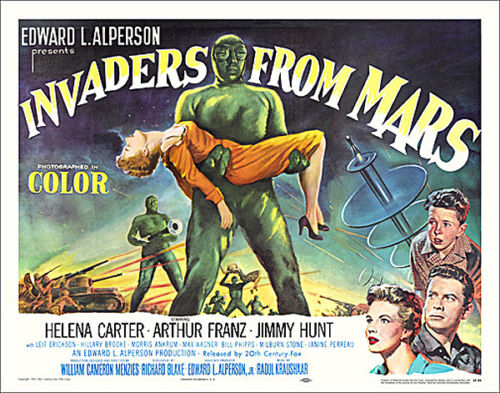
At the Cinecon Classic Film Festival in Los Angeles over Labor Day weekend, Scott MacQueen, the former head of film preservation at UCLA Film & Television Archive, presented his restoration of William Cameron Menzies’s Invaders from Mars (1953). MacQueen had previously introduced the film at this year’s Cinema Retrovato in Bologna.  Although a low-budget science fiction film in Cinecolor, the film had a huge impact on children in the 1950s, possibly because of the film’s threatening parents, influencing future filmmakers, like Steven Spielberg, John Sayles, John Landis, and Brad Bird. However, because the film was produced by Edward Alperson, who went bankrupt in 1956, the film’s elements were scattered to the wind. The restoration was further complicated by the fact that a European version with ten minutes of new footage and a different ending had been added a year after its original release. Apart from the European and American versions, a hybrid version was released in 1976.

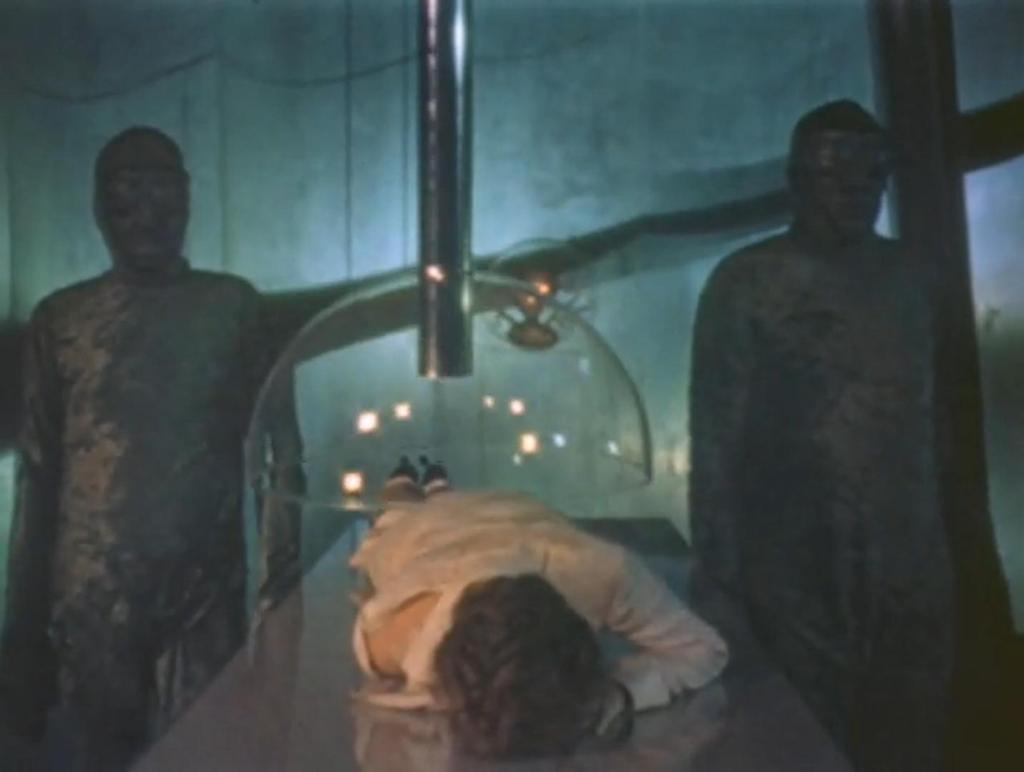
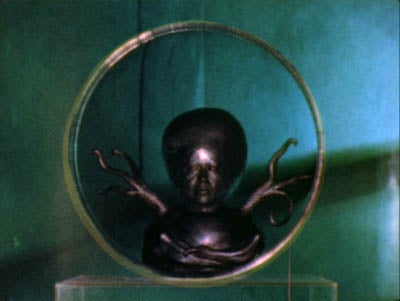
Invaders from Mars (1953) was directed by William Cameron Menzies, an art director of such classics as The Thief of Bagdad (1924) and Gone with the Wind (1939), who had occasionally directed films, like H.G. Well’s Things to Come (1934). Edward L. Alperson, who had worked as an independent B-film producer since the mid-1930s, financed the film, which starred Helena Carter, Arthur Franz, and Jimmy Hunt as the 10-year-old hero.  Made at the height of the flying saucer scare, the film theorizes that a Martian spaceship lands in America, kidnap Americans, and turns them into slaves by inserting a pin-sized receiver in their brain stem. The boy observes the flying saucer land but has trouble convincing any adults, including his own parents who soon turn against him because they are under the control of the aliens. Like other sci-fi films, including The Invasion of the Body Snatchers (1956), whose very title describes Invasion from Mars, the film metaphorically works through the dual traumas of a Communist infiltration – ordinary humans becoming malevolent social actors  –  and parental abandonment of children.

Scott MacQueen
Invasion From Mars (1953) with Jimmy Hunt

Invented in 1948, Super Cinecolor was a 3-color process, similar to Technicolor, but, rather than exposing three b+w negatives in camera with a beam splitter, Eastman color negative was used. While Technicolor created matrixes for color printing, Cinecolor generated b+w separation positives from the original camera negative (OCN), whose emulsions were impregnated with yellow dye. The sep pos’s were then toned cyan and red and step-printed on either side of duplitized Dupont film stock with an added cyan-colored soundtrack. The process was cheaper and utilized much less light than Technicolor (no beam splitter to diffuse light.), making it suitable for lower-budget producers.

Invaders from Mars (1953)
Invaders from Mars (1953) with Hillary Brooke

The process of restoration began more than ten years ago, when Jan Willem Boseman, the owner of Ignite Films, purchased the OCN from a laboratory. The restoration began in earnest in 2021 when MacQueen was brought in to manage the project, while Ignite combed the rest of the world for more material since the OCN was missing at least one reel. Further complicating the restoration was the fact that the Cinecolor process did not allow for process shots (dissolves, fade in-outs), which had to be produced separately, and were not cut into in the printing negative. Working at Roundabout in Los Angeles, the restoration team utilized the following elements: 1) The 35mm OCN from Ignite; 2) 2 35mm Cinecolor prints of the European version from the National Archives of Australia and George Eastman Museum, respectively; 3) 1 35mm print of domestic version; 1 35mm badly faded print of the 1976 reissue.

MacQueen’s restoration chart for The Invaders from Mars

Trying to produce a new restoration, means evaluating all the elements, and choosing the best material for different sections, once all the elements had been scanned and digitized. As MacQueen noted, the surviving prints have evidence of color fading and discoloration, and in some of the shadows what could only be described as solarization. Digital repairing these imperfections – one shot could only be found in the badly faded 1976 print –  as well as the usual splice lines, scratches, and tears further complicated the restoration.

Invasion from Mars (1953) with Hillary Brooke and Jimmy Hunt

Finally, philological decisions had to be made, e.g. whether to include the ten-minute scene in the observatory that had been added in 1954, in which Dr. Kelston explains to little David the work of astronomy, thus becoming a surrogate father after the real one turns evil. Then there is the issue of two different endings: a “happy” American end in which it all appears to be a little boy’s bad dream, and the much more threatening European finale, where the boy loses his parents. The blu-ray, released this week by Ignite Films, includes both endings as well as many other bonus features.     

Invasion from Mars (1953, William Cameron Menzies)

304: Salka Viertel Biography

Archival Spaces 304

Donna Rifkind’s The Sun and Her Stars

Uploaded 16 September 2022

Sergei Eisenstein and Salka Viertel, Santa Monica Beach, 1931

I first read Salka Viertel’s autobiography, The Kindness of Strangers (1969/2019) in the late 1970s, as I was writing my first piece on German-Jewish refugees in Hollywood, “The Palm Trees Were Gently Swaying. German Refugees from Hitler in Hollywood” (1980). The wife of the poet-filmmaker, Bertold Viertel, Salka was an accomplished scriptwriter, having worked on Queen Christiana (1933) and all subsequent Greta Garbo pictures. The first of only a handful of émigré autobiographies available at that time, her very literate book presented an insider’s view of Hollywood’s German-speaking community. I was therefore quite intrigued when I met Donna Rifkind at a conference last December and heard she had published a biography of Salka Viertel and her circle, The Sun and Her Stars. Salka Viertel and Hitler’s Exiles in the Golden Age of Hollywood (2020).

Rifkind opens her book by making the extremely important point that, for the most part, women have been written out of the histories of both classic Hollywood and German anti-Hitler intellectuals, in so far as they weren’t wives, secretaries, or movie stars; she does mention that has changed in the past decade with books on Charlotte Dieterle and Liesl Frank who organized the European Film Fund (2010), and a German biography of Salka Viertel (2007). However, refugee women scriptwriters Vicki Baum, Irmgard von Cube, Lilo Dammert, Lili van Hatvany, and Gina Kaus remain terra incognita, as do other women who worked behind the camera.

Bertold Viertel with Matheson Lang and Lydia Sherwood

In detailing Salka Viertel’s life, Rifkind focuses on three areas: 1.) Her marriages, lovers, and children; 2) Her professional struggles in the American studio system; 3) Her Sunday salons in Mayberry Road (Santa Monica) that brought together the crème de la crème of Germany’s literary exile. These three areas are however not mutually exclusive, – how could they be when women were still expected to manage a household, even if they worked? – but rather intertwined, so that people appear in different contexts. For example, Christopher Isherwood first met Bertold Viertel when both worked on Little Friend in England in 1934, then became a tenant in the Viertel’s garage, confident of Salka, friend to the Viertel children, and finally, he helped edit her autobiography.  

Rifkind does not proceed chronologically, rather opens in 1963, when Salka Viertel had been living in Klosters, Switzerland, trying to survive economically, and get her autobiography published, her Hollywood career long behind her. Rifkind pointedly  notes reactions to the manuscript: “Already the few who have read her drafts – all men – have blanched at every hint of woman mess, of love affairs and menstruation and childbirth. They insisted that she take it all out.” (p. 13) Indeed, Viertel was not only independent in her career, politically out-spoken and left-leaning but also sexually liberated, carrying on an open marriage, when America’s Puritans still condemned such licentiousness.  

Anna Christie, German Version (1930) , with Garbo and Viertel
Greta Garbo and Salka Viertel at Mayberry Road

Salka and Bertold Viertel had come to Hollywood from Berlin in 1928 on F.W. Murnau’s coattails, Bertold receiving a contract to direct at Fox. At 39 and 43, respectively, both had already entered middle age and hoped their temporary stay in America would help them straighten out their finances. But after four films, Viertel was out, moving to Warners in 1930, then Paramount, before making one film in Berlin in the first months of 1933, and ending his directing career in London in 1936. Salka, meanwhile, needing to pay bills, acted in several German-language films in Hollywood, including the German version of Anna Christie (1930) with Greta Garbo; the two became close friends, and lead to Viertel working on scripts for all subsequent Garbo films. Although she was able to purchase the house on Mayberry Rd., staying economically afloat remained a challenge throughout her Hollywood years and became critical after she was grey-listed by the FBI, which harassed her and her family for years. After the Nazis took control in Berlin, any return “home” was, of course, unthinkable.

Mayberry Road Garden
Dita Parlo, B. Viertel, Arnold Schoenberg, Thomas Viertel, Heinrich George, S. Viertel, 1930

With three kids to feed, a husband to support, an endless array of house guests, and Salka’s Sunday salons, there were a lot of expenses. As Rifkind notes: “Salka continued to feed the whole town for nothing in the comfort of her own home. Every Sunday her parties continued, along with frequent smaller gatherings during the week.” (p. 249) Viertel’s Mayberry Rd. Sunday Salon became a meeting point for German refugee intellectuals that soon rivaled Rahel Varnhagen’s Jewish salon in 19th Century Berlin. Sourcing Viertel’s letters, diaries, and autobiography, Rifkind lovingly details the comings and goings of Charles and Oona Chaplin, Thomas and Katia Mann, Heinrich Mann, Bertolt Brecht, Bruno and Liesel Frank, Alma and Franz Werfel, Garbo, Aldous Huxley, Christopher Isherwood, Lion and Marta Feuchtwanger, Max Reinhardt, Irwin Shaw, Sergei Eisenstein, Arnold Schoenberg, Otto Klemperer, Franz Waxman, Fred Zinnemann, and many, many others. Mayberry Road was usually the first stop for arriving Jewish Berliners and would remain so until 1947 when a back taxes bill forced Salka to move into the garage and rent the house to screenwriter Edward Chodorov.

Ernst Lubitsch, Gottfried Reinhardt on Design for Living set, 1933.
Christopher Isherwood (?), Salka Viertel, Gottfried Reinhardt at Mayberry Rd

Writing about Salka’s personal life, Rifkind is adamant that the persistent rumors of a love affair between Garbo and Salka were false. Bertold and Salka had taken lovers repeatedly after their marriage in Berlin in 1918. Beginning in 1933, she carried on a decade-long relationship with the son of Max Reinhardt, Gottfried, twenty-two years her junior, and a budding producer at MGM. Previously she had had an affair with a neighbor, screenwriter Oliver Garrett. Other lovers remained unnamed.  But Salka also lived for her three sons, worrying about their schooling, their careers, and their marriages, their father mostly absent; Peter became a successful screenwriter, and Hans a linguistic scholar after serving as an assistant to Max Reinhardt.

Donna Rifkind’s book thus presents an in-depth, fascinating, and well-written portrait of classical Hollywood and the German-Jewish film community in exile, especially its female members, and is indispensable reading for anyone interested in the subject.

Greta Garbo in Queen Christiana (1933)