311: Sirk-Fassbinder-Haynes

Archival Spaces 311

Douglas Sirk’s All I Desire (1953)

Uploaded 23 December 2022

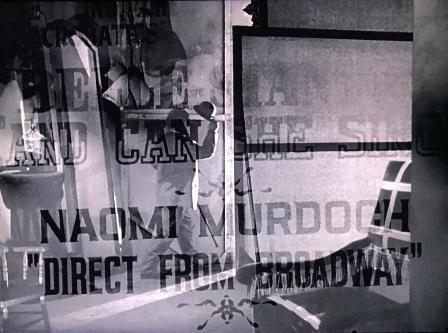
All I Desire, opening dissolve

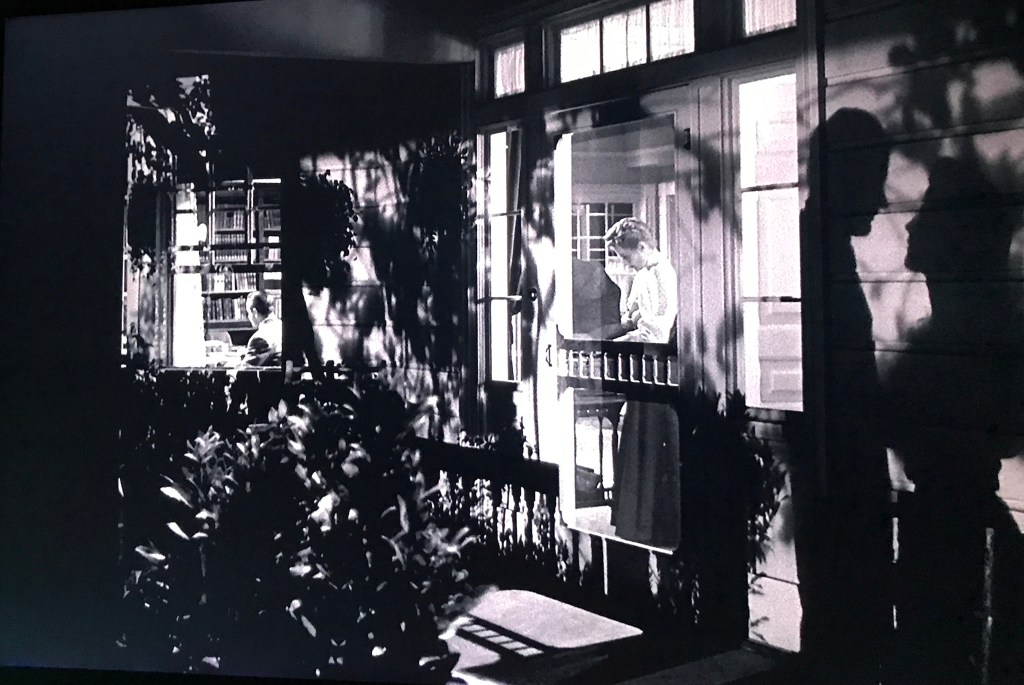
For the past couple of months I have been researching and planning a lecture course for UCLA, FTV 113 Film Authors, which will focus on the careers of Douglas Sirk, Rainer Werner Fassbinder, and Todd Haynes. Not only have all three specialized in melodramas, but Fassbinder and Haynes see themselves as heirs to the Sirk legacy, both directing quasi-remakes of Douglas Sirk’s All That Heaven Allows (1954), Fassbinder’s Fear Eats the Soul (1954) and Haynes‘ Far From Heaven (2002). It has been exciting to rediscover many of the Fassbinder and Sirk films I had previously seen, sometimes decades ago, but more exciting to see films by Sirk, Fassbinder, and Haynes in a comparative hall of mirrors, each marked by the times in which they were made,  each a product of a different decade, ethnicity and gender. One film I had previously not seen was Douglas Sirk’s All I Desire (1953), a black & white film that marks the beginning of Sirk’s famous series of melodramas, including Magnificent Obsession (1954), All That Heaven Allows (1955), Written on the Wind (1956), The Tarnished Angels (1957) and Imitation of Life (1959).

All I Desire stars Barbara Stanwyck who plays Naomi Murdoch, a less-than-successful actress who returns to her family in small-town America, the fictional Riverdale, Wisconsin after she had abandoned them a decade earlier. The film opens with a voice-over, during which Naomi comments on her failed stage career, which has sunk to the level of vaudeville, “not quite at the bottom of the bill.” When her daughter, Lily, invites Naomi back to see her in the Riverdale High School play, she spontaneously decides to return home. No sooner does she arrive at the local train station, when the town gossips start spreading their deadly poison so that all eyes are on Naomi when she shows up at the high school play. Her straight-laced, still husband, Henry Murdoch, the high school principal, and her oldest daughter, Joyce, are also hardly enthusiastic about her arrival, Henry now being in a relationship with schoolmarm, Sara Harper, and Joyce engaged to a “respectable” young man. Lily, on the other hand, hopes her mother will take her back to New York to become a famous actress. In the course of the narrative, we learn that Naomi had had a long affair with Dutch Heinemann, who Naomi ends up shooting when he tries to force himself on her after her return. Henry forgives her in a happy end that has Naomi receiving a house key.

Originally, Universal considered Joan Crawford and Bette Davis for the role of Naomi Murdoch but settled on Barbara Stanwyck because she was willing to work for “little or no salary,” being in desperate need of a comeback after her career went into decline in the early 1950s. Stanwyck was also not a big enough star anymore to justify Technicolor, which, according to Sirk, would have given the domestic scenes in All I Desire a warmth and glow, like his later domestic melodramas. Instead, Sirk and cameraman Carl Guthrie created an expressionist space of light/shadows and half-truths. The film was written by James Gunn and Robert Blees, based on an adaptation by Gina Kaus of Carol Brink’s 1951 novel, Stopover. Kaus was a German refugee who had been famous for writing feminist novels in Vienna and Berlin before Hitler, and who became a successful screenwriter in Hollywood, primarily at MGM.

In his famous interview with Jon Halliday,  Sirk on Sirk (1971), Sirk also complained that producer Ross Hunter had insisted on a happy ending, although Sirk wanted to retain the darker tone of the novel’s ending in which Naomi is forced to leave Wisconsin and her family behind. That ending and the original title, Stopover, “would have deepened the picture and the character – at the same time the irony,” he said. Sirk liked Barbara Stanwyck, because “in this picture, she had the unsentimental sadness of a broken life about her,” which perfectly contrasted with the cheerful hypocrisy of the people of Riverdale and the “rotten, decrepit middle-class American family she found there.’ Indeed, one can think of All I Desire as a film noir melodrama.

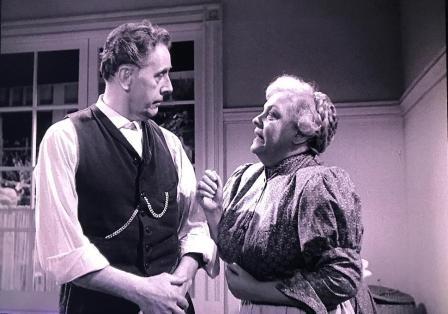
But my favorite characters in All I Desire are the German cook and houseman who have worked for the Murdoch family for decades; there is a running joke about the middle-aged couple getting married, but postponing at every family crisis. Lena and Hans were played by Lotte Stein and Fred Nurney who were both German refugees from Hitler, like Sirk himself; Nurney, in particular, had had bits and supporting roles in more than half a dozen Sirk films.

Mary (1931, Alfred Hitchcock)
Summer Storm (1944, Douglas Sirk)

Born in Berlin in 1894, Lotte Stein played supporting roles in thirty-five German silent and 12 sound films. She was a character actress even in her youth, given her face made for comedy. She appeared in From Morning to Midnight (1921), one of six bona fide German expressionist film classics. After a stopover in Vienna to make a film, Stein eventually emigrated to Hollywood. Like many German-Jewish refugee actors to Hollywood, Stein’s first American film work was in an anti-Nazi film, The Strange Death of Adolf Hitler (1943), after which she continued to appear in credited and uncredited film roles, often appearing as a cook or housekeeper, as in Wallflower (1948). She briefly returned to Germany in 1951, then re-emigrated to Munich after All I Desire, where she continued acting in film and theatre until her death in 1982.

The German-American actor, Fred Nurney, was born in Des Moines, IA in 1895 as Fredrich Nurnberger-Gelingk before he returned to Germany to act in theatre, while only appearing in one uncredited role in Fritz Lang’s M (1931). His first film in Hollywood was, like other émigré actors, an anti-Nazi film, Sirk’s Hitler’s Madman (1943), followed by further examples of the genre, They Came to Blow Up America (1943), Billy Wilder’s Five Graves to Cairo (1943), and Fred Zinnemann’s The Seventh Cross (1944). Playing Hollywood Nazis in postwar war films, as well as in the Sirk films sustained his career until his retirement in 1960. 

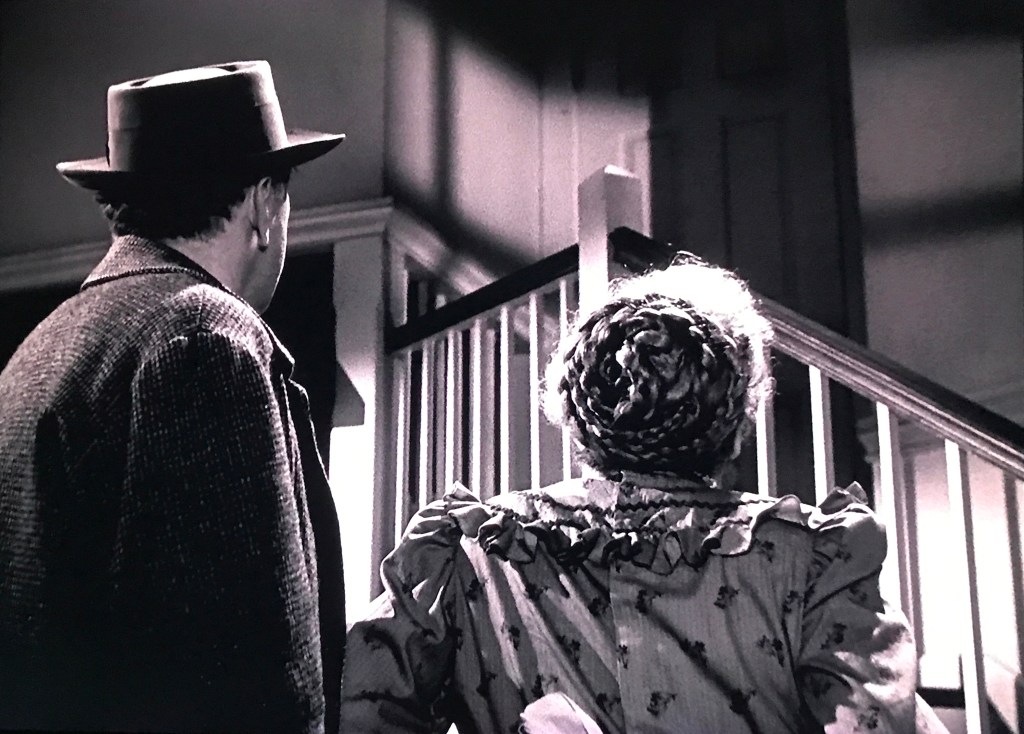
 Finally, if anyone doubts that Douglas Sirk was a master of expressionist lighting and not just color, one need only view All I Desire. Sirk had cameraman Carl Guthrie light the many night scenes like a film noir, another indication that Sirk still wished for a dark ending.

Barbara Stanwyck, Browning’s “How do I love thee, let me count the ways…

310: The DuPont Story

Archival Spaces 310

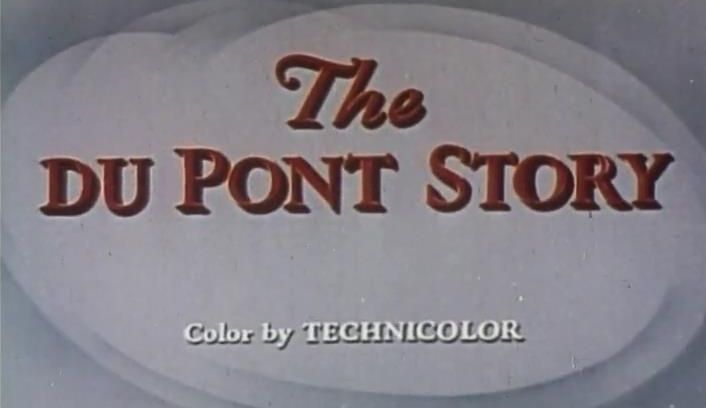
The DuPont Story (1950)

Uploaded 9 December 2022

With Senator Gerald Nye (R, ND) back in the news as an insurrectionist and anti-Semite, the political predecessor of Jim Jordan, I was reminded of his early 30’s project of blaming Jewish bankers and armaments manufacturers, like DuPont, for getting America into World War I.  I came across that story in my research on William Thiele’s feature-length industrial, The DuPont Story (1950).

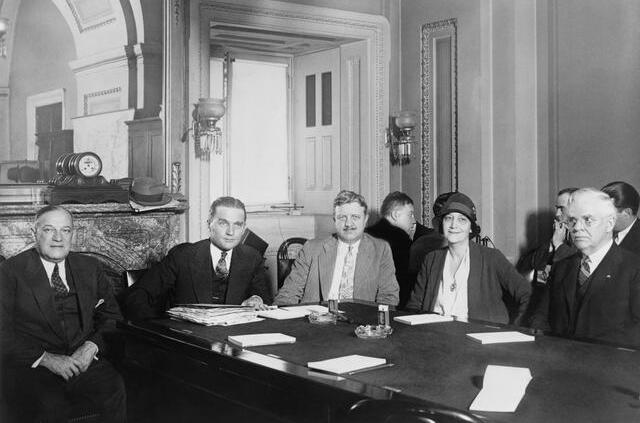
Nye Committee, 1930: Senators Wagner, Nye, Dill, Rep. McCormick, Sen. Deneen

DuPont started getting extremely bad press in the early 1930s because of persistent rumors about DuPont reaping vast profits during World War I, supplying half the world with gunpowder and explosives. “The Special Committee on Investigation of the Munitions Industry,” aka Nye Committee, under the chairmanship of Gerald Nye chased rumors of price fixing, war profiteering, and conspiring with the banks to stoke war fever in Senate Hearings, beginning in September 1934.  In fact, the production of explosives had increased from 8.4 million lbs. in 1914 to 544 million lbs in April 1917. Added to the negative ledger was the fact that DuPont also controlled General Motors which was subject to a major labor strike in 1936 that was settled in favor of the United Auto Workers. To counteract negative public images, DuPont began sponsorship of a weekly radio program, “The Cavalcade of America,” on 10 October 1935 on NBC Radio Network.  The DuPont Story was not only feature-length but also the most expensive industrial film produced up to that time.  

Muncie Star

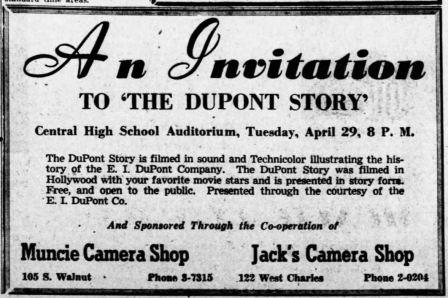
The DuPont Story (1950) was copyrighted on 15 December 1950 and shown at company headquarters in Wilmington, DE, as well as at over 100 DuPont plants and sales offices across the country in the Spring of 1951. The Exhibitor, a Hollywood trade journal called the film “documentary-type public relations,“ noting further that it would not be shown theatrically, but was „interesting and well done.“  In fact, theatrical screenings began a month later, The DuPont Story being screened twice daily over a three-week run in Philadelphia‘s WRVA, thus reaching a general public. Not only was admission free, but DuPont also paid for each customer attending, as stated when the film was projected in a Warner Brothers theatre in Reading, PA. Business Screen gave the film extensive coverage, commenting: “While it is true that no effort was made to drag every skeleton from Wilmington’s closet, the Family depicted is a pretty human lot, with some failings and a few false heroics.” The DuPont Story won a Freedom Foundation Award in 1952. It was listed in the Educational Film Guide (1953), available for free loan on 16mm, and is today accessible on YouTube.

Éleuthère Irénée DuPont

The film opens at a DuPont chemical plant in Waynesboro, VA., where the night shift is leaving and the day shift is going to work, the narrator explaining that the company operates 72 plants in 25 States, producing hundreds of products. The color film then flashes back to the company’s founding in 1803 on the banks of the Brandywine, where the recent French immigrant, Éleuthère Irénée DuPont, who had made gunpowder in France is convinced that there is a huge market for quality gunpowder in America. The company expands rapidly, thanks to the lower cost of American powder, now equal to European products, but an explosion in 1818 destroys 85,000 lbs. of powder, costing forty men lose their lives. Under the founder’s son, Alfred DuPont, the company expands, then brother Henry DuPont, “the General,” takes over the company, while his nephew, Lamont DuPont invents dynamite before blowing himself up.

Éleuthère Irénée DuPont (Edwardd Franz), Sophie Dupont (Sigrid Gurie)

As a sponsored film from the largest chemical company in the United States, The DuPont Story sought to project the image of a modern capitalist enterprise that took its civic responsibility seriously, creating products that improved the lives of Americans, while offering employment to tens of thousands. Private enterprise was highlighted early in the film when company founder, Éleuthère Irénée DuPont, visits President Thomas Jefferson, who tells him that he will need private investors since Americans do not believe in government handouts: ““We believe our citizens should take the risks and reap the rewards.” That civic duty extended to making the nation not only independent of European sources for gunpowder but also offering gunpowder at the lowest possible price to citizens engaged in the project of nation-building.

Coleman Dupont (Douglas Kennedy), Pierre S. DuPont (Stacy Keach, Sr.)
Dupont creates Nylon

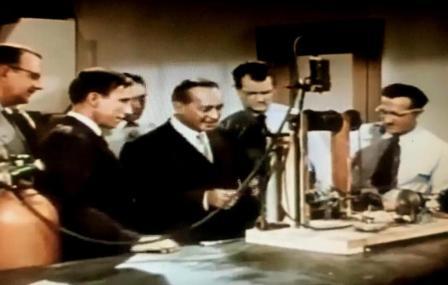
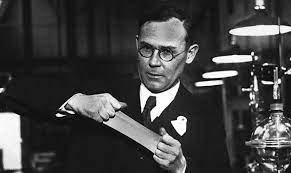
Given DuPont’s negative reputation for war profiteering during World War I, the film’s narrative of the 20th century deemphasized the production of explosives in favor of research and development of new products that fulfill the needs of the American consumer. As the DuPont Company notes on its website today: “The history of DuPont is a history of scientific and technological breakthroughs… to help people live safer, healthier lives.” Thus, the 20th century begins with the founding of a research facility and continues with a string of technological innovations, which are characterized as altruistic. In 1915, for example, the Company begins spending millions on the creation of new dyes, since America is cut off from high-quality European dyes, due to the war. In the 1920s, they invest further millions in creating fast-drying lacquer for automobiles, but the film fails to mention the company’s financial stake in the auto industry. The development of nylon for parachutes and other products is characterized by decades-long research into polymers by Dr. Wallace Carothers, while the company did its patriotic duty to the nation in World War II by supporting American defense, however without mentioning its involvement in the Manhattan Project to create a nuclear bomb.

Dr. Wallace Hume Carothers (Whit Bissel)
Dr. Wallace Hume Carothers

In its march through DuPont’s and white American history, the film featured a huge cast of Hollywood professionals who made each historical vignette credible, given that the brevity of every performance did not allow for audience identification. Here, one can see most clearly Thiele’s ability to cajole realistic performances through a few bold strokes. One wonders whether Thiele had casting rights since the production took pains to cast actors whose facial features strongly resembled known images of the DuPonts on screen, e.g. Grandon Rhodes who had already played President Jefferson in several films. Several actors had previously worked with Thiele, including Nana Bryant, Stanley Ridges, and Pierre Watkin, while David Bruce, Edward Franz, Stacy Keach, Sr., Douglas Kennedy, Walter Sande, Keith Richards, Grandon Rhodes, Lyle Talbot, Pierre Watkin and Whit Bissell, would also work with Thiele on the Cavalcade of America and The Lone Ranger series.

William Thiele who both directed and contributed to the script, structures the narrative as a series of dialogues between company leaders of various generations, illustrating significant moments in the company’s history. Despite major gaps in that history, Thiele avoids the pitfall of a boring parade of waxworks by focusing on technological development and the company’s investment in products known to the public. Thiele’s ability to extract believable performances from his actors in historical costume by featuring pithy dialogue that comes straight to the point, and an efficient mise-en-scene, make the film both entertaining and educational.

309: Art Cinemas in Crisis

Archival Spaces 309

Only in Theatres (2022)

Uploaded 25 November 2022

Laemmle Cinemas, Pasadena

There is a shot in the new documentary Only in Theatres of Greg Laemmle, the CEO of the storied Laemmle Theatres in Los Angeles, patiently putting up new lettering on the marquee, a cumbersome still analog process. The image is not only emblematic of Laemmle’s hands-on approach to running one of the oldest, continuously operating art house circuits in the country, but also his central role in this film. Raphael Sbarge’s Only in Theatres begins in the summer of 2019 when Laemmle announced that he was selling the family’s chain of nine theatres and 41 screens, only a year after they had broken ground on new cinemas in Newhall and Asuza, CA. The business was off 30%, due to new streaming channels, so the family was losing money. This is a film about the crisis in film exhibition, even before the COVID-pandemic generated an even deeper crisis. That the film ends on a hopeful note is a testament to the cinephilia of Greg Laemmle and his audience.

Sigmund Laemmle with sons Kurt and Max
Carl Laemmle (Center) with Max Laemmle, 1928
Max Laemmle

Carl Laemmle who had founded the Universal Film Co. in 1912, ran the studio until his removal in 1936, after which the diminutive film pioneer focused on helping his relatives and many others to get out of Nazi Germany. Among those refugees were his brother Sigmund Siegfried Laemmle and his two sons, Max and Kurt. Kurt was the first to get into the film exhibition business, purchasing the Ritz Theatre in Lowell, IN. in 1935 (sold in 1942). Max Laemmle, who had run Universal’s Paris operations arrived in L.A. in 1938, after which the Laemmle brothers opened the Franklin cinema in Highland Park, just north of downtown Los Angeles. The business eventually grew to include five neighborhood movie theaters. However, television in the late 1950s caused the chain to shrink to a single cinema, the Los Feliz Theatre, and the departure of Kurt Laemmle. In the 1960s, Max Laemmle’s son, Robert Laemmle joined the company, and the chain began specializing in art films, foreign films, and other independents. In the 1970s and the 1990s, the Laemmles expanded to include locations in Pasadena, Westwood, Santa Monica, the San Fernando Valley, and downtown Los Angeles.

Frankin Cinema, Los Felz
Laemmle Royale, former Tivoli, West L.A.

In 1988, Gregory Laemmle joined the company, bringing a third generation of the Laemmle family to the operation, while Robert remained the nominal owner. Greg opened the Sunset 5 in 1992 and the Laemmle Pasadena in 1999, the former the most successful new art house in the country.  By the time Greg offered the chain for sale, it owned Claremont 5, the Fine Arts center on Wilshire Blvd., The Glendale, The Santa Monica Film Center, the Music Hall, the Noho 7 in North Hollywood, The Playhouse 7 in Pasadena, the Royal on Santa Monica, and the Town Center 5 in Encino, CA. While The Sunset was sold to Sundance in 2012, the Fine Arts was abandoned in October 2019, and the Pasadena cinemas were sold to the Landmark chain in May 2020.

Robert Laemmle, 2013
Robert and Greg Laemmle

In Only in Theatres, numerous filmmakers and critics attest to the incredible influence the Laemmle cinemas have had on the film culture in Los Angeles, bringing European art films and American independents to a city that only supported the product of the commercial studios. Among those interviewed are Ava DuVernay and Alison Anders, both of whom credited the Laemmle’s with their becoming filmmakers, film critics Leonard Maltin, Kenneth Turan, Kevin Thomas, and film historians Michael Renov and Ross Melnick, all of whom attest that the Laemmle Theatres enriched the film landscape by taking financial risks on films that were not necessarily box office blockbusters.  

The documentary returns repeatedly to Greg Laemmle and his wife, Trisha, who nervously await offers in fall 2019, obsessing about their finances, and Trisha worrying that Greg was ruining his health, due to the strain of operating the theatres without the help of their three sons, who had no interest in taking over the business. Greg mentions over and over the pressure of the family legacy to support art cinema and serve a community in danger of completely disappearing. Finally, on Christmas Eve at a traditional screening of Fiddler on the Roof (1971), Greg Laemmle announced that the family would not sell the chain. Then the pandemic hit and everything shut down. In order to keep going, Laemmle divested some of the properties, but also eventually had to sell his L.A. home, moving to Seattle in January 2021. Finally, in April 2021, the theatres reopened, including the new Laemmle Newhall. Greg Laemmle noted that the chain was in a good position and ready to grow again. Seldom has a film about a film exhibitor been as intensely personal struggle as Only in Theatres; we witness Greg Laemmle’s anguish and suffer with him.

Only in Theatres opened on 18 November in Laemmle’s cinemas, after a sneak preview on the 13th at the Laemmle Royale, co-hosted by Hilary Helllstein and the L.A. Jewish Film festival. Like art cinema exhibitors Dan Talbot, Walter Reade, Don Rugoff in New York, the Laemmle’s belong to a rare breed of film showmen who are not just about the money, but about loving movies.    

Marquee, Laemmle Cinema, Newhall

308: Maddow’s “Ultra”

Archival Spaces 308

Rachel Maddow’s Ultra Podcast

Uploaded 11 November 2022

The Confessions of a Nazi Spy (1939, Anatole Litvak)

I’ve been listening to Rachel Maddow’s podcast, “Ultra,” narrativising the activities of home-grown American Fascists in the immediate pre-World War II period who openly supported and even carried out terror acts for the Nazi government of Adolf Hitler. The podcast has reminded me of “The Fifth Column” chapter in my dissertation, Anti-Nazi-Films in Hollywood, which analyzed Confessions of a Nazi Spy (1939, dir. Anatole Litvak), among other films. The term 5th column had been coined during the Spanish Civil War to explain how Franco’s Fascists had conquered Madrid with four military columns from the outside and a fifth column from inside. While some contemporary critics maintained that Hollywood’s anti-Nazi-Films were crude propaganda, their visualization of Nazi activity was not exaggerated; Maddow’s “Ultra” demonstrates that the threat of a white nationalist, anti-Semitic cabal in America was much greater than any Hollywood screenwriter could ever have imagined. Maddow could have started her podcast with the back story to Confessions.

The Confessions of a Nazi Spy was based on an actual trial in October 1938 of members of the German-American Bund in New York, the Hamburg-America shipping Line, and the German Embassy in Washington, D.C. The pro-Nazi German American Bund, organized into fifty-five chapters around the country, staged huge rallies at Madison Square Garden and elsewhere, where funds were collected for the Reich. However, of the 18 accused conspirators, only four were found guilty, while the American press seems to have treated the case rather lightly, grossly underestimating the threat. Warner Brothers began working on a film, even before the trial ended, even though the German Consul tried to stop the production and cast members were threatened with death by native rightwingers. The film, starring Edward G. Robinson as FBI investigator Leon G. Turrou and Francis Lederer as the German-American spy, opened on 28 April 1939 and caused a sensation. The film cleverly melds a spy story with both real and staged footage of Nazi Party activities in Yorkville; a prologue was added for the 1940 rerelease, consisting of newsreel footage of the Nazi Blitzkrieg. Unlike the real trial, Litvak’s film chose a happy end with the conspirators behind bars and American Democracy saved. At the box office, the film fared poorly. Nevertheless, Hollywood had made a film that was overtly political, explicitly partisan for American Democracy, and against the influence of Nazism or its American base. American critics complained that it was overly propagandistic. Like the journalists covering the trial, film critics remained complacent to radical right-wing activity in America. Once World War II began five months after the film’s opening, attitudes would begin to change in the USA.

Senator Lundeen Making America Great (1940)

Rachel Maddow’s “Ultra” podcast begins with the plane crash of Minnesota Senator Ernest Lundeen on 31 August 1940, who had been working closely with and getting paid by Nazi agent George Sylvester Viereck to keep America out of the war in Europe, even writing Lundeen’s speeches for him. On her website, Maddow reproduces one of those speeches: “The leaders of the movement to get us into war, employ falsehoods as their most deadly weapon… Thus an entirely false picture is created in the mind of the American public, as if Hitler actually threatened to descend on the United States.” But it wasn’t just speeches by isolationist senators, like Burton Wheeler and Gerald Nye that were a threat, it was actual violence.

The Brooklyn Boys of the Christian Front
Father Charles E. Coughlin, an anti-Semitic Catholic Radio Demigod

In the next podcast, Maddow reveals the plans of Father Charles E. Coughlin’s Christian Front to create a militia armed with military-grade machine guns to overthrow the government and bomb Jewish and “communist” businesses. Eighteen members were arrested in January 1940, but again the Justice Department bungled the case so that 9 of 13 defendants were acquitted and a mistrial declared for the rest. It would take the government four more years to put together another case against the Christian Front. The trial opened in April 1944 with sheer pandemonium in the Court, what with initially 30 accused and 22 separate defense teams all screaming at once. But that prosecution, too, would explode. But I get ahead of Rachel.

The Ruins of the Hercules Powder Plant in Kevil, N.J.
William Dudley Pelley and his Silver Shirts

While episode 3 begins with a terrible act of right-wing sabotage at a Hercules Powder Plant in Kenvil, N.J. on 12 September 1942, killing 52 and injuring 125, and destroying 30 buildings, it mostly concerns the efforts of a private citizen, Leon Lewis. An L.A.-based Jewish lawyer, Lewis in 1933 began documenting subversive activities by American white nationalist groups in Los Angeles, like William Dudley Pelley’s Silver Shirts (Silver Legion of America). When he went to the law, the L.A. Police sat on their hands, stating they saw no threat. On 12 November 1942, three more munitions factories were blown up, killing 16 more people, but no one was ever arrested in the aftermath of either act, even though the FBI had evidence of involvement by pro-Nazi groups.

German American Bund Rally in Madison Square Garden, 1939.
Senator Burton Wheeler and Charles A. Lindbergh

Episode 4 takes up the story of Ernest Lundeen again, showing the way Lundeen and numerous other members of Congress supported the Nazi cause by forming the America First Committee. Nazi agent  George Sylvester Viereck actually paid dozens of members of Congress to send millions of pieces of Nazi Propaganda, printed and paid with taxpayer dollars, through Congress’s free mail service. While the Justice Department named a special prosecutor, William Power Maloney, to investigate Viereck and members of Congress, including Rep. Hamilton Fish (NY) who had willingly misappropriated government funds for Nazi propaganda but Burton K. Wheeler and other America First’ers used their influence to get Maloney fired and shut down the investigation after a grand jury had convened.   

Hamilton Fish III
George Sylvester Viereck
Senator Gerald Nye

But Justice did not close down the investigation, it hired a new special prosecutor, John Rogge who widened the investigation, and gave it focus, indicting the Christian Front insurrectionists for sedition (although Congressmen were spared); they had conspired to overthrow the government by undermining the armed forces in time of war. That four-year prosecution ended in a mistrial when the trial’s verbal violence literally may have killed the judge.

Maybe in future episodes, Rachel Maddow will reveal why the U.S. government has consistently failed prosecutions of right-wing terrorists, but been so successful at prosecuting leftists?  Hopefully, she will also reveal why the present crop of seditious Trump insurrectionists in Congress have avoided prosecution or even real scrutiny.

America First Rally in Madison Square Garden, 1941
Donald Trump’s MAGA base saluting the Fuehrer