384:  Friedrich P. Kahlenberg

Archival Spaces 384:

Remembering Bundesarchiv President Friedrich P. Kahlenberg

Uploaded 17 October 2025

Autosave-File vom d-lab2/3 der AgfaPhoto GmbH

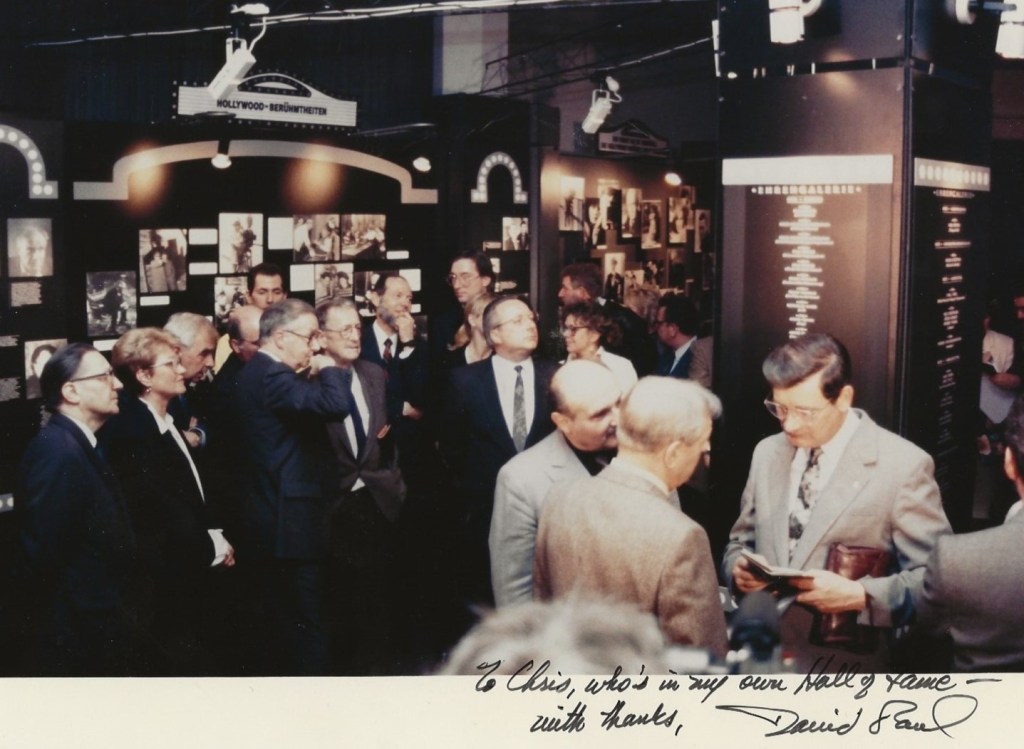
Prof. Dr. Friedrich P. Kahlenberg would have celebrated his 90th birthday in twelve days. Born on 29 October 1935 in Mainz, where the Main and Rhine Rivers run together, Kahlenberg was one of my most important mentors, the person responsible more than any other for my film history and archive career on two continents. I only realized that fact when I recently looked over the more than 40+ letters we exchanged between 1976 and 1985, a period when I was trying to find my place in the film archive world, while also completing a PhD. His official letters were typed (no computers yet), but his more personal letters were hand-written in a beautiful cursive, the longest of which was six pages, sent from his country house in Schönecker Mühle, a hamlet in the northern corner of the Hunsrück Mountains, made famous by Edgar Reitz’s monumental Heimat TV series. We last met face to face in the late 1990s in Munich, when I had become Director of the Munich Filmmuseum and he was President of the Federal German Archives; at a time he was preoccupied with the legacy of terror, represented by the East German STASI (Secret Police) Archives, which included files on 6.8 million GDR Germans in 69 miles of running documents.  

Federal German Archives, Koblenz, Germany
Fortress Ehrenbreitstein, home of Bundesarchiv Filmarchiv in 1970s

Friedrich P. Kahlenberg completed his PhD. in history in June 1962 at the University of Mainz with a dissertation on the military policies of the Electors of Mainz in the 17th and 18th centuries and immediately thereafter became an intern at the Federal German Archives in Koblenz, finishing his archive studies in March 1964.  He entered public service at the Bundesarchiv in Division II (Government documents), becoming its chief in 1965. Four years later, he joined the Bundesarchiv’s administrative unit (Referat II 1), where he was responsible for capital planning. In January 1973, Kahlenberg was named head of Division III (non-paper materials), which included the film archive. That same year, at his behest, the film archive became a member of FIAF (Fédération Internationale des Archives du Film). He guided the fortunes of the film archive for 12 years, expanding its international reputation and making the preservation of Germany’s national film patrimony a priority for the first time in the institution’s history. Transferring to Division I (Central) in 1985, Kahlenberg was appointed President of the Bundesarchiv in June 1989, a point at which it was not yet clear that he would be responsible, beginning in October 1990, for the integration into the Bundesarchiv of the State Archives of the GDR, including the Staatliches Filmarchiv DDR, the giant STASI archives, and later the Berlin Document Center (the Archives of the Third Reich). He retired in November 1999, having achieved the monumental task of creating a functioning archival system for Germany. Meanwhile, Kahlenberg also taught history at the University of Mannheim for more than 25 years. He died in Boppard on the Rhine on 16 July 2014.

Bundesarchiv’s Public Death Notice
Festschrift, Droste Verlag, 2000

Kahlenberg’s first official letter to me is dated 1 Nov. 1976, when he expressed his regret that there were at present no open positions in the Bundesarchiv Filmarchiv, and that film archive positions were extremely scarce throughout Germany. A handwritten letter followed only six weeks later, after I had reported that I was interviewing for a position at the University of Munich. We met in Koblenz the following Summer, at which time I was able to tour the film archive, while we discussed my applying for various PhD. programs.  Days later, Kahlenberg wrote letters of recommendation to the Professors Knilli (Berlin), Reimers (Munich), and Lerg (Münster), also procuring for me an invitation to the founding conference of the International Association of Audio-Visual Media and History (IAMHIST), which Reimers was hosting in September 1977, and which Kahlenberg also attended. Those letters resulted not only in my acceptance as a doctoral candidate with Prof. Winfried B. Lerg but also in a close association with IAMHIST after presenting a paper there. Several more letters followed in Autumn 1977, including a note that Kahlenberg had discussed my PhD. proposal for a history of German-Jewish film exiles in Hollywood with Karsten Witte, the well-known critic and Kracauer editor, who would later become a friend, giving me indirect international recognition when he reviewed the 1981 Venice Biennale conference, “Berlin-Vienna-Hollywood.” Kahlenberg’s academic interests were many, but the history of the Third Reich and the fate of German exiles interested him in particular.

Meanwhile, in March 1978, just as I was moving to Münster, Kahlenberg recommended me to the editor of Der Archivar, a quarterly journal of all German archives, where I then published an article on the state of American film archives; my first in German. Several more letters followed in which Kahlenberg discussed the feasibility of my applying for a lower-level position in the film archive, a position which, to his regret, he was forced to fill internally with a non-film specialist. Finally, in Spring 1979, an Assistant’s position opened up, but Kahlenberg expressed his regrets after I applied that I was ineligible because I was an American citizen; he had assumed I was German. The position went to Karl Griep, who became a friend.

In 1980-81, Kahlenberg recommended me to two film production companies as a film researcher: Bernhard Frankfurter’s Austrian TV film, On the Road to Hollywood (1982), allowed me to travel to New York for my film exile research, as well as do contract work. and Edgar Reitz’s prize-winning television series, Heimat (1984); I visited the set and conducted research at the Bundesarchiv for documentary clips inserted into the film. I also visited him in Koblenz in May 1980, where we discussed the outline of my dissertation, a proposal my thesis advisor had already seen in March.

Avodah /Work (1935, Helmar Lerski)

In 1982-83, our correspondence intensified again, because I had discovered in the course of my curation of an exhibit on the German-Jewish photographer filmmaker Helmar Lerski what I thought was a lost film. Avodah/Work had turned up in a laboratory in Budapest, so I asked Kahlenberg to request the material and preserve the film, which he gladly did. Unfortunately, the material turned out to be merely outtakes, and it would take another ten years for a print to be discovered in London. Other letters concerned bibliographic and research suggestions for my dissertation, which I was able to report had finally been completed in December 1983.

16 February 1989 opening of the exhibition “40 Years Federal Republic” with German President Richard von Weizsäcker, Chancellor Helmut Kohl, and Friedrich P. Kahlenberg. Photo: Bundesarchiv, B 145 Bild-F080833-0016 / Engelbert Reineke

As noted in a letter in December 1984, Kahlenberg was extremely happy that I had landed a job as Associate Curator at George Eastman Museum, announcing in the same letter that he had been asked to move out of the film archive into the Federal Archives directorate. His subsequent personal letters were filled with the many problems he was encountering in managing an unwieldy bureaucracy, and understandably became ever less frequent, although we heard about each other through Karl Griep, who had become Kahlenberg’s successor. Given his exalted position in the Federal German Archives, I’m still surprised and unbelievably grateful that he took a young American student under his wing.

Administration of GDR State Archives visiting Bundesarchiv, 7 May 1990: Mr. Hebig, Dr. Siegfried Bütttner, Prof.Dr. Kluge, Prof.Dr. Friedrich Kahlenberg, Dr. Günther Herzog. Photo: BArch, B 198 Bild-00596

383:  Weimar Comedies

Archival Spaces 383:

Four German Comedies (1931-32) Blu-Ray

Uploaded 3 October 2025

Proletarian back alley singers in Ich bei Tag und Du bei Nacht (1932, Ludwig Berger)

Flicker Alley has released a two-disc blu-ray set, “Champagne & Caviar: Four Weimar Comedies (1931-1932),” which for all the many merits of the presentation, is somewhat of a misnomer. Produced during the depths of the world-wide Depression, these are not frothy Hollywood comedies in the style of Ernst Lubitsch, taking place in the upper classes of New York or Ruritania, but rather are focused on the impoverished and mostly desperate German middle and working classes, attempting merely to survive through their wit, graft or chutzpah, while Hitler’s fascist regime is clearly visible on the horizon.

Renate Müller in Die Privatsekretärin (1931, Wilhalm Thiele)
Müller and Felix Bressart in Die Privatsekretärin

The opening salvo is fired by Wilhelm Thiele whose comedy, The Private Secretary (1931), stars Renate Müller (Vilma) as an unabashed gold digger, hoping to marry wealthy. She turns down an offer to sleep with a mere employee, telling him she doesn’t want to stay in the typing pool forever, then latches unwittingly onto the firm’s director (Hermann Thimig), who says of her after she refuses to become his mistress: “A crafty character who knows exactly what she wants.” Helping her reach her goal is the delightful Hasel – translates as Bunny – (Felix Bressart), whose singing and dancing to Thiele’s leitmotifs provide comedy relief, and who convinces the reluctant Villma to marry with the line: “Think of the Happy End.” That self-reflexive conclusion is buttressed by multiple exposures in close-up of pining young women in Vilma’s boarding house, representing the film’s female audience. “The little shop girls,” as siegfried Kracauer called them in a late 1920s essay. The film was simultaneously shot in a French version and proved so popular that it was immediately remade in Britain and Italy.

Kathy von Nagy, Willy Fritsch in Ichbei Tag und du bei Nacht (1932, Ludwig Berger)

Ludwig Berger’s I by Day and You by Night (1932) not only visualizes the plight of the working poor but also consciously parodies Hollywood’s operatic fluff. Grete (Kathy von Nagy) is a manicurist and Walter (Willy Fritsch) a waiter, who unbeknownst to the other share a bed, one by day, the other by night, but have never crossed paths. They meet on town and fall in love, both claiming to be wealthy, while hiding their working-class origins and their occupations as wage slaves. Berger frames their story with scenes in a movie theatre, inserting an on-screen film operetta produced by the Bombast Film Co.  – the singer Ursula van Diem looks just like Lubitsch’s Jeanette MacDonald – introduced and commented in a heavy Berlin dialect by the working-class film projectionist. The film-within-a-film scenes are preceded by fireworks, again creating a self-reflexive moment, while the working-class love story outside the cinema is contrasted with the unrealistic narrative among the upper crust on screen.

Heinz Rühmann, Max Pallenberg in Der brave Sünder (1931, Fritz Kortner)
Pallenberg, Rose Poindexter in Der brave Sünder

The petit bourgeoisie and their philistine morality are the subject of Frtiz Kortner’s The Upright Sinner, a biting comedy written by Vienna’s premier satirist, Alfred Polgar.  “Head cashier Pichler” – the Austrian mania for job titles lives here – played by Max Pallenberg in his only sound film role, doesn’t want his daughter to work, even though he can barely support his family.  Pichler and Wittek, the latter sweet on Pichler’s daughter (Dolly Haas), are sent to Vienna with 6,000 Schilling to give to the company’s CEO. They lose the money in a night of drunken revelry and are seduced by an African American jazz singer, but fate comes to their rescue when the CEO absconds with even more of the company’s money. Pallenberg plays the bumbling fool, misunderstanding and misspeaking his way through the proceedings, while Heinz Rühmann as Wittek embodies “the little man” character he would make his own in dozens of subsequent Nazi German films. Kortner enlivens the story with many expressionist techniques, including introducing animal sounds for human characters and creating a drunken dream sequence in which angels and locomotives are transformed into monstrous projections of the ego.  After worrying that he will go to prison, Pichler complains when he is only made a temporary company director.  Kortner, who would be forced into exile by the Nazis and was vilified in the Nazi-infested Federal Republic af his return, delivers his poison-pen letter to the German middle class here, fully aware of their racism and mendacity, which will result in Hitler’s fascism.

Ludwig Stössel in Die Koffer des Herrn O.F. (1931, Alxei Granowsky)
Hedy Kiesler (Lamarr) in Die Koffer des Herrn O.F.

Like Alexei Granowsky’s previous film, The Song of Life (1930), an avant-garde musical with only a bare semblance of narrative, The Trunks of Mr. O.F. (1931) is a musical comedy, structured as an endless cabaret show, visualizing an economic boom that transforms a sleepy country village into a bustling metropolis, an illusion of promise during the depths of the Depression. According to the opening song, it is a “fairy tale” for adults, with much of what follows tongue-in-cheek. Thirteen suitcases arrive in a rural village where pigs still roam freely in the square and the hamlet’s motto is:  “Better two steps backward than one forward in haste.” The mysterious suitcases unleash a tidal wave of speculation about their absent billionaire owner, leading to massive modernization, unbridled financial investment, and rapid urbanization, as the town’s mayor (Alfred Abel), a journalist (Peter Lorre), and an architect (Harald Paulsen) keep the rumors flying that the owner will invest millions. Granowsky cleverly intercuts footage of huge building projects and stock market mania with musical nightclub numbers, fashion shows, and the rising wealth of the townspeople. A world economic conference also meets in the new Ostend, but after more than a 1000 sessions, is unable to discover the origin of Ostend’s boom; meanwhile, no one even remembers the 13 suitcases that started it all. Near the end, we learn, the baggage was actually destined for Ostende, the wealthy Belgian seaside resort, not the “dark spot” on the map called Ostend.

What sets all of these comedies/musicals apart from American films is the way they disrupt viewer identification, incorporating patently unrealistic and dream sequences which satirically comment on comedic narratives involving the mostly petit bourgeois pretensions of their protagonists. One of the joys of these films, is seeing a number of German actors who in exile would have prominent careers in Hollywood in mostly character parts, including Hedy Lamarr (Algiers, 1938), Peter Lorre (The Maltese Falcon, 1941), Dolly Haas (I Confess, 1953), Felix Bressart (To Be or Not to Be, 1942), and Ludwig Stossel (The Pride of the Yankees, 1942). All four films feature audio commentaries by well-known German film scholars, as well as a beautifully produced souvenir booklet.

Projectionist Friedrich Gnaß in Ich bei Tag und du bei Nacht

382: Abraham Ravett

382: Abraham Ravett

Archival Spaces 382: Abraham Ravett Films in Berlin

Uploaded 19 September 2025

Łódź:22592 (2019, Abraham Ravett)

I’ve known independent filmmaker Abraham Ravett for 35 years. We met when he came to Rochester in 1990 to screen his late Hampshire College colleague, Tom Joslin’s Blackstar: Autobiography of a Close Friend (1976), one of the first films about everyday gay life. Abraham and I became friends and have kept in touch over the years, our friendship cemented by the fact that we are both sons of concentration camp survivors, whose fathers were silent. Recently, Abraham wrote to me that his films be screened in Berlin, a selection of four experimental films he has made over the years, ostensibly about his family, and the family he might have had, were it not for the Holocaust. The films will screen on 30 September at the Zeughauskino in the German Historical Museum on Unter den Linden Strasse.

Toncia and Fela Ravett

There is a mysterious image of young girls carrying chairs over their heads, obscuring their faces, that is repeated several times in Abraham Ravett’s Half Sister (1985), a shot we learn at the film’s end was taken by a Nazi cameraman in the Warsaw ghetto. Like a second image from the same source of girls exiting a door, possibly a school, it is a stand-in for Ravett’s half-sister, Toncia, who perished in the Holocaust. Abraham’s mom describes the moment her daughter was taken from her in May 1944, one of a few sound sequences in the film. But like the other films in the program, Half Sister is about absence, loss, and silence. We see modern footage of a woman at various stages in her life, implying the life Toncia may have led, but also a field burning, symbolizing the chimneys at Auschwitz. Most of the images, whether negative, out-of-focus, or flash frames, do not reveal their meaning; they are too disconnected to create coherence, just as the loss of a child and a would-be sister defies comprehension.

Łódź: 22592 (2019, Abraham Ravett)

Łódź:22592  explores the Jewish ghetto in what the Germans called Litzmannstadt in the years 1941-1944, as captured by the Jewish photographer, Henryk Ross (1910-1991).  Ross, who worked for the Nazis but was Jewish, buried the negatives in 1944, then recovered ca. 3,000 of them after the war. The collection was eventually purchased by the Art Gallery of Ontario, which published the book, Memory Unearthed. The Łódź Ghetto Photographs of Henryk Ross (2015). Ravett begins the film by placing a copy of the catalogue on a table, and then reproducing images from the book, while noting in a title, he wishes he could see images of his father, first wife, and their two children. The film is thus a search for traces of his family in their last known place of residence. It is a film about the trauma of loss, of fragments of memory and images which will never again create a whole. Ravett utilizes long takes to explore Ross’s black and white photographs of everyday ghetto life under Nazi occupation, children, street scenes, work in factories, family gatherings, the subjects often looking directly into the camera. Ravett also intercuts images of ghetto postage stamps and other public documents. The film is almost completely silent, except for snippets of ambient sound and a color image of Łódź today, its past invisible. There follows a live action shot of Abraham’s father later in life, talking but without sound. As I know from Abraham, Ravett’s father never revealed the secrets of his Holocaust survival; the end title tells us the film is dedicated to ר׆׆   חװק (Chaim Rawet). One image shows a portrait of a Jewish woman with the negative number 22592 clearly visible. Ravett highlights the number in his title. Could this be an image of his father’s first wife, who perished in the Holocaust? The film’s silence indicates that neither the filmmaker nor we shall ever know.

Notes on a Polish Jew (2012, Abraham Ravett)

Ravett’s obsessive (and seemingly futile) search for his father story is given abstract form in Notes for a Polish Jew (2012), an experimental film, created with an optical printer. The silent film opens with a freeze frame of a typical Communist era food shop in Łódź, then a brief image of a man walking through the frame who could be Abraham’s dad, but is not, because as he tells us in a description of the film “If his father had lived beyond the age of seventy-four, the following may have been the cinematic response to the city….” But the image is fleeting, the footage abstracted by slippages in the projector, flash frames, black and colored leader, scratches, sprocket holes, upside down footage, discolored frames, a Goofy cartoon. Shot in color in the 1980s, we see glimpses of ordinary Poles and an open air marketplace, but they reveal nothing of the present or the terrible past. The film ends as it begins with a man walking throught he frame, a circular narrative into a void.

One Flower (2023, Abraham Ravett)

If Łódź:22592 revisits the filmmaker’s relationship to his father, One flower (2023) is a recent film about his mother, who has been the subject of numerous previous films, including The March (1999), Lunch with Fela (2005), and Trepches (2009). At its center is a grainy photograph of a women, her head and face obscured by decomposition, the only photo his mother managed to carry from Poland to Israel and then to America. We never learn who is seen, but we read that, like Abraham’s father, her mother had a family that perished in the Holocaust. Ravett obsessively asks questions he can’t answer. Maybe that is the real message of the Holocaust. Silences dominate the film, just as the fragments of images and documents, whether a large family portrait with grandmother, grandfather and mom, passports of his parents, Abraham’s youthful sketches of his parents, unidentified images of black & white country landscapes, . children in a kibbutz or grocery lists, raise more questions than they answer. But asking those questions is itself an act of mourning and memorialization.

P.S. The Zeughaus Cinema has moved temporarily into the Pei-Bau on Hinter dem Glasshaus 3, just off Unter den Linden.

One Flower (2023,, Abraham Ravett)

381:  Tamara

Archival Spaces 381: 

Identifying Silent Film Actors

Uploaded 5 September 2025

Ein Sommernachtstraum (1925, Hans Neumann) with Tamara, Charlotte Ander

Identifying film actors who are not listed in the credits or misidentified can be a tricky business, because available filmographic resources are not always accurate and comparing images can be deceiving. I ran into this problem a number of years ago, when I helped Northeast Historic Film identify an unknown biblical epic that had been distributed in America as The Fall of Jerusalem, but turned out to be Jeramias (1923, Eugen Illés), a German film. IMDB is often not completely reliable because it is a user-generated site that depends on input and corrections from the public. I encountered both filmographic inaccuracy and photo identification issues recently again, but, as in the case of Jeramias, both issues were solved through the concerted effort of a number of international film scholars and collectors, including Jean Ritsema, Ivo Blom, Johan Delbecke, and Werner Mohr.

Tamara, Guido Seeber, Production shot A Midsummer Night’s Dream
Star Postcard

The story begins when Michigan collector Jean Ritsema contacted me in early July about identifying a postcard for “Tamara Karsavina” (Traldi 863, Ross Image Archive) from the German collector Werner Mohr, which they believed might be a shot of the character of Oberon in the German film, A Midsummer Night’s Dream (1925). I had written about that film (https://archivalspaces.com/2023/08/04/327-a-midsummer-nights-dream/) and had misidentified Oberon as Tamara Geva, as had the San Francisco Silent Film Festival and other sources. Ritsema stated that the Russian ballerina was probably still in Russia when the film was made, and also noted that she looked very similar to Tamara Tolstoi in The Joyless Street (1925), which I had restored at the Munich Filmmuseum. She also sent me a 1925 interview with Tamara (no last name) from the German fan magazine Filmland (No. 8, June 1925), which included a photo recognizable as the actress “Tamra Tolstoi,” playing Lia Leid in The Joyless Street. According to the interview, Tamara had started her career with Friedrich Zelnik in a film later identified as Eugen Onegin (1919), where she used the pseudonym Thea Pellard. Next, Ritsema sent me a link from a Belgian postcard collector, Johan Delbecke,  to an “Erna Thiele” webpage by Stephanie D’heil (www.steffi-line.de), suggesting that Dorothea Elise Alma Gertrud Thiele, an actress prominent in the mid-1910s in Germany (Homunculus, 1916), may have used various pseudonyms, including Renée Pelar, Thea Pellard, and Tamara. After her retirement from the screen, she married the Swiss painter, Peter Voltz, and became a painter herself, Tamara Voltz.  I responded that it was strange that in the Tamara interview, she had not mentioned her earlier German career. The photo of Erna Thiele on the webpage also looked very unlike the dark-haired, “Russian” beauty of Lia Leid.

Over the next weeks, we both attempted to research Tamara Geva and Tamara Tolstoi. Geva, as Ritsema noted, apparently made two films for UFA, but was only in Berlin a couple of months before moving on to Paris with her husband, George Balanchine. None of the films credited on IMDb to Geva were produced by UFA, but Gräffin Plattmamsell (1926) was distributed by UFA. Was this Geva or Tamara, or Thiele? Through continued research, I realized that Countess Tolstoi credited in the Joyless Street was actually the daughter of Leo Tolstoi, and was on a lecture tour through Europe in 1925, but was about 60 years old and played Valeska Gert’s brothel assistant. At the Munich Filmmuseum, we had credited Tamara Tolstoi as Lia Leid, but now I was no longer sure since no German version credits of the film had survived.  On the other hand, a contemporary reviewer had eroneously listed Lia Leid as Countess Tolstoi.  We also followed up on a lead from Ivo Blom that a Countess Tolstoi had appeared in La Petite Marchand d’Allumettes (1928) as a woman with a dog, again obviously the older Countess.

Dorothea Thiele’s birth certificate
Tamara Voltz 1970s

Ritsema had contacted Blom, a well-known Dutch film historian and specialist in Italian Cinema, to research the Italian films mentioned by Tamara in her interview. Blom consulted Vittorio Martinelli’s Il cinema muto italiano, Vol. 1920 and discovered that Renée Pelar had indeed starred in several Italian films in the early 1920s, including Liberazione (1920) and La donna del mare (1922). So Renée Pelar was another pseudonym for Tamara, but was she also Erna Thiele? The Erna Thiele website had also named a source as documentation for her later marriage to Voltz, so Ritsema looked up the book on WorldCat and found that a copy was housed at the UCLA Library. I ordered the book, Alfred A. Häsler’s Außenseiter-Innenseiter, 28 Porträts aus der Schweiz (1983). A chapter in the book on the Swiss painter, Tamara Voltz, confirmed that she had been born in Berlin on 23 March 1896 and spent much of her life in Locarno, Switzerland; she died in Klosters on 4 August 1985. So we thought Dorothea Thiele was indeed Erna Thiele, but also Thea Pellard, Renée Pelar, and Tamara in her fractured film career.

But in a final twist, Jean Ritsema wrote to me on the day the first version of this blog was published that Erna Thiele and Dorothea Thiele are two different actresses; the former was born in St. Petersburg on 6 May 1895 as Erna Josephine Thiele. Her filmography has now been corrected on IMDb. We still don’t know what Tamara Geva’s only possible German film credit was.

Tamara in The Joyless Street (1925, G.W. Pabst)