351: Isaac Julien @ Whitney Biennial

Archival Spaces 351

Film/Whitney Biennial

Uploaded 12 July 2024

I last viewed the Whitney Biennial more than ten years ago, when the Whitney Museum was still located in the Breuer Building on Madison Ave.. However, in 2017 I reviewed the Whitney exhibition, Dreamlands: Immersive Cinema and Art, 1905–2016(Archival Spaces 200 https://www.cinema.ucla.edu/blogs/archival-spaces/2016/11/25/dreamlands-immersive-cinema), the museum now located in the former meatpacking district on the lower Westside. Now in its 81st iteration, the Whiney Biennial “showcases the most relevant art and ideas of our time.” It has often been the center of intense political controversy for its sexism (1987), lack of diversity (1991, 2014), and its connections to arms manufacturers (2019). Organized by curators Chrissie Illes, Meg Onli, Min Sun Jeon, and Beatriz Cifuentes, this year’s Biennial offered both abstract and highly political art by mostly artists of color and also included numerous film/video installations. According to a wall text, “The Biennial is a gathering of artists who explore the permeability of the relationships between mind and body, the fluidity of identity, and the growing precariousness of the natural and constructed worlds.” Interestingly, many of the film/video installations featured works of feature-length, presenting a challenge to visitors unable to spend a whole day in the show.

Diane Severin Nguyen’s In Her Time (Iris’s Version, 2023-24), is a 67-minute meditation on the Japanese massacre of Chinese civilians in Nanjing in 1927, recreating historical scenes, intercut with abstract footage and fan fiction, as well as footage of film extras at the giant Hengdian World Studios, near Jinhua, China. The scenes of the massacre make no attempt at realism but rather feature the artist’s camera roaming around a static tableau of bloodied civilians. Further distancing the viewer from the historical reality of 1937, an actress comments on the making of the work with her own iPhone footage.

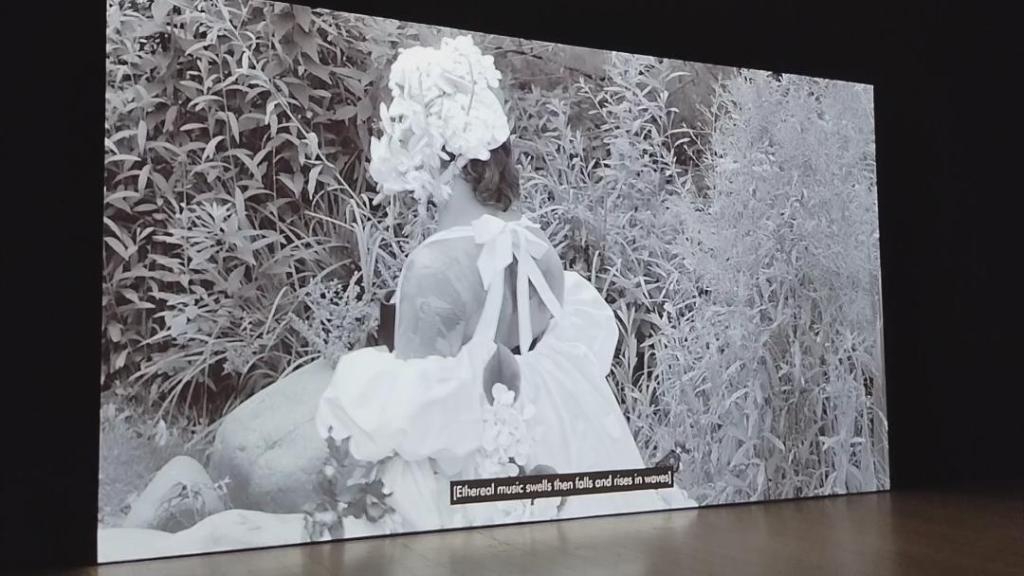
With Pollinator (2022), African-American artist, Tourmaline (formerly known as Reina Gossett), memorializes the Black trans activist and performance artist, Marsha P. Johnson (1945-2022).In the five-minute video, the artist in a white floral dress and elaborate headdress, walks through a garden (B&W), throws flowers into the river (color), and intercuts footage of Johnson’s funeral procession, while her late father, George Gossett, sings “The Cisco Kid” to the artist behind the camera, thereby reminding audiences of the profound legacy of Johnson for the LBGTQIA community.

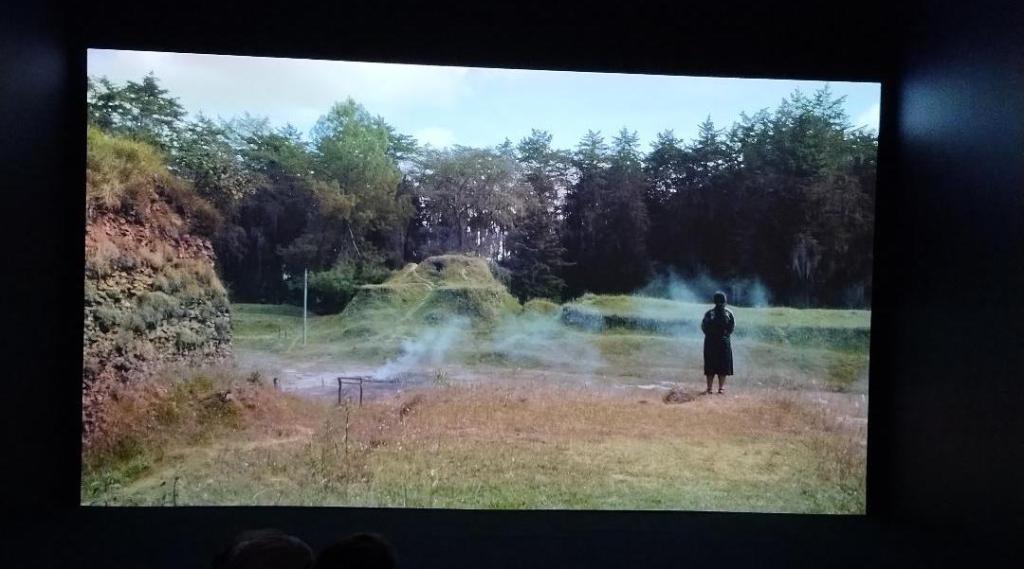
In Antes de que los volcanes canten/Before the Volcanoes sing (2022), Clarissa Tossin’s 64-minute 4K video, the artist explores the archaeological remnants of Mayan civilization in Guatamala and classical Mayan hieroglyphs in stark white-on black, as well as the appropriation of Mayan architecture by western civilization in Frank Lloyd Wright’s John Snowden House in Los Angeles. The work also presents soundscapes and music (utilizing replicas of pre-Columbian wind instruments), poems, and songs by Rosa Chávez, Tohil Fidel Brito Bernal, and Alethia Lozano Birrueta. The 4K images of nature give the footage a hyperreal feeling, conveying an intense sense of oneness with nature, a unity broken by modern civilization.

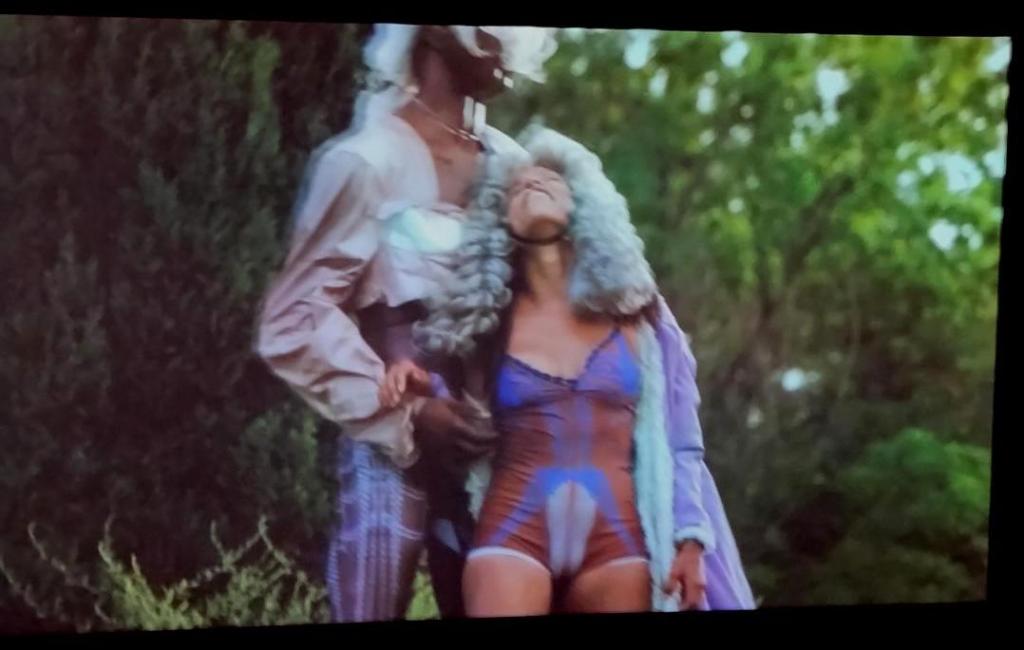
San Domingo-born artist Ligia Lewis based her 20-minute video, A Plot, A Scandal (2022) on her own dance performance piece of the same name. Filmed among the ordered rows of Rimini’s cypress trees (Italy), the artist recites 18th-century laws governing the keeping and maintenance of slaves as property, noting that even children born to slave-freeman couples were considered slaves. The landscape becomes a metaphor for civilization’s attempt to bend nature to its will. Dressing her dancers in historical costumes, while weaving together political and mythical narratives, Lewis catalogues the historical crimes of European white civilization against non-white peoples, as well as the continued dispossession of “Europe’s Others.”

Once Again… (Statues Never Die)

The most interesting installation is Isaac Julien’s 31-minute, multi-screen piece, Once Again… (Statues Never Die), commissioned by the Barnes Foundation in 2022. Coincidently, it can be seen as a pendant to Julien’s Lessons of the Hour (2019), presently viewable uptown at the Museum of Modern Art. While the MOMA show deconstructs the history of American racism in images and texts of the abolitionist Frederick Douglass, the later installation analyses traditional art history’s racist presuppositions about what it has termed “primitive” African art. The British documentary filmmaker is, of course, most well known for his feature films, Looking for Langston (1989), Young Soul Rebels (1991), and Baadasssss Cinema (2002), all of which explore Black art and culture.

Once Again… (Statues Never Die)

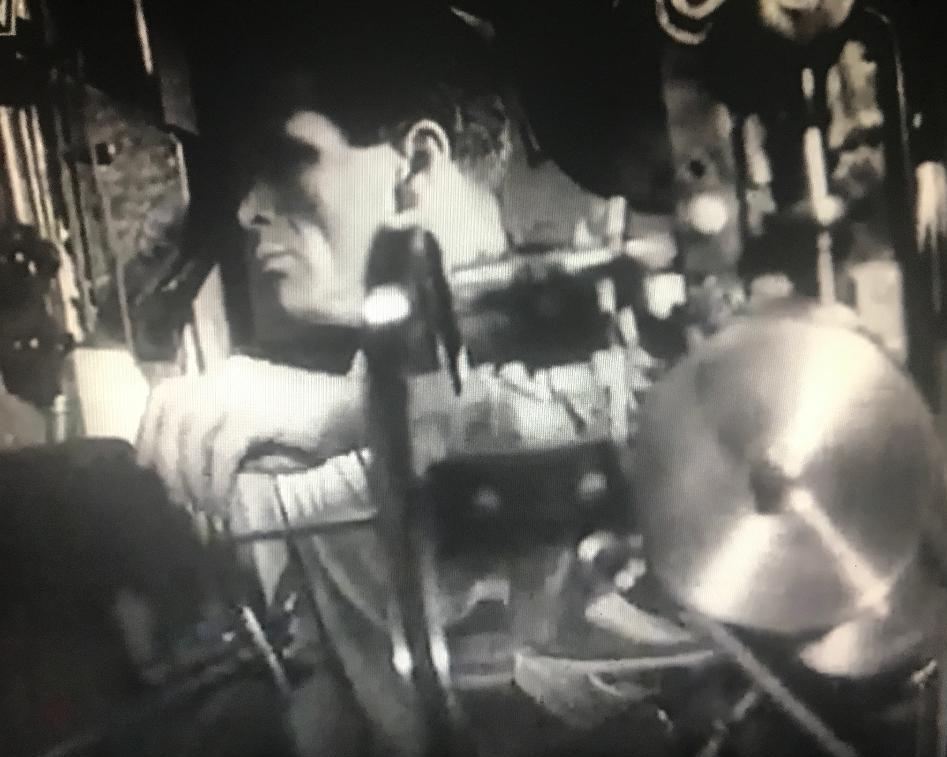
In Once Again… Julien reflects on the work of Harlem Renaissance philosopher and critic Alain Locke (1885-1954), played by André Holland, who is seen wandering through exhibitions of African art, contrasted to Albert C. Barnes, played by Danny Huston, who appears among the high western art of the Barness Collection in Philadelphia. Decrying art history’s pejorative labels, Locke advocated embracing African art, to reclaim a Black cultural heritage. Making the connection to modern African-American art, Julien also intercuts modern sculptures by Richmond Barthé (played by Devon Terrell) and Angelo Harrison. Visually, Julien juxtaposes the architecture of the respective exhibitions, again revealing cultural bias: African art is treated as an object of folklore for anthropology in display cases, thus denying it any status as art, while of course western art is valorized as “the true and beautiful.” The work ends with singer Alice Smith, walking down the steps of the Barnes Foundation, celebrating Black art through the blues.

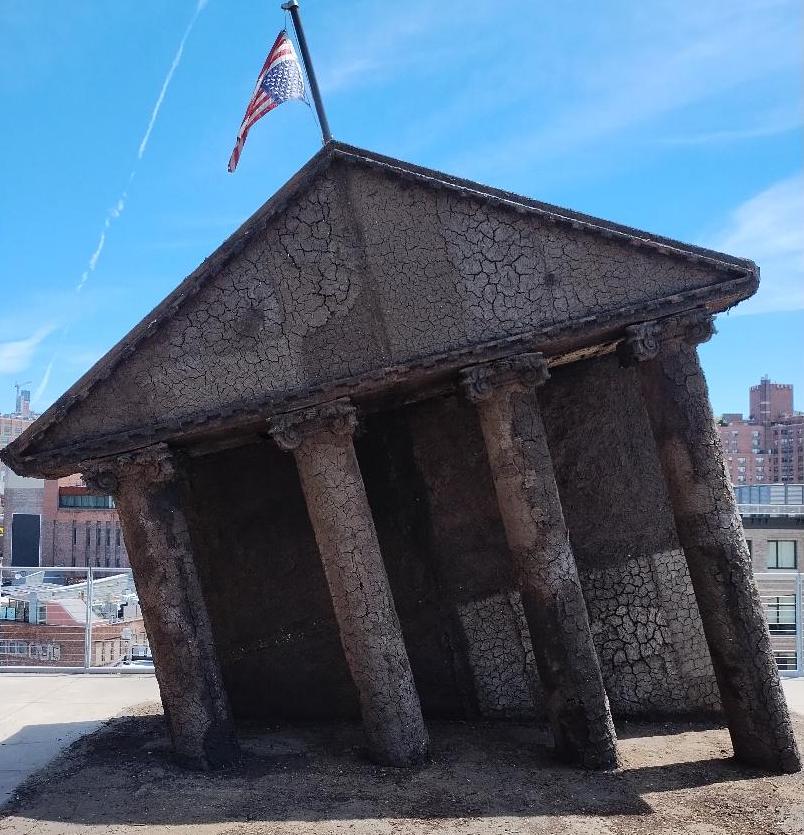
Kiyan Williams: Ruins of Empire II or The Earth Swallows the Master’s House (2024)

Given Kiyan Williams sculpture near the entrance to the exhibition, this Witney Biennial explicitly pushes back against white nationalist Republican Party efforts to outlaw diversity, sexual and gender equality, and inclusion.

Once Again… (Statues Never Die)

350: Spanish Hollywood

Archival Spaces 350

Spanish-Language Cinema Hollywood, 1929-39

Uploaded 28 June 2024

Back in 2017, I organized a major Getty-funded exhibition, Recuerdos de un cine en español: Latin American Cinema in Los Angeles, 1930-1960,” with the help of my co-curators, Maria Elena de las Carreras, Colin Gunkel, and Alejandra Espasande-Bouza, which presented forty-one films from Hollywood, Mexico, Argentina, Cuba, and Puerto Rico; almost all of them had been screened in L.A. first run theatres at the time of their release.  We programmed the films at the Hammer and the Downtown Independent, the last physical remains of a circuit of cinemas, catering to Latinx audiences. Augmenting UCLA’s exhibition catalog were two book publications, Cinema Between Latin America and Los Angeles. Origins to 1960 (2019), and Hollywood Goes Latin. Spanish-Language Filmmaking in Los Angeles (2019). Alejandra Espasande-Bouza’s important essay appeared in the second volume but also contributed valuable ideas to the curatorial team, especially her expertise in Cuban cinema. She has now organized a wall exhibit, Hablada en Español. The Legacy of Hollywood’s Spanish-Language Cinema (1929-1939) is on view for only three more days at L.A.’s  Pico House, one of the few original structures in the heart of what was once the thriving Mexican community up and down Main Street.

Carlos Gardel, Rosita Moreno in El día que me quieras 

 Last week, I received an invitation to attend a screening of the restored version of Carlos Gardel’s  El día que me quieras (1935), his second to last film before tragically dying in a mid-air plane over Medellin, Columbia. It was the third program, after screenings earlier in the month of the Spanish-language Drácula (1931) and The Spanish Dancer (1923).  Maria Elena de las Carreras introduced the film, which was screened in a side gallery of the exhibit. Afterward, Maria Elena, Alejandra, and I participated in a Q & A. followed by a live Tango singer performing, while visitors roamed through the exhibit.    

As Espasande-Bouza notes in her introductory text: “The materials on exhibition bear witness to a cinema on the brink of extinction that was once a daily staple of the vibrant movie-going experience enjoyed by Angelenos throughout the 1930s.” She further notes that of the approximately 180 Spanish-language films produced in Hollywood by the majors and studio independents, less than 10% exist in film archives, and only 2% are available on electronic media. Through posters, film stills, production shots, fan magazines, and film star portraits, this exhibition brings back to historical consciousness a cinema perdu, an American cinema in Spanish, produced for the sizable domestic market, all of Latin America, and Spain. Spanish Hollywood’s material culture, at least that which survives, despite its worldwide circulation, its artifacts in many cases represent the sole visual record of a film. It is a plea for preservation and accessibility.

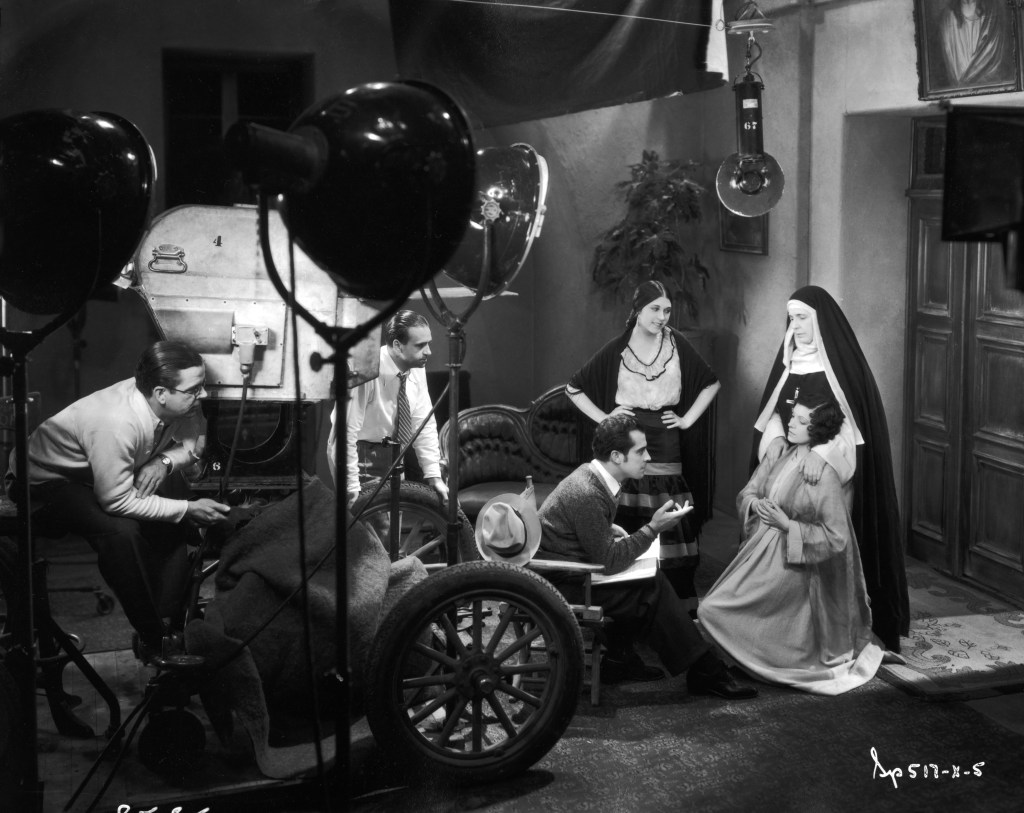
Gardel is represented in Hablada en Español with a video monitor screening clips of his singing performances in Asi Cantaba Carlos Gardel, as well as in photo portraits. However, the most interesting exhibition pieces are of lost films. For Example, the production crew and cast photo of Dos Noches (1933, Carlos Borocosque) . a Spanish=Language version of the B-film Mayfair Studio production,  Revenge of Monte Carlo (1933, B. “Breezy” Reaves Eason), starring Spanish film star José Crespo in both versions, while popular Conchita Montenegro, another star from Spain, played in the Spanish version, June Collyer taking her role in the English version. Montenegro is also represented with a cover image from the Madrid-based fan magazine, Cinegramas (1934-38). Both versions were produced by Fanchon Royer Pictures, controlled by female producer Fanchon Royer. The Chilean film director, Carlos Borocosque, who directed mostly Spanish language versions for Metro-Goldwyn-Mayer, before moving to Argentina, where his work helped establish the Argentine film industry, was not only responsible for Dos Noches but also an important correspondent for Latin American fan magazines; he is represented in the exhibition by an official studio portrait.

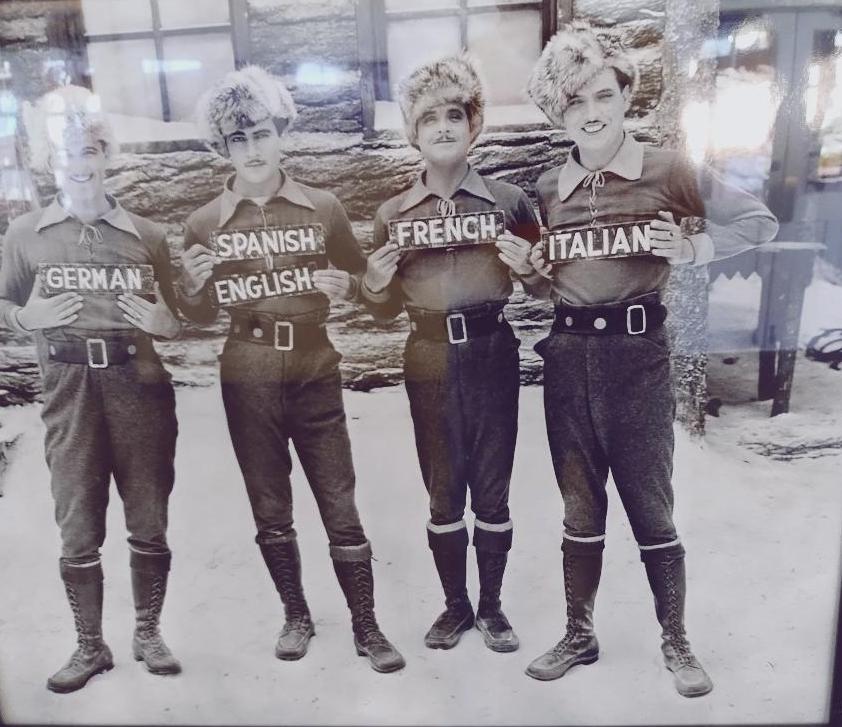
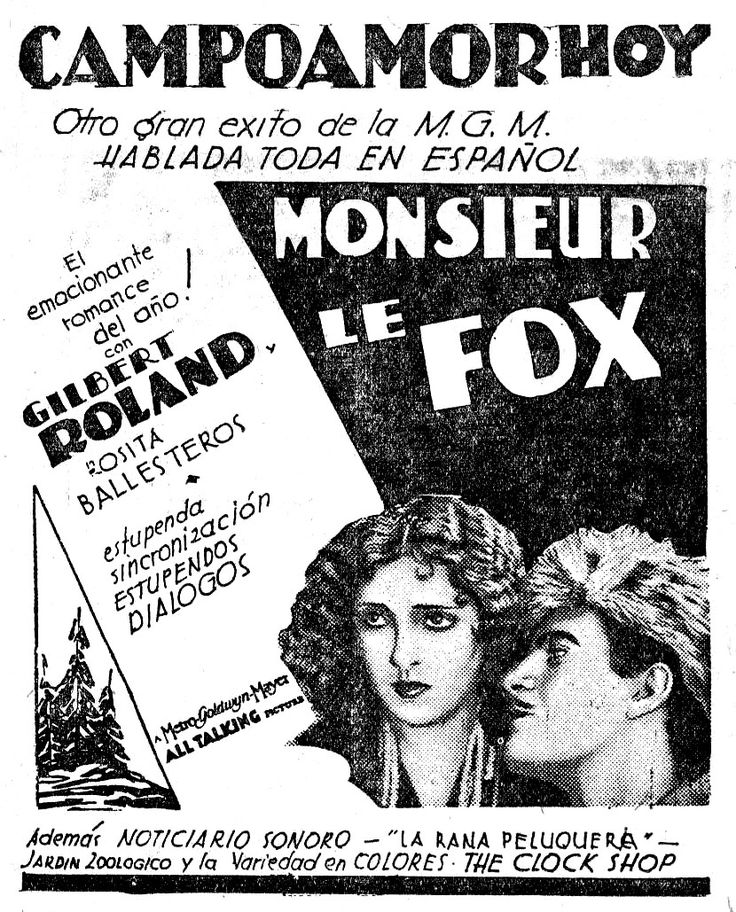
Another great photograph depicts in costume the four actors, playing Louis le Bey aka Monsieur le Fox in five different language versions of Hal Roach Studio’s Men of the North/Monsieur Le Fox (1930): in German with John Reinhardt, in Spanish and English with Gilbert Roland, in French with Anré Luguet, and in Italian with Franco Corsaro. Except for the English version, none of the other versions unfortunately survive. Indeed, the survival rate of various language versions, produced by Hollywood is dismal.   

The most famous Spanish-language version of a Hollywood film is, of course, Drácula (1930), starring Carlos Villarias in the Bela Lugosi role. With Lupita Tovar, Drácula en espagñol is sexier than the American version but its present popularity and circulation on DVD is the result of a film restoration in the 1990s by Bob Gitt at UCLA. The exhibition’s lead image is of Villarias, a second photo later is complemented by an extremely rare booklet, Spanish Casting Directory, published in February 1931, which was probably instrumental in finding actors for the Universal production. Tovar, BTW, lived to be 106 years old and is the grandmother of film directors Paul and Chris Weitz.

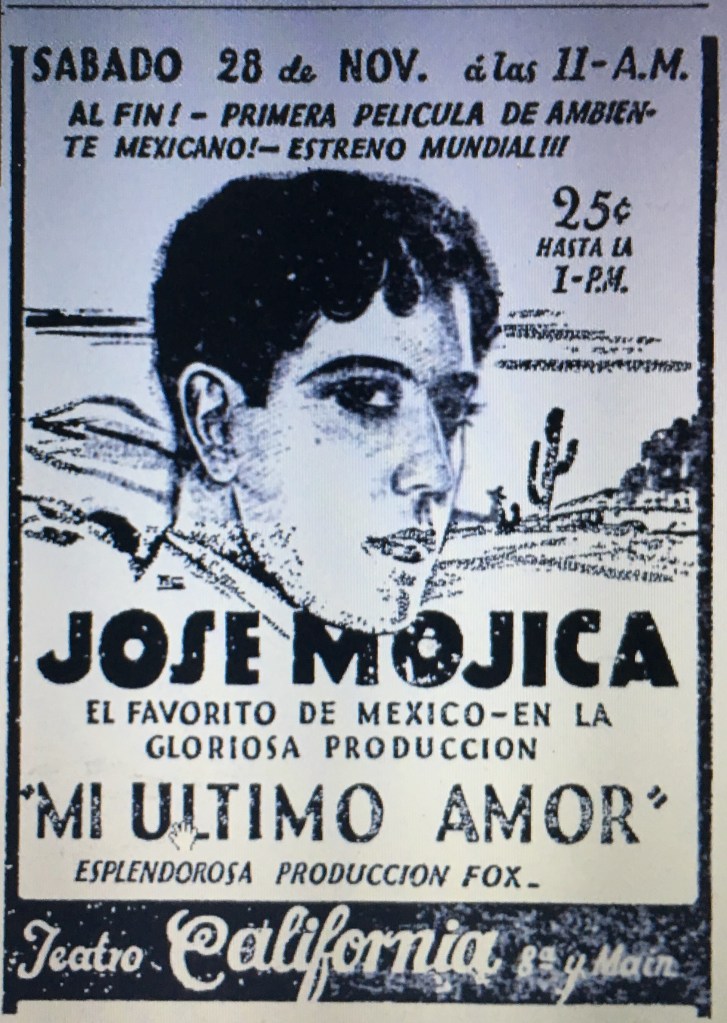
This exhibition is well worth a visit. Hopefully, more films from Spanish Hollywood will be released on video, allowing the public to rediscover Carlos Gardel, José Mojica, Antonio Morena, Ramón Novarro, Lupe Vélez, Lupita Tovar, and Conchita Montenegro.

Sevilla de mis amores (1930, Ramon Novarro) with Conchita Montenegro, Ramon Novarro

349: German film operettas

Archival Spaces 349

UFA greets Lubitsch: Early Sound Film Operettas

Uploaded 14 June 2024

Three Good Friends (1930, William Thiele)

In November 2023, I gave a keynote, titled “UFA greets Lubitsch,” at Cinegraph’s annual film historical symposium, “Danger! Music…Between Film Comedy and Musical.” My Archival Spaces 336 discussed their film program of Weimar German sound films, which included many discoveries of recent restorations. Now my paper will be published in German by the Hamburg Cinegraph film research center, headed by Hans-Michael Bock, with Erika Wottrich no second fiddle.

Joseph Schmidt, Frida Richard in When You Are Young, the World Belongs to You (1934, Richard Oswald)
Szöke “Cuddles” Szakall, Joseph Schmidt in Wenn du jung bist, gehoert dir die Welt (1934, Richard Oswald)

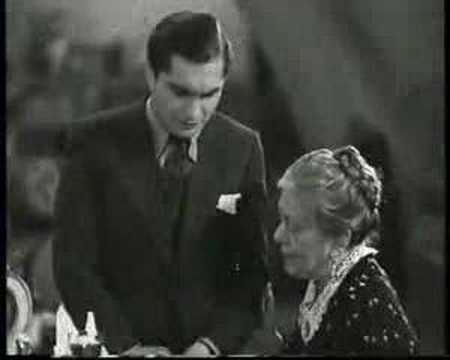
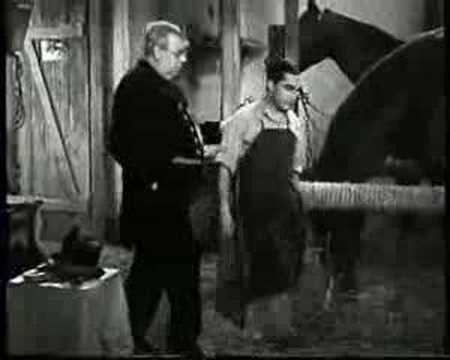
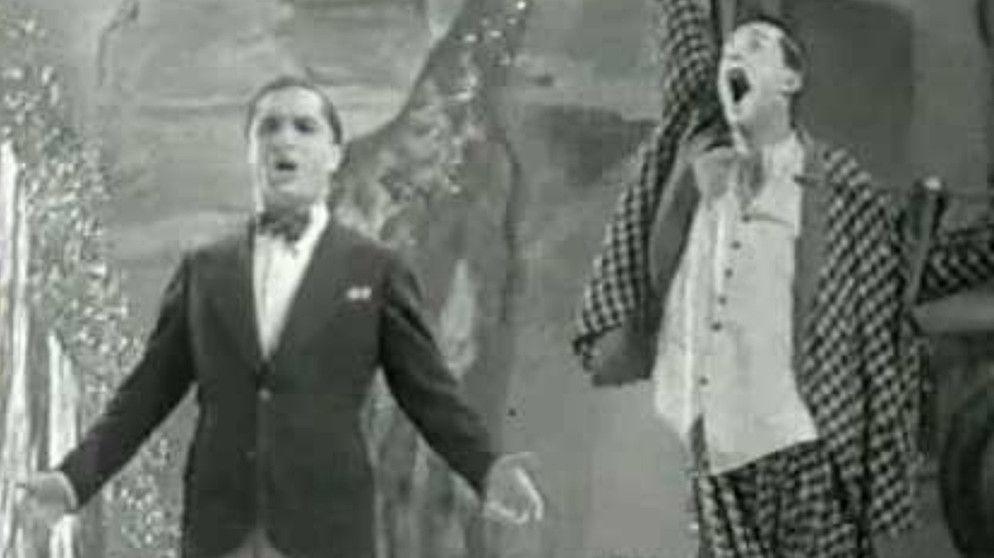
I recently discovered on YouTube a Joseph Schmidt film, When You Are Young, the World Belongs to You (1934), which I had not seen before writing my essay that mentioned Schmidt’s previous film, My Song Goes Round the World (1933). That film premiered in Berlin’s largest cinema on 9 May 1933, days after the Nazis burned books, and weeks after the Jewish boycott began, actions that would lead to the forced emigration of more than 500 blacklisted Jewish filmmakers. Richard Oswald who directed both films, shot the later film in Austrian exile, then fled to Amsterdam and Paris, before ending in Hollywood, where his career crashed and burned. In both films the diminutive opera and recording star played characters who come from humble beginnings but become singing stars while losing the girl to a friend. In Young, an Italian gardener-opera star, Carlo, suffers from unrequited love for his wealthy childhood girlfriend, while his relationship with his mother is deeply oedipal, and his friendship with the faithful Beppo, played with comic flair by Szöke “Cuddles” Szakall, is possibly gay.  As in Song, Oswald creates numerous situations in Young, which allow Schmidt to perform on stage or in stage-like situations, thus mitigating the irritation characters bursting into song in a realistic narrative. As a recording star, Schmidt’s voice was recognizable to millions of fans, so Oswald highlights the inter-media aspects of opera: Carlo sings to his mother on the phone, and competes with his own voice on a record player, to prove he is who he is. Repeatedly, his voice is disembodied, as in the extended travelogue footage of the singer’s stops in Paris, Amsterdam, New York, and Vienna. That willingness to self-reflexively meditate on film craft through experimental forms characterized early German film operettas and Ernst Lubitsch’s comedic operettas at Paramount.     

An irony of the history of German sound film operettas is that at the very moment the Ufa-produced films celebrated their first popular successes, the classic Viennese operetta had lost much of its popularity, even on Broadway where it had reigned supreme for almost forty years. Operettas migrated to the cinema after the perfection of sound film technology, becoming an ever-shifting genre in Berlin and Hollywood, guided by its own conventions and form. Operettas also migrated to the new medium of radio (and disc), becoming the most requested form of popular music in a 1926 radio survey. However, unlike the radio which only acoustically reproduced stage operettas, as did recorded discs, filmmakers found creative visual solutions to marry image and sound. In his ground-breaking book on German musicals, Michael Wedel discovers the formal richness of early film operettas in the joy of technical experimentation, and in film economic imperatives, based on alliances with the broadcasting and record businesses.

Maurice Chevalier in Love Me Tonight (1932, Erst Lubitsch)

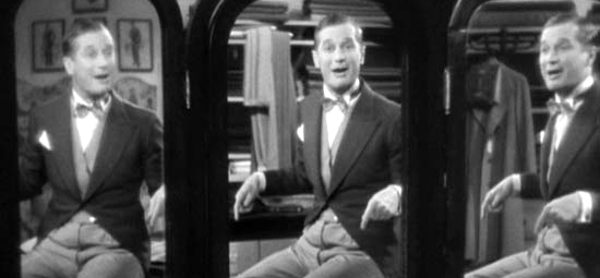
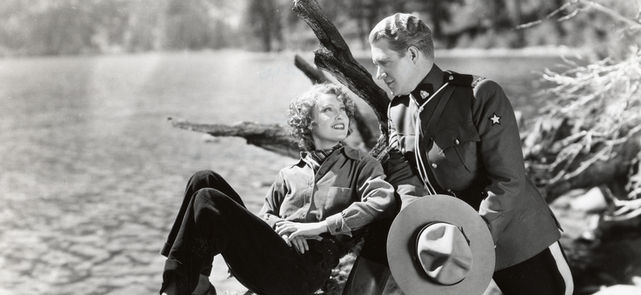
UFA sound film operettas resisted classical narratives, based on coherent and logical plots, psychological motivation of its characters, and identification mechanisms that bound the audience to the story. Similarly, Paramount‘s film operettas by Ernst Lubitsch and Rouben Mamoulian eschewed film realism. Especially Maurice Chevalier and Jeanette MacDonald’s films, like The Love Parade (1930, Ernst Lubitsch), Love Me Tonight (1931, Rouben Mamoulian), and One Hour With You (1932, Ernst Lubitsch), displayed a high degree of self-reflexivity, employed direct address, utilized both song and dance to move the plot forward, and emphasized the artificiality of their never-neverland settings in a mythical Europe of royalty, where romance consistently overcame class difference.

Friedrich Gnass in Ich bei Tag und du bei Nacht (1932, Ludwig Berger)

In contrast, the UFA operettas, whether Three Good Friends (1930, William Thiele) or A Blonde Dream (1932, Paul Martin) were firmly situated in real locations, like gas stations and trailer parks, while The Congress Dances (1931) ends with the Prince and the flower girl going their separate ways because class difference is unsurmountable. As if to confirm the trans-Atlantic affinity between Berlin and Hollywood’s operettas, Ludwig Berger included film operetta scenes in I By Day, You by Night (1932), which consciously parody Lubitsch’s films. Berger inserted these scenes on a film screen – the singer Ursula van Diem looks just like MacDonald – , introduced and commented on by a working-class film projectionist. The film within film scenes are preceded by fireworks, again creating a self-reflexive moment, while the working class love story outside the cinema is contrasted to the fantasy narrative in the cinema.

Gold Diggers of 1933 (1933)
Schmidt, Viktor de Kowa in Ein Lied geht um die Welt (1933, Richard Oswald)

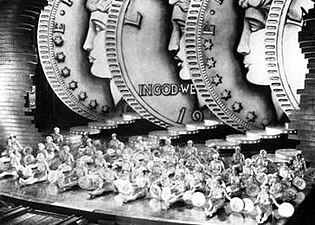
Because the artificiality of Paramount’s Ruritanian dreams alienated Depression-stressed audiences, the most working class of the Hollywood studios, Warner Brothers, introduced the backstage musical, e.g. 42nd Street (1933, Lloyd Bacon), Gold Diggers of 1933 (1933, Mervyn LeRoy) and Footlight Parade (133, Lloyd Bacon), whose plots were situated on Broadway, thus creating a realistic motivation for songs and dance on stage, while metaphorically addressing the effects of the Depression.

The German counterpart to the backstage musical was the fictitious film biographies of 1930-34. Michael Wedel notes that these films with singing stars Richard Tauber, Joseph Schmidt, Gitta Alpar, and Martha Eggerth, presented their songs and arias on improvised or actual stages, while the rise to stardom mirrored the singer’s actual biography. In contrast to the Hollywood backstage musical, though, the male singers in Berlin often sacrifice romance for their careers, as in the two Joseph Schmidt films.  

Surprisingly, the backstage musical’s popularity also waned quickly in America, supplanted by a comeback of the film operetta, no longer self-reflexive, as with Lubitsch, but rather film adaptations of classical operettas by Victor Herbert and Sig  Romberg, often mixed with other genres. Jeanette MacDonald moved to MGM, where she was teamed with Nelson Eddy and starred in Rose Marie (1936, W.S. van Dyke), Rudolf Friml’s operetta from 1924, which mashed up backstage musical, western, and melodrama.

Martha Eggerth, Jan Kiepura in Zauber der Boheme (1938)

Meanwhile, despite the objections of Joseph Goebbels to the “Jewish” film operetta, the UFA continued to produce operettas, especially with Martha Eggerth, who was allowed to perform in the Third Reich though Jewish, even if the films were actually shot in Austria and financed by Jewish producers. Like the MacDonald/Eddy films, they were adaptations of Franz Lehar and other classical operettas, mixed with different genres. 

Although no historian to my knowledge has made such a comparison, it does therefore seem fruitful to compare the historical development of film operettas/musicals in Berlin and Hollywood in a trans-Atlantic context.  Such a comparison may also reveal why exiled German directors, like William Thiele, Joe May, and Erik Charell failed, when they made their first operettas in Hollywood.

Willi Forst, Lilian Harvey, Willi Fritsch in Ein blonder Traum (1932, Paul Martin)

348:  Academy Museum’s Jewish Film Pioneers

Archival Spaces 348

Hollywoodland: Jewish Founders and the Making of a Movie Capital

Uploaded 31 May 2024

Academy Museum w/Louis B. Mayer, Carl Laemmle, Samuel Goldwyn and Jack Warner. Gregg DeGuire (Photo)

Two weeks ago, the Academy of Motion Picture Arts & Sciences Academy Museum opened what most observers called their mea culpa exhibition on Hollywood’s Jewish Pioneers, “Hollywoodland: Jewish Founders and the Making of a Movie Capital,” which occupies a small gallery and is now part of the permanent exhibition. When the Museum opened two years ago, it was heavily criticized for creating a permanent exhibit on Hollywood that was all but Judenrein, a single display of Louis B. Mayer with an Oscar constituting the only Jewish reference in the many thousand square feet exhibition. Four months later, the Academy Museum announced its Jewish Pioneers exhibit to counter criticism. As The Times of Israel wrote (22 March 2022): “The museum’s announcement of its new permanent exhibition focused on Jews came only after the Academy admitted it had initially sidelined or ignored Hollywood’s prominent Jewish founders.”

The gallery on the 3rd floor consists of three distinct experiential spaces: 1. A geological model of the L.A. basin with its film studios, 2. a series of wall panels, dedicated to the eight major studios, Fox, MGM, Universal, Warner Brothers, United Artists, RKO, Columbia and Paramount, 3. a screening space presenting a ½ hour documentary, From the Shtetl to the Studio: The Jewish Story of Hollywood, narrated by Ben Mankiewicz, and directed by Dara Jaffe and B.J. Thomas. The film‘s and the exhibition’s master narrative follows that of Neal Gabler’s An Empire of Our Own: How the Jews Invented Hollywood (1989), – Gabler is credited as an advisor – which was hugely influential in naming that which dared not name itself, namely the predilection of the Jewish Hollywood Studio system for self-erasure.  

Early Nickelodeon
Harry Rapf, Louis B. Mayer, Irving Thalberg at MGM

Thus, Eastern European immigrants, often from the garment industry, who were barred by nativist American anti-Semitism from entering many professions or living in a place of their choosing, saw an opportunity to assimilate into the American mainstream by establishing a new entertainment industry through motion pictures. In controlling production, distribution, and exhibition of motion pictures, the major studios headed by William Fox, Louis B. Mayer, Carl Laemmle, Jack L. Warner, Joseph Schenck, David Sarnoff, Harry Cohn, and Adolph Zukor, created a monopoly that not even the government’s anti-Trust units could break for more than 20 years. Despite their power, Jewish producers were gripped by fear of anti-Semitism, not without justification, given attacks from – in chronological order – Edison’s Motion Picture Patents Trust, Joseph Breen and the Catholic Legion of Decency, Henry Ford and America First, and the House Un-American Activities Committee (HUAC). The studio moguls practiced not only public self-effacement in the media, they also produced almost exclusively white nationalist movie dreams for WASP America while actively excluding Jewish Americans, as well as all other people of color from that vision. These were visible merely as stereotypes, as were women and gays. With the demise of the major studios, the Jews “no longer control Hollywood,” the film tells us.  

While this narrative is legible in the film, the exhibition’s first space is more impressionistic, offering images of the growth of Los Angeles from a largely uninhabited desert to a thriving metropolis of movies, during which the population increased 12-fold between 1902 and 1929 and movies became its primary business. The wall panels dedicated to the eight major studios follow, offering photographs of the physical studios and stars, film posters, and mini-portraits of their Jewish founders. The film is a thoughtful and easily understood documentary of the rise of Hollywood and its Jewish moguls. Overall, the exhibition is an excellent introduction to classic Hollywood through the 1950s and its Jewish origins, especially for non-specialists, and could easily travel to libraries and other public spaces.

HUAC Hearings in From the Shtetl to the Studio: The Jewish Story of Hollywood

However, given that the Academy’s recent temporary exhibit on African-American in film was five times larger and included numerous original objects, and not just reproductions, one might have hoped for more. Why is the Jewish exhibit ghettoized in a completely separate space, rather than integrated into the narrative flow of other Academy exhibits? Why are there no original objects on view in the museum exhibit from this incredibly rich period of Hollywood history?

Produced by Leo Popkin
Produced by Alfred N. Sack

Given the very modest size of the exhibition, there are also missed opportunities to create a more nuanced view, e.g. to talk about Jewish producer-distributors, like Alfred N. Sack and Leo Popkin, who worked with African-American directors like Oscar Micheaux and Spencer Williams to finance race films in the 1930s and 40s, which catered specifically to audiences of color. Jewish filmmakers were also extremely philanthropic, financially supporting numerous liberal causes, including the civil rights movemenmt. Finally, Jewish producers are also credited with bringing over countless European artists to Hollywood, giving their films a cosmopolitan flair, but also rescuing many filmmakers threatened by the racial policies of the Third Reich. Such an exhibit would have however required more space and more generous financing beyond the mea culpa on display.

Louis B. Mayer and the MGM “Family” (1943)