389: Saul Bass & Oscar

Archival Spaces 389:

Saul Bass wins an Academy Award

Uploaded 26 December 2025

Why Man Creates, Saul Bass, 1968

Ten years ago, in 2015, I published Saul Bass: Anatomy of Film Design, a University of Kentucky Press book, a French edition arriving seven years later.  Not many people know that George Lucas worked for Saul and accompanied him to the 41st Academy Awards, where Bass won for Why Man Creates. Behind the scenes, there was turmoil.

Dorothy Chandler Pavilion. Photo by Bud Gray – © 1978 Bud Gray – Image courtesy mptvimages.com


The Forty-First Academy Awards ceremony took place on 14 April 1969 at the Dorothy Chandler Pavilion, on what used to be Bunker Hill in downtown Los Angeles. It was the first Oscar ceremony to be broadcast worldwide and the first held at that location. As usual, it was a star-studded affair. Katharine Hepburn was nominated as best actress for the second year in a row, this time for The Lion in Winter, an award she would have to share with Barbra Streisand for Funny Girl—the only time there has been a tie in this category. Saul and Elaine Bass, too, were present at the awards ceremony, the designer nominated in the “best documentary short” category for Why Man Creates (1968). The couple rode to the Chandler in a rented limousine together with USC graduate student and Bass advisee George Lucas, who had been an assistant on the production. Lucas would never work for or with Bass again, but he gave strong public support to Quest (1983, Saul Bass). Bass’s competitors for the Academy Award were The House that Amanda Built (Fali Bilimoria), The Revolving Door (Lee R. Bobker), A Space to Grow (Thomas P. Kelly Jr.), and A Way out of the Wilderness (Dan E. Weisburd). Given his longtime work in the film industry, Bass was heavily favored to win.

Saul Bass and Tony Curtis at the Academy Awards (frame from television footage of the event. Courtesy Academy of Motion Picture Arts & Sciences.
Offical Academy portrait w/ Oscar. Courtesy AMPAS.

At the ceremony, Bass sat in an aisle seat at stage left, ten rows from the podium; Elaine was next to him in a light-colored chiffon dress. Actors Diahann Carroll and Tony Curtis read out the names of the nominees for best documentary and best short documentary, respectively. When Tony Curtis called out Bass’s name as the winner, he bounced up to the stage, despite the wooden cane that preceded his every step. Curtis handed the Oscar to Bass, who was wearing a traditional tuxedo, in contrast to Curtis’s mod outfit. Bass took the Oscar in his right hand while balancing his weight with his left hand on the cane. He bent over the microphone and, in an uncharacteristic moment of brevity, said, “Thank you, thank you very much.” Then he quickly walked offstage. No thanks to his staff, no thanks to his wife, certainly a co-creator, no thanks to the Academy. More importantly, Bass failed to mention Kaiser Aluminum and Chemical Corporation, the film’s sponsor and original producer, causing a mini-scandal to erupt at corporate headquarters. Did Bass just forget, due to nerves or under pressure, to keep his acceptance speech short? Or was it something else? We will probably never know. The oversight may not have been accidental, however, given the huge fights with Kaiser over the film’s final structure, laboratory costs, and even the title. Bass hated the title because he thought it promised more than he could deliver.

Why Man Creates Saul Bass, 1968
Why Man Creates, Saul Bass, 1968

In hindsight, it’s clear that Bass deserved to win for what would be his greatest cinematic achievement, although his largely avant-garde work certainly challenged the Academy’s notions of genre. Indeed, the category “Best Documentary, Short Subjects” hardly describes Bass’s free-form essay, a hodgepodge of film notes that asks many more questions than it answers. And what makes it a documentary? The film includes several forms of animation and mostly staged sequences. Indeed, it is a modernist romp, at moments seemingly incoherent and yet also brilliant in its open-endedness; its fragmentation forces the viewer to engage in the construction of meaning, thus fulfilling the promise of every modernist work to make the audience an active participant. In addition to the Academy Award, Why Man Creates won numerous film festival and other awards, and was placed on the National Film Registry of the Library of Congress in 2002, designating it a national treasure.

Why Man Creates, Saul Bass, 1968

But the somewhat tortured production history of the film also points out the pitfalls of having a corporate sponsor for such a personal and highly idiosyncratic project. In Bass’s most cynical evaluation of the film, he admitted to a group of AT&T executives: “I think now that the most creative thing about the film was that I found a rationalization that enabled me to convince the client, to allow me to make the film.” Even if the film was not a direct advertisement for Kaiser, the company covered all the production costs, while corporate executives and Bass often had vastly different ideas about what kind of film they were financing. Bass never wanted to answer the question the title asks; it was antithetical to his work methods, but the sponsors were looking for easy answers that could be sold in the education market. The designer usually argued that because sponsored films didn’t have to sell anything, they were preferable to commercials or industrial film productions, where the filmmaker was at the mercy of the client. But Bass wanted to have it both ways: complete freedom to produce artistic work, and complete financing by a corporate sponsor that would pay all the bills, including a substantial honorarium to support Bass’s office. Unlike most other avant-garde filmmakers, Bass was not willing to self-finance or to take on contract work to pay for his own personal films. After all, Bass had grown up in the Hollywood film industry, where no one invested their own money. Paradoxically, despite the insider status that an Academy Award seemingly represented, Bass remained an outsider in the movie industry.

Why Man Creates, Saul Bass, 1968

388: Riefenstahl

Archival Spaces 388:

Riefenstahl (2024) – The Movie

Uploaded 12 December 2025

Leni Riefenstahl

The penultimate scene in Andres Veiel’s new documentary, Riefenstahl (2024), which opened recently in Los Angeles, shows footage that producer Sandra Maischberger possibly shot in ca. 2002, when Leni Riefenstahl was over 100 years old. In close-up, the Nazi diva frets fussily in front of a mirror, complains to the cameraman about the lighting, wearing enough make-up to look like a way-over-the-hill Kurfurstendam whore.  The scene is a metaphor for Riefenstahl’s whole life, a life spent polishing her image, brow-beating journalists into submission, denying she was only an artist, not a propagandist, and certainly not complicit in the Holocaust, despite substantial evidence to the contrary. I wrote about my own encounters with la Riefenstahl in Archival Spaces 352 (https://archivalspaces.com/2024/07/26/352-riefenstahl/), so I was anxious to see the new film, as well as meet the filmmakers Andres Veiel and Sandra Maischberger, who answered questions at the Thomas Mann House in Malibu on 12 September, and again after a screening the same evening at the Laemmle Royale.

Sandra Maischberger and Andres Veiel

As the pair explained, there have been several documentaries about Riefenstahl, most famously Ray Müller’s The Wonderful, Horrible Life of Leni Riefenstahl (1993), but after the death of Horst Kettner in 2016, the secretary-husband of Leni, the estate papers promised to reveal new information. In fact, there are some surprising new details, although, as both admit, Leni worked very hard “to curate” the papers and surviving film footage, and apparently also spent weeks in late Spring 1945 burning evidence of her Nazi past. From the drafts of her highly sanitized memoirs, we learn that she had been abused by her authoritarian father, who threw her into a lake to let her sink or swim, and was sexually and violently abused by her relatively short-lived husband, Peter Jacob (1944-46). Riefenstahl also claimed that Joseph Goebbels and a 1930s German tennis star attempted to rape her. Unmentioned, but repeatedly stated in her memoirs, is the allegation that Henry Sokal, her Jewish producer, tried for years to get into her pants; passages that reek of anti-Semitism.

Leni and Adolf in love in 1930s

That experience of sexual violence in her childhood and adulthood may be the key to her fascination with Hitler, since, like most Nazis, she firmly believed that what doesn’t kill you makes you stronger; she apparently also had an abhorrence of any physical or mental weakness.  When her Olympia cameraman, Willy Zielke, had a nervous breakdown in 1937, Riefenstahl supposedly had him committed to a psychiatric clinic where he was forcibly sterilised, in keeping with Nazi euthanasia and sterilisation policies for “all unworthy life.”

Willy Zielke (left), Riefenstahl during Triumph of the Will (1935)

One of the most important aspects of Riefenstahl is that it makes clear that the actor-director never really relinquished her Nazi ideology. Like tens of thousands of ordinary Germans who participated willingly in the Third Reich and its policies of genocide, she just screamed her innocence over and over after the war to anyone who would listen. After one controversial TV appearance in November 1976, which included a woman who had resisted the Nazis, she received hundreds of phone calls and letters from ordinary Germans expressing their support for her, many revealing their own overt racism by attacking the “Jewish” press of Springer et al. She remained friends with Albert Speer and other Nazis to the end. Horst Kettner, who filmed Leni obsessively until literally the moment of her death, shot footage of Riefenstahl “directing “ Nuba children in the 1960s by beating them with sticks, always the Aryan superwoman, the white colonialist, despite her expressed love for black bodies. In that sense, she was a prototypical fascist, not unlike many Germans (and Americans) who today support anti-immigrant ideologies and yearn for dictatorship. Despite her protests to the contrary, she was always close to Hitler and never gave up that love, even after she should have known better. Maischberger theorises that the reason Jody Foster’s Riefenstahl film never came to fruition was that there was no “third act.” Riefenstahl remained the same after 1945, no repentance, no acknowledgement of guilt, no cathartic realisation of her flaws.

Riefenstein, “NEIN!!”
Riefenstahl at Konskie

Apart from the hundreds of photographic portraits of Leni, documenting he overt narcissism, and the many interviews where she is constantly denying EVERYTHING, the filmmakers subtly contradict her with images: In one interview, she states that there is absolutely no anti-Semitism expressed in Triumph of the Will, followed by a clip from the film of Julius Streicher claiming the Jewish race must perish. Leni claims she never abused any Jews or Roma/Sinti, then we see photos of her in Konskie, Poland, looking in horror as Jews are gunned down before her eyes, possibly at her unwitting instigation, according to a Wehrmacht officer. She also claimed she met her Roma and Sinti extras from Tiefland after the war, when in fact almost all died in Auschwitz. This is a hard film to watch, but also a necessary film, given the fact that so many Americans are falling prey to anti-democratic sentiments.  

Frau Elfriede Kretschmer, Riefenstahl at a November 1976 German Talk Show

387: Nazi Film History II

Archival Spaces 387:

Otto Krieg’s German Film in the Mirror of the Ufa

Uploaded 28 November 2025       

The Congress Dances (1931, Erik Charell) Ufa Production shot

By 1943, the Ufa was not only the largest German film company, as it had been in the Weimar Republic, but the only German film company, nationalized and under direct control of Joseph Goebbels’ Nazi Propaganda Ministry. In celebration of the 25th anniversary of the founding of the Universum Film A.G., Goebbels’ Ministry published two histories of the company: Otto Kriegk’s Der deutsche Film im Spiegel der Ufa / German Film in the Mirror of the Ufa and Hans Traub’s Die UFA – Ein Beitrag zur Geschichte des deutschen Filmschaffens /UFA – A Contribution to the History of German Cinema Art. The latter is – despite its title – a large format (9” x 13’) volume that focuses solely on the economic and structural history of the film industry, with 80 pages of illustrations of cinemas, studios, and cameras, written by a film scholar. Part Jewish, Hans Traub avoids anti-Semitism by eschewing any mention of Jews at all, even omitting the forced removal of Jews from the industry in 1933. Kriegk’s film history, on the other hand, is an openly anti-Semitic work by a journalist long allied with the white Nationalist Right, that blames the (unnamed) Jewish film pioneers for the degeneration of German cinema, at least until it is rescued by Adolf Hitler and the Nazi movement.

Kriegk’s radical anti-democratic and anti-Semitic credentials were impeccable. Born in a small town in Lower Saxony in 1892, Kriegk earned a PhD. in 1914 in economics at the University of Göttingen with a dissertation on beer production, then became a political editor at a rightwing newspaper in Bremen; during WWI he was kept out of military service, due to blindness in one eye. In 1922, he joined Alfred Hugenberg’s radical nationalist press empire, becoming a close associate of Hugenberg’s, writing an official biography, and working as press chief for Gen. Paul von Hindenberg’s successful presidential campaign in 1925, the first step in the upending of German democracy. As co-editor of Der Deutschen-Spiegel, Kriegk advocated that the radical Right take the presidency and weaken democracy from within, rather than through (unsuccessful) putsches, like Kapp and Hitler’s Beerhall. Over the next twelve years, he published numerous right-wing political tracts, railing against Jewish domination in international relations and attacking in particular the Locarno Peace Treaty (1925), while continuing his journalistic work for Hugenberg’s Scherl newspaper chain. He joined the Nazi Party in 1937 and soon became Goebbels’ favorite journalist. In 1944, he was one of only two journalists allowed to attend the Volksgerichtshof trial of the 20 July conspiracy against Hitler, then writing the official Nazi press release about the failed assassination plot.

Kriegk’s book, which carries the subtitle “25 Years of Struggle and Achievement,” begins with full-page portraits of a Nazi rogues gallery, including Fritz Hippler, the director of The Eternal Jew (1940), and the late Emil Georg von Stauß, the founder with Gen. Ludendorff of the Ufa in 1917. The narrative begins with a personal romanticized narrative of discovering Henny Porten, Asta Nielsen, and Paul Wegener in the cinema, then relates the founding of Ufa by the German High Command in 1917, before going on the attack against “the Jews from the garment district” (p. 81), producing pornographic films, after the end of censorship in November 1918. When censorship was reestablished in May 1920, “the Jews who had made their money with cinematic bordellos, withdrew into their basement hovels.” (p. 82) Kriegk reduces the postwar Weimar era to Hollywood’s attempts to destroy German cinema independence, mentioning successful imports to America, Madame Dubarry (1919) and Dr. Caligari (sic)(1920), without naming their Jewish film directors. Then comes Metropolis: “The attempt to beat American films with a film produced in Germany, led straight to a glorification of Bolshevism.”(p. 91-2) Thus, Kriegk, as in all his previous political writings, connects Jews with the threat of Communism and sexual degeneracy. Hollywood’s initial victory over UFA and the Berlin film industry was complete with the Parufamet contract of 1925. Further help, according to Kriegk, was given by the Jewish Berlin publishing houses of Mosse and Ullstein, which were allegedly allied with American banks.

Metropolis (1927, Fritz Lang) Kriegk illustration
The Blue Angel (1930, Josef von Sternberg) Kriegk

In 1927, the Hugenberg Group came to Ufa’s rescue, installing Ludwig Klitsch as Chairman of Ufa’s Board, infusing massive amounts of capital, and sending Klitsch to New York to renegotiate the Parufamet contract.  Meanwhile, sound films had arrived. America forced Germany to show The Singing Fool, starring “der Neger Al Johnson” (sic). The Ufa fought back with state-of-the-art sound film studios, defended itself against a successful sound film patent war, but then the Depression hit. According to Kriegk, liberating German cinema from Jewish influence was not possible through private means alone, given that 70% of film production in 1932 was in Jewish hands. Those Jewish interests, allied with left-wing critics, continuously attacked the Ufa. The Blue Angel (1930) and The Congress Dances (1931) are identified as successful German counterattacks, but fail to mention that both films were produced by Jewish film crews. Indeed, contradictions and illogical conclusions abound.

Morgenrot/Dawn (1933, Gustav Ucicky) Kriegk
Unternehmen Michael (1937, Karl Ritter) Kriegk

After the Nazis took power, the goal was to purge the industry of Jews and eliminate (Jewish) “industry business practices” (p.183) whose goal was speculation, rather than uplifting German culture. Kriegk quotes a 1935 Goebbels speech extensively, listing proscriptive formulas for German cinema, then sings the praises of such Ufa films, as Hitlerjunge Quex (1933), while attacking an unnamed American gangster film for including “everything a Jewish political dictatorship needs to stupefy the masses”(p. 224), as well as “bolshevist” Russian films. Ironically, while dedicating space to Ufa’s successful nationalist productions, including new color films – Jew Süß is only mentioned once in a list of other titles – Kriegk literally spills considerably more ink on the Moscow-New York-Hollywood Jewish conspiracy to destroy German cinema, maybe because he is unable to discuss their dubious aesthetic merits. If you want to know about Ufa’s real history, read the late Klaus Kreimeier’s excellent The Ufa Story (1999).

Muenchhausen (1943, Josef von Baky) Kriegk

386: Giornate del cinema muto

Archival Spaces 386:

Pordenone’s Days of Silent Film, 2 – 12 October 2025

Uploaded 14 November 2025

It was the first time in six years I was back in Pordenone, Italy, for the Giornate del cinema muto, having been forbidden by the powers that be at UCLA to travel to the oldest silent film festival in the world, two days before my departure in 2019.  While I enjoyed watching films on the big screen, always with live musical accompaniment, I quickly realized that the best part of the Giornate was meeting the many old friends I have accumulated in the last 37 years, since attending my first festival in 1988. Among them in no particular order: Serge Bromberg, Donald Sosin, Neal Brand, Thomas Christensen, Peter Bagrov, Don Crafton, Susan Ohmer, Bill Uricchio, Martin Loiperdinger, Charles Musser, Ulli Rüdel,  Piera Patat, Livio Jacob, Federika Dini, Oliver Hanley, Eva Hielscher, Tom Dogherty, Phil Carli, Günter Buchwald, Jane Gaines, Laura Horak, Federica Dini,  Ivo Blom, Martin Koerber, Cathy Surowiec, Geoff Brown, Doron Galili, Catherine Cormon, Dave Kerr, Paolo Tosini, Lea Jacobs, Ben Brewster, Byrony Dixon, Richard and Diana Kosarzski, Sabine Lenk, Frank Kessler, Jeffrey Masino, Robert Byrne, Elif Rongen-Kaynakçi, Stacy Wisnia, Mark Williams, David Pierce, Phil Rosen, Eva Orbanz, Tony Kaes, André Gaudrault, Erika Wottrich, and Richard Abel. Many of them came to my wife Mindy’s aid when she broke her hip outside the theatre and spent ten days in an Italian hospital, especially Jay Weissberg and the Giornate team.

The Pordenone program is so rich with screenings from 9 AM to midnight that, unfortunately, I missed important programs due to jet lag, inertia, or meetings. I would have liked to see, including early cinema, the Belgian avant-garde, Cyrano Bergerac (1923), and the Chaplin Connection/Slapstick programs. As a result, my comments are limited to some highlights and revelations.

The Vipers (1912, Louis Feuillade)
Le Nain (1912, Louis Feuillade)

The first screening to blow me away was a Louis Feuillade program of pre-World War I shorts, including The Vipers (1912), Le Nain (1912), and The Heart and the Money (1912). Feuillade, most famous for the surrealist serial, Les Vampires (1915), is master of economy, utilizing multiple exposures and split screens to express dreams and desires, employing actors whose subtly of gesture create a realism that has nothing in common with the melodramatic catalogue of stock gestures seen in American films from the period, composing images in depth that communicate meaning through mise-en-scène. The Vipers visualizes the havoc caused by town gossip, forcing a poor widow to flee; Le Nain is a Cyrano story of an extremely diminutive writer who suffers rejection at the hands of normal-sized women; Heart ends in suicide, when an ambitious mother forces her daughter to marry an older, rich man, rather than the poor fisherman she desires. Probably generated from original Gaumont negatives, the digital copies were breath-takingly beautiful, subtle in grey scale, with an extremely high resolution. 

Itala Almirante Manzini in L’innamorata (1920, Gennaro Righelli)
Zingari (1920, Mario Allmiranre)

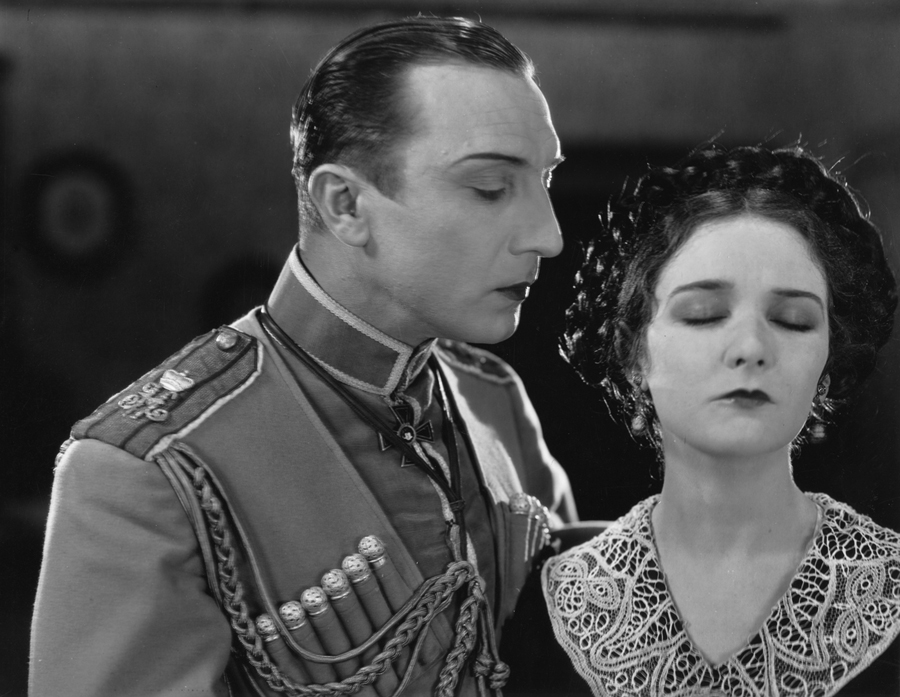
The three melodramas of Italian diva Itala Almirante Manzini I viewed were a surprise; divas from 1920s Italy tend to fall off film historical radar, but Manzini was impressive, the actress switching social classes from film to film: L’innamorata (1920),  Zingari (1920), La piccolo parrochia (1923). Much less well-known than her rivals, Lydia Borelli and Francesca Bertini, Almirante Manzini rose to prominence with Cabiria (1914), but many of her films have disappeared, leading to neglect. In The Lover, she plays an upper-class, man-eating vamp, concerned only with her own social pleasures, who drives at least one man to suicide and threatens another; her own suicide to save that same lover is, however, overdetermined. Manzini next dominates the screen in Zingari, where her action heroine defies her father and his Roma clan to pursue actively the man of her dreams, a rival clan leader, burning down a barn, creating chaos, all in the interest of feminine erotic desire. Several women told me they loved this film. I understood intellectually, but didn’t quite feel it. I’m glad they pointed it out to me. With The Little Church, the diva plays an orphan who marries rich, but is mercilessly harassed by a domineering mother-in-law; an illicit affair with a callous playboy almost destroys the couple’s marriage, until Mother finally embraces her daughter-in-law.  All three films featured well-constructed and opulent production design.

The Adventures of a Penny (1929, Aksel Lundin)

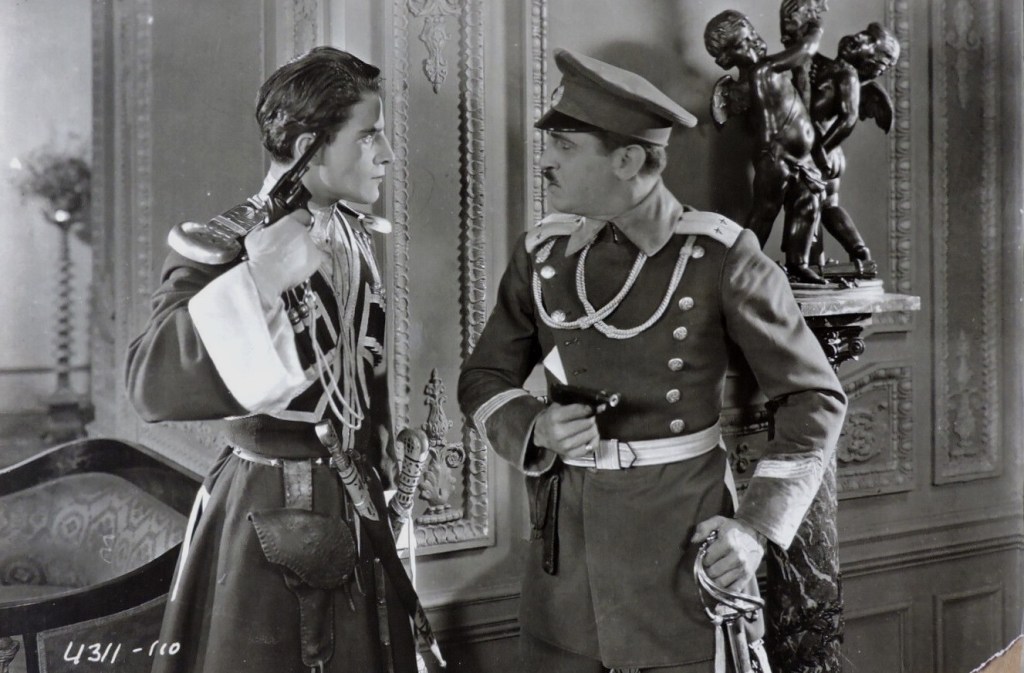
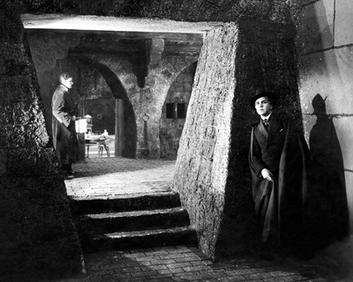
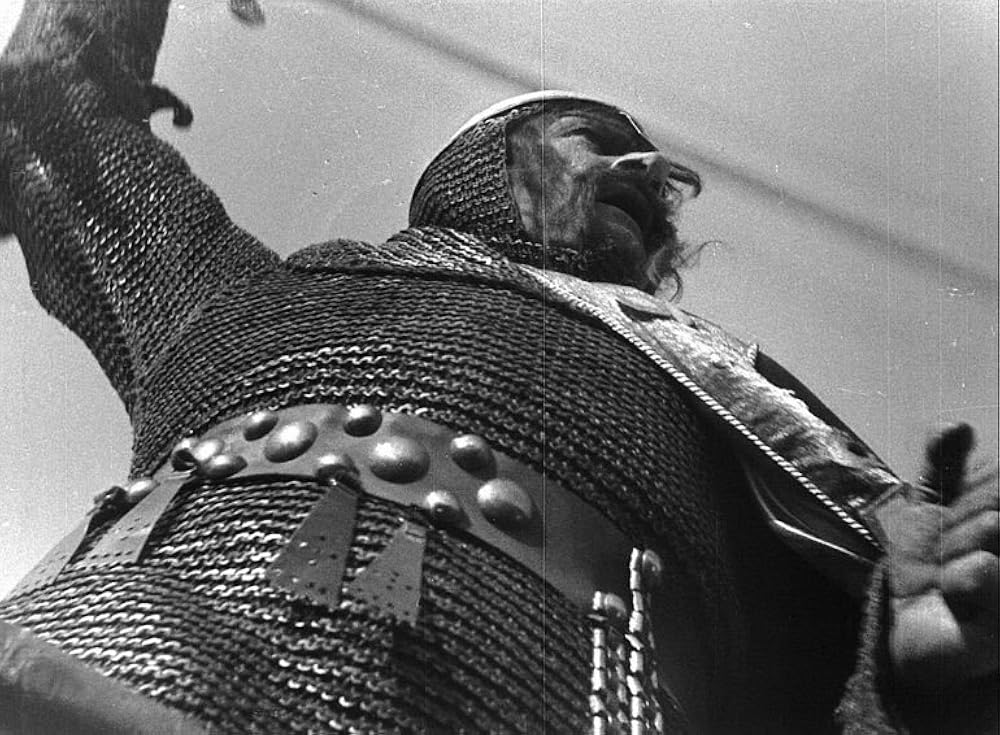
A major discovery was the Soviet Ukrainian children’s films, Adventures of a Penny (1929, Aksel Lundin), and Robinson on His Own (1929, Lazar Frenkel), which were edited in the Russian style, but also filmed on location in Kyiv. The first title follows a gang of working-class boys in the Czarist era, who cause trouble for adults but are loyal and charitable, even when betrayed by the spoiled boy seed of a stingy bourgeois landlord. The central character in Robinson, a bookworm, lives in his dreams until the harsh reality of his environment catches up and he has to be rescued by the Young Pioneers. The film was criticized by the Nomenklatura for its joyous celebration and spoofing of American westerns and adventure films, unable to hide its fascination. Both films expressed an optimism for the new Communist society, in keeping with its target audience of young citizens, in marked contrast to another Soviet film, Wings of a Serf (1926, Yuri Tarich). In terms of art direction and costuming, one can see its influence on Sergei Eisenstein’s Ivan the Terrible, its baroque style, its reliance on mise-en-scene over montage, but the first Ivan is significantly more violent and perverse. First, we see the Boyars rape, pillage, and murder serfs, because they are the masters, then Czar Ivan’s entourage rape, pillage, and murder the Boyars, before Ivan strangles his Czarina, she having slept with a serf. That serf, our hero, dreams of flying, fashions wings, and successfully lifts off- the wonders of cinema –  only to be sentenced by Ivan to a beheading, for “going against God’s wishes by flying.” A lesson in autocracy.

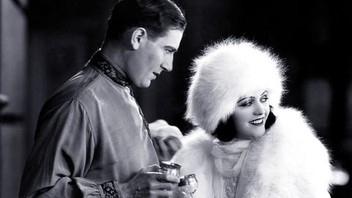
Love and Duty (1931, Bu Wancang) stars Ruan Lingyu, in her first surviving role, the doomed star of many Shanghai dramas screened at the Giornate in 1997. A bit long at 2 ½ hours, the film concerns the tragic love affair of two upper-middle-class Chinese in Shanghai, who fall for each other as teenagers, their relationship upended by Chinese patriarchy, when the father orders his daughter into an arranged marriage. Years later, the couple meet again and decide to elope, thereby becoming social pariahs. Although the story itself is melodramatic, the acting is realistic and underplayed, and the camera work and set design are both modern and unobtrusive. Bu Wancang focuses on social issues, the privileges of the ruling class, the harsh punishments meted out to transgressors of social morality, the strict demarcation of social classes, the unjust power relations between chauvinist men and victimized women, and the sins of the parents transferred to the children.

The Woman with a Mask (1928) flor show in film

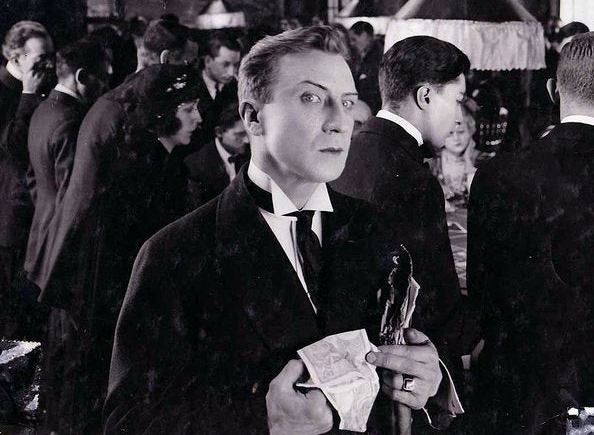
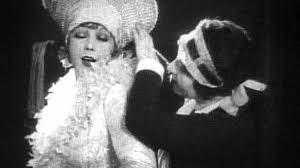
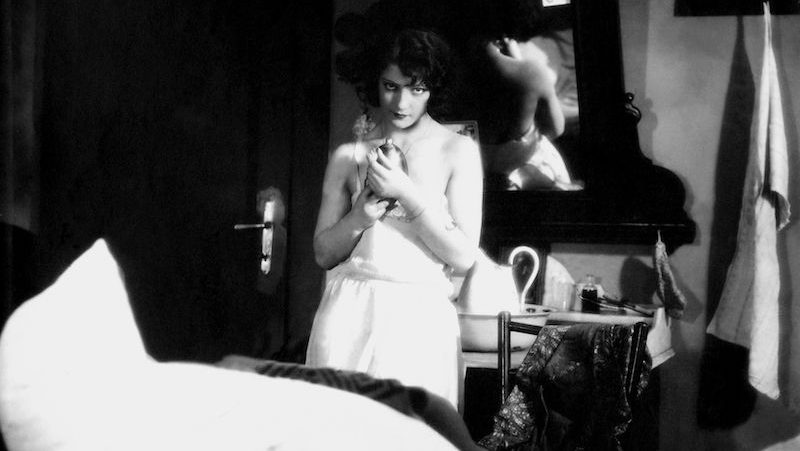
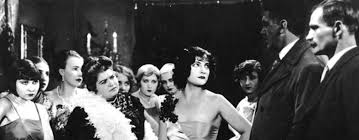
Finally, it was a particular pleasure to see Wilhelm Thiele’s The Lady With a Mask (1928), which I had not seen, despite publishing a book on Thiele last year. The opening montage, Inflation, a five-minute tour de force constructed by Hans Richter, has been a favorite of mine since I programmed it in 1979. The experimental short sets the stage for a class conflict between impoverished nobility and uncouth, i. e. working class and nouveaux riches. Produced by UFA after German Nationalist Alfred Hugenberg had bought the company, the film clearly reveals its political sympathies for the upper-class, aristocratic heroine, the daughter of a baron, and her Russian émigré boyfriend, himself a former prince. She must work half-nude in a cabaret to make ends meet, a fact she tries to hide from her father; her friend is a waiter, hoping for better days. All the class-specific biases towards morality, money, and ethics boil to the surface.  In contrast, Thiele’s nearly sarcastic view of the working class serves up an overweight, wealthy inflation speculator who threatens the heroine sexually, and who is more suited to the plebian tastes of his cute but dumb showgirl squeeze. But Thiele complicates the proceedings by suggesting that the slob actually falls genuinely in love with his social superior, making him ultimately a pitiful if not sympathetic character. Formally, Thiele continually plays with shadows and silhouettes, some realist, some aesthetic, some narrational, including the heroine’s nude form behind a screen. Their lack of legibility communicates the unreality of the German inflationary period, when a loaf of bread cost over 1 million Reichsmarks.   

Giornate’s catalog