Archival Spaces 343
Vanderbilt Television News Archive
Uploaded 22 March 2024

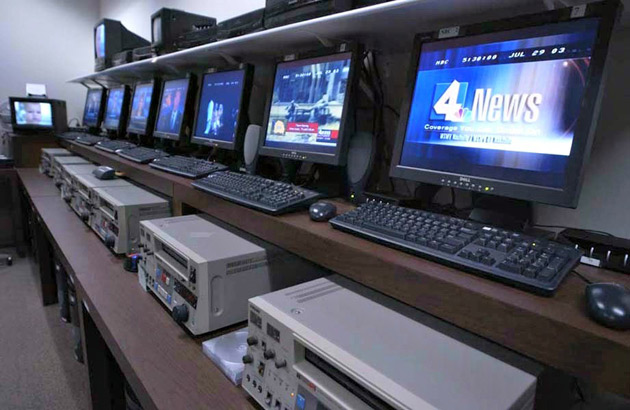
In the early 1980s, before the Association of Moving Image Archivists (AMIA) constituted itself, film archivists met yearly under the guise of the Film Archives Advisory Committee/Television Archives Advisory Committee (FAAC/TAAC). The Vanderbilt Television News Archive was one of the first institutions to join TAAC, having been founded in 1968 to tape off-air all national news broadcasts from ABC, NBC, and CBS, with CNN (1995) and Fox News (2004) added later. Its mission, then as now, was “to create, preserve and provide access to the news broadcasts from the U.S. national television networks.” From almost the beginning two issues were apparent, one legal, one organizational. On the legal front, the question was whether the University had a right to copy and preserve copyrighted material. In fact, CBS sued Vanderbilt in 1973 for what it termed the unauthorized editing, videotaping, and distributing for a fee of copies of the “C.B.S. Evening News” with Walter Cronkite. CBS eventually dropped the suit, after Tennessee Senator Howard Baker inserted a clause into the Copyright Law that protected libraries taping television news from prosecution. The second question was whether these recordings on ¾ inch U-Matic videotape were archival since they weren’t “originals.” That argument became moot, once all moving image media began migrating to digital. In the early 2000s Vanderbilt began digitization of 37 years of analog tapes (30,000 tapes), which currently includes 1,443,318 records and constitutes one of the most complete historical records of the past 50 years.
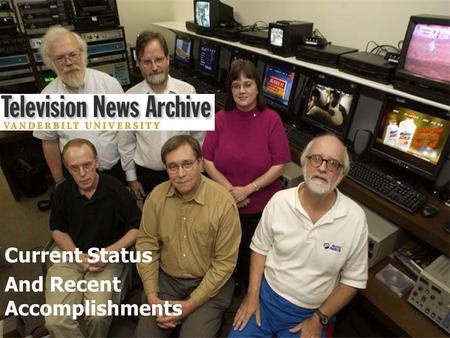
Today, the Vanderbilt Archive works in concert with the Library of Congress’s Motion Picture, Broadcasting, and Recorded Sound Division. Copies of its recordings are sent to LOC, which guarantees long-term preservation while providing for onsite access. Vanderbilt’s present staff includes curator Nathan Jones, director Jim Duran, and three catalogers and technicians, overseen by chief digital strategist, Clifford Anderson. Beyond the actual taping and preservation of the video material, the greatest amount of work goes into cataloging and attaching keywords to the material, so it can be found in the vast database.
While in the analog era, researchers looking for historical television news material had to travel to Nashville to view material on-site, the Vanderbilt Television News Archive now allows researchers to peruse its huge catalog and makes the material accessible through its streaming site (https://tvnews.vanderbilt.edu/explore), but with restrictions. Material can be researched in three different ways: 1. By clicking on the “Search” button at the top right of the webpage, 2. By inputting a date, or 3. By clicking on a menu of collections, which include topics like Space Exploration, Weather, Sports, War, Medicine, Personal Computing & Technology, the Arts, Protests, and Celebrities.

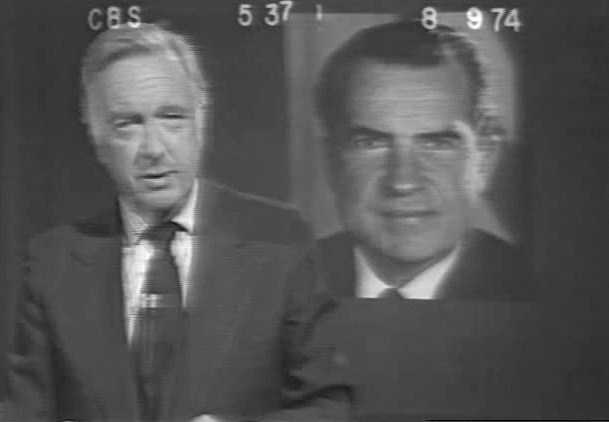
To continue research, you must become a registered user, which is accomplished at no cost. Once registered, I typed in the Nixon resignation, and found more than twenty clips, plus numerous others of anniversaries of the resignation, those of Vice-President Spiro Agnew, and other staff members. Each entry includes both a “details” and a “clip” button. The details button provides more information about the clip, including a brief description of the clip, the reporter(s) involved, and the length of the clip. The clip button puts the clip into a basket or allows you to remove the clip. The basket icon at the top right of the page then asks you to “order” the clip and takes you to a pricing page. Much to my surprise, the cost of three clips, totaling twenty-seven minutes came to a whopping $ 127.00 to loan, unless you go to Vanderbilt to view on-site or your institution becomes a member of the Archive. As the website notes: “Streaming video is available to a limited audience and to limited parts of the collection due to copyright considerations. Currently, only individuals associated with sponsoring colleges and universities can view streaming video.” Unlike other public archives, like UCLA and the Library of Congress, which allow you to stream newsreel material free of charge, Vanderbilt charges fees. While such fees seemed reasonable in the analog era, when the archive had to find the tape, and make a copy (until recently on DVD, previously on analog tape), it now seems excessive. Why not allow low-resolution access for free and charge users for high-resolution images, since the cost of duplication has already been covered and exists on a server?
The term “loan” is also a misnomer, since the link is only available for one month, and does not include licensing fees. Any use beyond simple research, e.g. for inclusion in a documentary film, requires contacting the network that owns the broadcast, where the user will be charged additional substantial licensing fees. While this site is therefore useful for commercial users with deep pockets, it is a disappointment for academic and amateur users who are researching historical topics.

 Archival Spaces
I agree 3 clips totaling 27 minutes costing $127 to loan does seem high.
Thank you for providing the step by step details of how to order the clips from Vanderbilt.
Regarding the Nixon resignation: I find it ironic that Nixon won the 1972 election by a landslide so there was no need to hire the crew to break into the Watergate to view the Democratic Nation Committee’s documents.
I’ve seen a number of video clips of Nixon being interviewed at colleges long after his fall from power. He was very impressive assessing foreign& domestic politics. There’s an interview conducted at an English University (Cambridge or Oxford?) where he was absolutely magnificent answering a wide assortment of their questions.
The image I gained of him then was of the classic hero (a great person doomed by a tragic flaw).
LikeLike