267: Ufa’s Aryanization

Archival Spaces 267

The „Aryanization“ of the Ufa

Uploaded 16 April 2021

Der Kongress tanzt / The Congress Dances (1931, Erik Charell), Ufa’s worldwide mega-hit

Some historians have always understood the Third Reich as a dictatorship that suppressed democratic institutions and oppressed, even murdered its citizenry without due process, but as the example of Germany’s largest film company, the Universum Film A.G. (Ufa) demonstrated, a significant portion of the population, including the business community, the military and the judiciary were willing conspirators in the establishment of Adolf Hitler and the National Socialist Party before Hitler was legally named Chancellor in January 1933. Even before the Nazi government passed anti-Semitic legislation, banning Jewish people from public life, the Ufa’s Board of Directors, in what the Germans call „voraus eilendende Gehorsamkeit” (anticipatory obedience) declared contracts with their German-Jewish employees to be null and void.

When the Nazis declared a nationwide boycott of Jewish businesses on 1 April 1933, it resulted in the destruction and looting of Jewish businesses by Brown Shirts, while innocent Jews were beaten and humiliated in the streets. Obviously, the Ufa’s Board of Directors could not have known that the fascist disregard for law would manifest itself in violence and death when they met on the morning of 29 March – the same morning the papers announced the boycott. But they did vote to fire no less than twenty-four prominent film directors, writers, and actors.  Attending the meeting were Ludwig Klitzsch (CEO), Ernst Hugo Correll (Production chief), Alexander Grau (Film Theatre Dept.), Hermann Grieving (Studio Operations, Accounting), Paul Lehmann (Newsreels, Advertising Films), and Wilhelm Meydam (Distribution), as well as some non-Board members and company lawyers, the latter responsible for dissolving contracts.

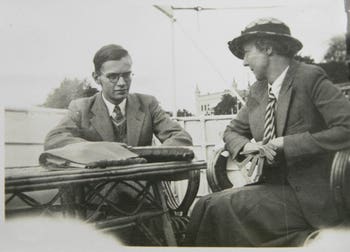
Alfred Hugenberg and friend in 1933

Although the company’s majority stockholder, Dr. Alfred Hugenberg, was a member of Hitler‘s cabinet, the Board minutes reflect a certain guilty reticence on the Board’s part, probably because the talent involved were their biggest moneymakers. Then there was the uncomfortable fact that one of their own, Meydam, was a so-called „half-Jew,“ who was not forced out until 1941. But, in fact, Joseph Goebbels had informed Klitzsch of Nazi plans for the 1 April Jewish boycott, before the papers announced it, so the CEO was prepared. As a result, Jewish Board members Salomon Marx and Curt Sobernheim were not even invited to the meeting and were officially removed shortly thereafter, „due to the national revolution in Germany.“ Marx, who had been a member of the Board since its founding in 1917, died in October 1936, after his private bank had been confiscated, while Sobernheim fled to Paris, where he was murdered by German occupation forces in June 1940, days after the Fall of France.

Rosa von Borsardy and Anton Walbrook in Walzerkrieg (1933)

On 29 March fifteen of Ufa‘s most important filmmakers were sacked, while the fate of nine others was tabled in the hopes of quietly keeping them, a hope that proved illusory.  Except for the head of UFA Distribution, Hermann Kahlenberg and five secretaries, all the axed employees were prominent film talent: two producers (Erich Pommer, Fritz Wechsler), four directors (Ludwig Berger, Erik Charell, Erich Engel, Vikor Gertler), four scriptwriters (Robert Liebmann, Hans Müller, Otto Hein, Fritz Zeckendorf), two composers (Werner Richard Heymann, Gérard Jacobson), three actors (Rosy Barsony, Julius Falkenstein, Otto Wallburg), a set designer (Rudi Feld) und two technical department heads (Gerhard Goldbaum, Georg Engel).

Most were, at that moment, in production: Erik Charell was in pre-production on an Odyssey film, while Pommer, Berger, Liebmann, Müller, and Barsony were making War of the Waltzes (1933), and Heymann and Jacobson were in post-production on Season in Cairo (1933). The latter was directed by Reinhold Schünzel, another „Halbjude“, whose contract had been renewed to finish the film before the end of April. Schünzel was able to continue working for Ufa as an „honorary Aryan“ (Goebbels) until 1937, then got into political hot water over the supposed anti-Hitler satire, The Land of Love (1937). Only Erich Engel, who was on the list for leftist sympathies, rather than racial „impurity,“ was able to continue his career in Nazi Germany after that fateful Ufa Board meeting.

Kurt Gerron and Dolly Haasin Dolly macht Karriere (1931)

Ultimately, many other German-Jewish filmmakers were victims of the Ufa’s policies, not just those specifically named in the minutes. For example, Billy Wilder and Walter Reisch were also under contract in 1933, the latter actually suing Ufa for breach of contract. Ditto Fritz Zeckendorf. Film director Kurt Gerron was fired after he finished his film in May 1933. Gerron, who was also a well-known character actor, co-starring in The Blue Angel (1930), worked for the Nazis again in 1944, when as an inmate of Theresienstadt Concentration Camp, he was forced to direct a Nazi propaganda film about the happy communal life in Theresienstadt (1944), before being murdered in Auschwitz.

Ufa’s anti-Semitic blacklist, included other first tier talent, like producers Gregor Rabinowitsch, Arnold Pressburger and Alfred Zeisler, scriptwriters Irmgard von Cube, Otto Eis, Max Jungk, Felix Joachimson, the cameraman Otto Kanturek, composers Friedrich Hollaender, Bronislav Kaper and Franz Wachsmann, and actors Walter Rilla and Rose Stradner, and eventually Anton Walbrook, because he was gay.

The Rabinovitch-Pressburger films were international hits

One wonders how many lower-level film technicians (not named in the credits), – painters, carpenters, plumbers, gaffers, camera assistants, drivers, etc. – lost their livelihood in this anti-Semitic purge? Since the movie theater business had literally been founded in Germany as elsewhere by a generation of Jewish pioneers, it stands to reason that literally hundreds of employees in Ufa’s extensive first-run theater circuit were also fired. There are no statistics for Germany, but Klaus Christian Vögl has compiled figures for Austria after the so-called „Anschluss“ in 1938. In Vienna alone, the Nazis „Aryanized“ over eighty cinemas, which had a value of 6.6. million Reichsmarks.

Jewish Cinema in Vienna, 1938

Of the eighteen filmmakers fired by the Ufa on 29 March, at least five are known to have perished in the Nazi German genocide, i.e. almost one-third.  While Fritz Gertler actually survived the camps, Wallburg, Goldbaum, Zeckendorf, Jacobson, and Liebermann died at the hands of the Nazis. The others survived, with only some of them able to continue their careers in Hollywood or elsewhere. The Ufa’s decision to fire Jewish employees prior to any anti-Semitic government legislation sadly indicated the willingness of German private industry to accommodate the Nazis. Their action constituted literally the first shot in a war against European Jewry, genocide, and confiscated Jewish wealth financing Nazi Germany’s ultimately failed wars of aggression. 

Theresienstadt (1944, Kurt Gerron)

266: Josephine Baker’s Cinematic Prism

Archival Spaces 266

Josephine Baker’s Cinematic Prism

Uploaded 2 April 2021

Earlier this week, I participated in an online book launch at the Finger Lakes Environmental Film Festival (https://www.ithaca.edu/finger-lakes-environmental-film-festival) for Terri Simone Francis’s book, Josephine Baker’s Cinematic Prism (Indiana University Press, 2021). I was invited to be on the panel because as a young curator at George Eastman Museum in the late 1980s, I had helped preserve and make available to the African-American community several rare Josephine Baker films that seemingly only existed in unique copies in our archive. I noted that I had first encountered “La Bakaire” as a teenager in the 1960s in Germany where she appeared regularly on the type of Saturday night variety shows I detested.  After the Archive preserved Zou Zou (1934, Marc Allégret) and Princess Tam Tam (1935, Edmund T. Gréville), as well as some of the Folies Bergère footage, I presented Josephine Baker programs in Boston, New York, Chicago, Washington, DC, Minneapolis, and Durham, NC; at Film Forum in October 1987 the crowds were so great that traffic came to a standstill in downtown Manhattan. Afterward, Jean-Claude Baker invited Bruce Goldstein, the Nicholas Brothers, Fayard and Harold, my wife and myself for dinner at his 42nd Street after-theatre brasserie, Chez Josephine, a little more than a year after it had opened. Jean-Claude, who was at the time writing his own biography of his adopted mother (published 1993), became an acquaintance, who we would see on subsequent visits to New York.

Unlike several biographies about Baker, Terri Francis’s book analyses for the first time Baker’s film career, rather than her life, mixing close textual analysis with historical contextualization. Baker was in fact unique in that she had starring roles in several French films, at a time when her career possibilities in Hollywood films would have been limited to playing stereotyped, walk-on roles as a domestic or mammy. Instead, Josephine Baker moved to Paris in 1925, where she became a huge star at the Folies Bergère, sustaining a career there as a dancer and singer for fifty years. That fame was based on her infamous semi-nude banana dance, so that her public image vacillated between the demeaning stereotypes of black minstrelsy, the sexual allure of an ebony goddess, and liberated independent womanhood. To explicate the many different sides of Baker, Terri Francis employs the metaphor of the prism, which, with the changing light, offers ever different views.

Francis begins with a lengthy discussion of Baker’s banana skirt routine, explicating it as a potent symbol for primitivist and colonialist ideologies signifying persons of color, connecting her to nature, but also to underdeveloped cultures in relationship to supposedly superior white, modern European civilizations. Francis argues that the banana dance is not just a performance, as captured on film, but also performative, in the sense that Baker is simultaneously and self-reflexively satirizing her position as an object for white man’s desire. Indeed, her cabaret performances continued to negotiate these ambiguities and contradictions.

Siren of the Tropics (1927)

In the following chapters, Terri Francis presents close textual analyses of her three main features, The Siren of the Tropics (1927, Henri Étiévant and Mario Nalpas), a silent, Zou Zou, and Princess Tam Tam, in which Baker speaks fluent if vernacular FrenchAll three films offer a version of Baker’s own rags to riches biography, in which an untrained woman of color morphs into a European musical star. In her chapter on Zou Zou, Francis discusses the 18th century case of Alice Baartman, an African woman who was “exhibited” to British and French audiences, noting that Baker, like Baartman, was perceived as an exotic object, available to curious audiences for visual inspection. Significantly, while she is undoubtedly the star of these films, she is ultimately not the “love interest” for the white male hero. Indeed, Baker as Papitou, Zou Zou and Alwina, fantasizes about the European male object of her desire, but love remains unrequited, while the white male loves only whiteness. Francis demonstrates this mise en scene of gazes precisely by pointing to Jean Gabin in Zou Zou constantly looking away from Baker as she speaks to him towards her girlfriend, whom he desires. Thus, while her stage shows fore-grounded Baker as an object for white colonialist fantasy, her films visualize her subjectivity as a sexual woman of color, while keeping her within an ideological frame of European negrophilia. Politely kept in her place as other, Baker is left to continue her entertainment career or return to her roots, as she does in Princess Tam Tam. Clearly, while the French film industry was willing to have the dark-skinned Baker star in mainstream feature films, an impossibility in Hollywood, it, too, was worried about the specter of miscegenation, which remained a threat to white control of the colonialist imaginary.

Baker’s place in black film history, if mentioned at all, is usually that of a European outlier, divorced from the hard realities of white supremacist America, the race films produced at its periphery, or today’s more mainstream black films. Yet Francis, by focusing on the African-American press reception of Baker and her films, connects Baker directly to black film history, valorizing her as a hope for black cinema in America, but also demonstrating that she was consistently integrated into African-American social consciousness. In other words, Francis theorizes a bifurcated African-American cinema,. split between America and the African-American diaspora, where seminal figures like Paul Robeson and Melvin van Peebles worked.   

Princess Tam Tam (1935)

Finally, a note that in no way diminishes Terri Francis’s critical achievement: it is curious that Francis avoids any discussion of Baker’s well-known queerness, although such a discussion could have been easily integrated into her prism analysis as just another facet, and may even be supported in the text, e.g. in Zou Zou’s relationship to Claire, and, more obtusely in the white-white-black relationship triangles in the other films. Francis’s Josephine Baker’s Cinematic Prism, by melding textual analysis with historical contextualization, even showing how Baker remains an icon for contemporary entertainers, like Beyoncé, makes a seminal contribution to African-American film history.   

Still from Zou Zou (1935)

265: Love & Death in Cinema

Archival Spaces 265

Love and Death in “ism” Cinema

Uploaded 19 March 2021

I’m reading and reviewing for a German publication an excellent new book on Israeli cinema, Projecting the Nation. History and Ideology on the Israeli Screen (2020) by Eran Kaplan. I was particularly struck by a line in his chapter on Eros: “The real fulfillment of love and desire in the Zionist epic is death.” (p. 134) Kaplan describes “the New Hebrew” of the Zionist imaginary as having strong physical and masculine traits combined with “moral restraint: a saint with muscles,” – unlike the feminized, victimized and weak Diaspora Jew. The goal of nationhood consistently trumped private erotic happiness. Indeed, Kaplan characterizes all Israeli cinema’s depiction of sex and romance as inextricably linked to death, with only rare moments of tenderness and erotic pleasure.(p. 130)   

I instantly recognized “the pathology,” having in 1981 ascribed similar kinks in the national imaginary of proto-fascist and Nazi German films about the history of Prussia. “Love, Duty and the Eroticism of Death,” was indebted to both Sigmund Freud and Klaus Theweleit, whose seminal Männerphantasien, has been translated as Male Fantasies (1987). A German reviewer of the multi-volume exhibition catalog, Prussia. Attempt at a Reckoning) referenced my contribution, but was actually taking a swipe at Theweleit when he wrote: “With the help of the volume on “Prussia in the Cinema,” one can yet again be instructed in the relationship between Fascism and Sex…” (Die Zeit, 8-28-81) My essay constructed meta-narrative of German films, whereby the male hero falls in love with a woman, but then – despite the pleas of his love interest – realizes his duty to the nation/revolution and sacrifices himself in a Heldentod.

Does this mean, I’m equating Zionism with Nazism or Communism? Absolutely not, because I believe Zionism remained morally, if not always in practice, dedicated to democratic principles and has survived with democratically elected governments in Israel for 73 years;  i.e. it never entered a totalitarian phase. Totalitarian by design, on the other hand, were Communism and Fascism. Both enforced tight parameters on public eroticism and sexuality outside marriage. Zionism, too, apparently encouraged moral Puritanism.  But, think about it, why are Hollywood, French Cinema, Indian cinema obsessed with romance and erotic pleasure, while the cinemas of these three isms are machines of sexual sublimation?  

Zionist Histadrut Poster
Soviet Proaganda Poster

German films from Theodore Körner (1932, Carl Boese) to Kolberg (1945, Veit Harlan) propagated a fanatic patriotism, renunciation of individual happiness, total commitment to the state, the valiant and unflinching heroism of Teutonic men, the honor and rapture of a death for the Führer und Volk. Eros conquered by Thanatos; the life and death instinct, intertwined and always present, according to Freud. Narratives of sexual sublimation, of the organism surrendering to a death wish, of self-sacrifice for the Vaterland, permeate Prussian films, creating an idealized fascist German imaginary obsessed with death.

Kolberg (1945) the Movie
Kolberg, East Prussia, 1945

While the transformation of Prussian history into German myth was well underway in 19th-century German poetry and popular literature, German commercial cinema quickly appropriated both its narratives and ideology. Isolated in World War I from the French competition, which had dominated film distribution before 1914, German film producers rushed to make patriotic films. However, the incredible financial success of Arzen von Cserepy’s four-part epic, Fridericus Rex (1920-1922), made only two years after the end of a bitter world war, established the Prussian film genre. No less than ten films between 1927 and 1942 starred Otto Gebühr as the legendary Frederick the Great (1712-1786), while more than 300 German films touch on Prussian history, from the Napoleonic Wars to Germany’s reunification under Bismarck.

Otto Gebuehr as Frederick the Great

After 1933, Prussian films drew historical analogies to imply that the Third Reich constituted the next reawakening in German national power. Its heroes were invariably military men, who had fought valiantly on the battlefields, or great “men” who through their deeds had contributed to the growth of national consciousness, while women were relegated to making babies. After 1945, Prussian films lay dormant for a few years, only to be revived in the 1950s, during the period of reconstruction and rearmament under NATO. Less authoritarian than their predecessors, Prussian films under Adenauer nevertheless retained elements of “patriotic” anti-Communism and patriarchy.

Prussian and Nazi cinema was more invested in patriarchy than other male action genres, like the American western, addressing a male subject, while denying the existence of female subjectivity. Not only were women consistently removed from the narrative as figures of identification, but their gaze too was rarely acknowledged. Woman’s desire, as positioned in narratives of heterosexual romance and sexual union, is consistently denied and ultimately eliminated, privileging narratives of male bonding and violent aggression.

Besatzung Dora (1943) Male Bonding

My meta-narrative of Prussian films functioned this way: 1. A love story develops in the course of which woman is revealed to be in conflict with the male hero’s military aspirations; 2. the hero realizes that his true duty lies in his sacrifice to the nation; 3. through the group dynamics of male-bonding, the hero experiences true brotherhood; 4. the hero finds the strength to embrace his fate as a martyr. Such a meta-narrative aspired to trace the imaginary trajectory of the German male’s sexual sublimation, from a renunciation of heterosexual union via an only barely repressed homoeroticism to an ultimate death wish. By positioning the male subject in this drama of Thanatos, Prussian films, especially those produced in the Third Reich, prepared young men for their imminent death on the battlefields, and thus represented an overt ideological manifestation of Fascism.

(1932)

The abandonment of sexual desire and heterosexual union promised in the fascist cinema imaginary a higher, spiritual form of bliss, dissolved within the national body politic. The individual body was robbed of its physicality and sensuality, co-opted into an idealized, fetishized Übermensch, integrated in the geometry of the Nazi masses. Eternal life guaranteed through ethereal union with the Nation, seen over and over in Nazi cinema images of fallen military heroes marching through the heavens. The trope is repeated in Zionist cinema, but with a twist: the Sabra masses are pioneers, marching to build, not destroy, like those jackboot bodies. And maybe that juxtaposition succinctly captures the difference between the two.

For those wishing to read a revised  English translation of my essay: “Eros, Thanatos, and the Will to Myth: Prussian Films in German Cinema,” in: Bruce Murray and Christopher Wickham (eds.): Framing the Past: The Historiography of German Cinema and Television (Carbondale: University of Southern Illinois Press

264: Restored Avant-Garde Films (NL)

Archival Spaces 264

Restored Avant-Garde Films from the Netherlands

Uploaded   5 March 2021

Joris Ivens in De Brug (Joris Ivens, 1928)

Between February 24 and March 9, 2021, the Eye Museum, Amsterdam and Anthology Film Archives, New York, are presenting a streamed film program, “THERE ARE NO RULES!: RESTORED AND REVISITED AVANT-GARDE FILMS FROM THE NETHERLANDS,” co-curated by Simona Monizza, Mark-Paul Meyer and Marius Hrdy. Originally scheduled as a theatrical series for April 2020 on the history of Dutch avant-garde film from the 1920s to the present – canceled due to COVID), –  the present online program focuses on three areas: pre-World War II avant-garde films, screened by the Dutch Filmliga, Dutch avant-garde work from the 1950s, and films by the contemporary filmmaker, Henri Plaat. These five, rare programs, each running about an hour, can be viewed for a nominal. http://anthologyfilmarchives.org/film_screenings/series/53327.

Edited by Ute Eskildsen and Jan-Christopher Horak, (Stuttgart, 1979)

Given my own long-standing interest in the 1920s European avant-garde, I viewed the first two programs, dedicated to works screened at the Dutch Filmliga (1927-1933). My own research in this area goes back to 1979 when I co-curated (with Ute Eskildsen) the 50th anniversary reconstruction of “Film and Foto,” an exhibition of European avant-garde film and photography, curated by Hans Richter and Laszlo Moholy-Nagy. Our show, “Film und Foto der 20er Jahre,” opened in Stuttgart, then travelled to Essen, Hamburg, Zurich, and Berlin, before Van Deren Coke remade the exhibition at the San Francisco Museum of Modern Art. My essay in the accompanying German catalog (translated into English for Afterimage in 1980), was the first film history to recontextualize European avant-garde filmmaking as a cultural phenomenon, consisting of production, distribution, exhibition, and reception, and not just as a valorization of isolated film artists. It was a methodology I subsequently applied to defining the first American film avant-garde in Lovers of Cinema: The First American Film Avant-Garde (Madison, 1995).   

The present Filmliga program is divided into “Shapes” and “Structures,” although the reason for this breakdown is unclear, given that Jan C. Mol’s microscopic films bookend the two programs. Generally, the first program is about humans in relationship with nature, the second about city life. Founded in 1927 by Dutch intellectuals, the Dutch Filmliga was one of many film societies, like the Le Club des Amis du Septième Art in Paris, the London Film Society, and the German Gesellschaft Neuer Film, which hoped to support independent and avant-garde film in the face of American commercial cinema. As a result, the program includes not just Dutch films, but also German, French, and Belgian examples.

Uit het Reijk der Kristallen (Joris Ivens, 1927)
Kristallen in Kleur (Jan Mol, 1927)

Program 1 opens with Jan C. Mol’s From the Realm of Crystals (1927), which uses microscopic and time-altered photography to visualize the growth of various chemical crystals, including boric acid, potassium sulfate, and silver nitrate. Mol’s scientific film was championed by the avant-garde because it revealed the abstract beauty of structures in nature, which were invisible to the human eye but made visible through film technology. Mol’s Crystals and its color remake, Crystals in Color (1927), look surprisingly like abstract modernist art in motion. Henri Chomette had already included similar shots of crystals in his Cinq minute de cinema pur (1925), and, indeed, the trope of abstract art in nature was also mined by Jean Painlevé in France, and photographers Karl Blossfeldt, Albert Renger-Patzsch, and Imogen Cunningham, among others.

Images d’Ostende (Henri Storck, 1929)
Dagjesmenschen (Henri Storck, 1929)

The next two films by Belgian film documentarian Henri Storck were shot on the beach at Ostend. Images of Ostend (1929) is a visual poem of sea and surf in the dead of Winter, searching for the abstract beauty of moving water, sand and wind, punctuated by signs of human activity: an anchor, a jetty, an abandoned fishing boat, rapidly edited to convey the rhythm of the sea. Daytrippers (1929), on the other hand, documents with a great deal of humor crowds of beachgoers from all social classes and of all ages congregating, playing, strolling, swimming, lying, and reading in the Summer sun; some wear bathing suits, others wade in their street clothes. Unfortunately, the first-named film is slightly over-exposed, leading to a loss of detail.

Disc 957 (Germaine Dulac, 1928)
In der Nacht (Walter Ruttmann, 1931)

French filmmaker Germaine Dulac’s Disc 957 (1929) and German avant-gardist Walter Ruttmann’s In the Night (1931) are very short films (5” & 6”), one silent, one sound, that attempt to visualize music. In both cases, the emotional power of music is equated with lyrical images of nature.  Dulac intercuts images of the forest and natural landscapes with animated images of sound waves, a revolving 78 RPM disc, piano hands, and a metronome, all to accompany an absent Chopin Prelude, which was probably played live, but is missing from this performance. Similarly, Ruttmann’s sound film intercuts images of a female concert pianist playing a classical piece with night time shots of lakes seen between the trees, running water, and the surf smashing against rocks.

Regen (Joris Ivens/Manus Franken, 1929)

Sandwiched between these two films is Joris Ivens and Manus Franken’s silent, poetic city film, Rain (1929). Film portraits of cities, beginning with Paul Strand’s Manhatta (1921) and Alberto Cavalcanti’s Rien que les heures (1926) were an almost universal phenomenon in the pre-war avant-garde, as documented the recent publication, The City Symphony Phenomenon (New York, 2019). Shot in Amsterdam before, during, and after a rain storm, Ivens’ camera searches out abstract visual designs in the concentric circles of water falling into canals, in a crowd of umbrellas, in the rack focus of raindrops on windowpanes, in ever-changing cloud formations. As Eva Hielscher notes in the above publication, the rain creates reflective surfaces that act as screens, “generating a new and modern mediated vision, not unlike cinematic perception.”(p. 253)

De Brug (Joris Ivens, 1928)

The second Filmliga program continues the theme of city symphonies with Joris Ivens’ The Bridge (1928), a poetic view of a movable, steel-constructed railroad bridge in Rotterdam as it is raised and lowered to allow for river traffic below. De Brug is in fact a visual symphony of moving machine parts, rhythmically cut on movement within the frame or the moving camera, whether the trains rolling over the bridge, the bridge’s machinery and steel girders in motion or the abstract design of vertical and horizontal planes. The beauty of modern technology is, of course, another ubiquitous trope of the modernist film avant-garde, as demonstrated by Laszlo Moholy Nagy’s Impressions of Marseille’s Old Port (1929), Eugène Deslaw’s La Marche des machines (1929) and Dziga Vertov’s Man With a Movie Camera (1929), among many others.

Fragment Nul Uur Nul (1928)
Hoogstraat (Andor von Barsy, 1929)
Doordeweekse Dag (1932)

Three other city symphonies follow: Andor von Barsy, Simon Koster, and Otto van Neijenhoff’s Fragment Zero to Zero (1928) uses the repeated image of a clock to document human activity in a city over a twelve-hour period, beginning with industrial work and ending with urban leisure time activity. Andor von Barsy’s Hoogstraat (1929) is an “absolute film,” documenting Rotterdam’s famous shopping street, intercutting pedestrians and street vendors with storefronts. The numerous shop window mannequins point to another favorite visual trope, especially of the Surrealists, as inspired by Eugène Atget’s pre-WWI images of Paris. Sadly, Hoogstraat’s picturesque neighborhood was completely obliterated by Nazi bombs in 1940, giving the film added documentary value. Finally, the anonymous and charming Weekday (1932) uses a uniformly subjective p.o.v. camera to illustrate a commuter having breakfast, dressing, then taking a taxi through city streets to work.

Diepte (Frans Dupont, 1933)

The outlier in the second program is Frans Dupont’s animated Depth (1933), which as the film tells us is “an absolute film about harmony; not a representation of a particular subject.” The film intercuts abstract circles and rectangles, some of which connote an urban landscape, with animated portraits of a man and woman, interrupted by a live action scene of a smoky card game. It is an experiment in creating three dimensions from two, but remains mysterious.

In any case, this excellent primer on the 1920s-30s European film avant-garde is available for viewing through March 9th.