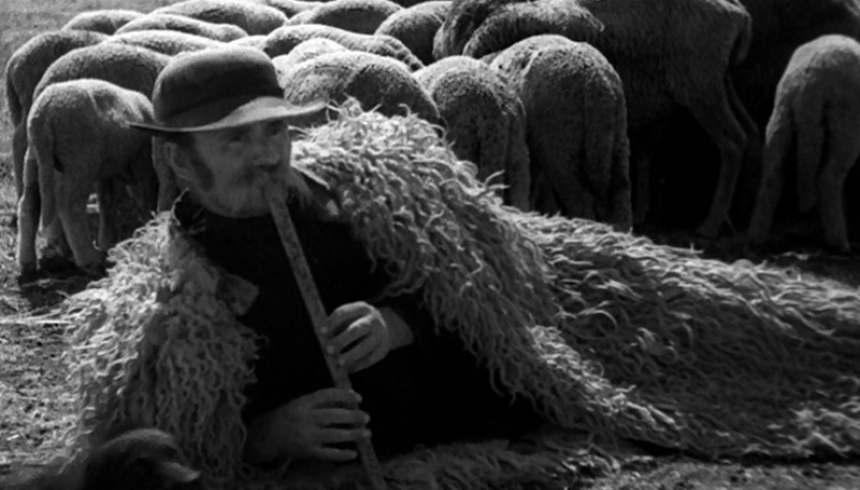
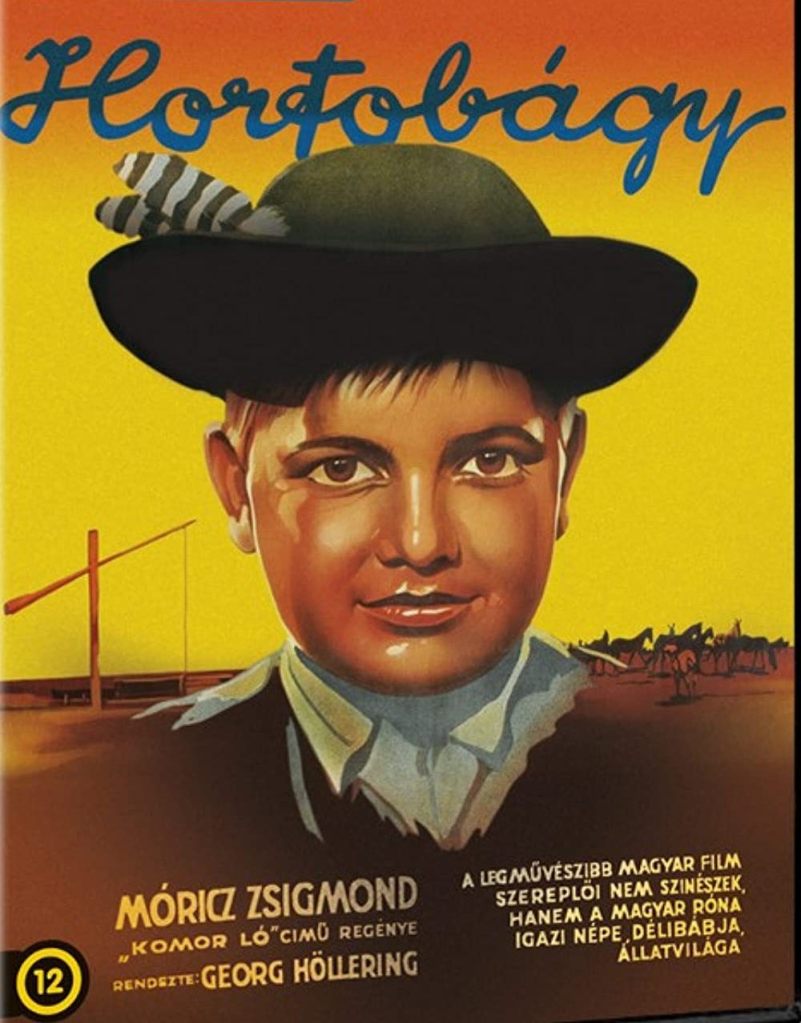
George Höllering’s Hortobágy (1937) is one of those films I have been chasing after for decades and was finally able to see the film at the German Kinemathek’s recent “Film Restored: The Film Heritage Festival,” in a wet-gate transferred digital copy, restored this year by the National Film Institute Hungary, using an internegative for the picture, and a safety print for sound. I was not disappointed in Hortobágy which turns out to be an anomaly in Hungarian cinema in the 1930s when domestic comedies like István Székely’s Lila Akacs/Purple Lilacs(1934) and Béla Gaál’s Meseautó/Car of Dreams (1934) dominated screens in Budapest and Debrecen. An almost neo-realist look a peasant life in the Hortobágy region of Hungary, the film’s long, languid takes and lyrical documentary style is reminiscent of Robert Flaherty’s Man of Aran (1934).
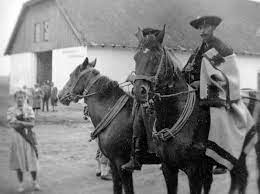
Located in the flatlands East of Budapest and West of Debrecen in central Hungary, the Horotbágy was an arid and sparsely populated steppe or puszta where distinctly Hungarian breeds of cattle, sheep, and horses were raised, the peasants maintaining their traditional and archaic way of life. Originally a center of commerce, the “Great Inn of the Hortobágy” (built-in 1781) was located on the road between Debrecen and Budapest where a stone bridge crossed the Hortobágy River, but the region dried out and the land was depopulated after the Tisza River was redirected in the 1840s. Höllering’s film documented the conflicts between tradition and modernity in a narrative that featured amateur actors exclusively, Hortobágy’s peasants and herdsmen playing themselves with surprising naturalness.
Austrian film director Georg Höllering spent more than two years under difficult working conditions producing independently what was initially only to be a documentary, the director traveling to the region in 1934 to shoot footage with his cameraman László Schäffer. In a second phase, Höllering asked the writer Zsigmond Móricz to develop a film narrative while shooting continuing through 1935. In 1936, the director produced a prologue and the film was released in March 1937. Hortobágy was a huge success throughout Europe but was heavily criticized by right-wing politicians and Hungary’s Fascist government for showing a pre-industrial view of the country. It was also a failure in the country’s cinemas because popular taste favored the kind of commercial comedies mentioned above. On the other hand, the film was imported to the United States by Sam Cummings’ Jewel Prods., where – after a battle with the New York Board of Censors and a Supreme Court injunction – it premiered in January 1940 and did relatively well given its brief shots of nudity and the amazing depiction of the birth of a foal.
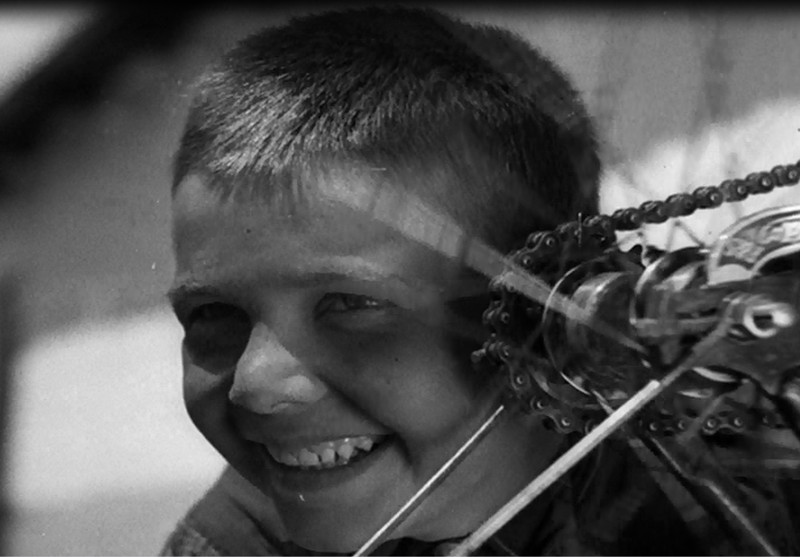
Opening with extensive shots of livestock, herding, and moving on a seemingly endless plain, the film then slowly introduces its human subjects, the Cinege family, consisting of a pater familias, his wife, Jansci, their 10-year-old son, Juliska, their daughter, and their csikós (horseman), Mihály. Everyone is preparing to go to town for the yearly market festival, where horses are studded. The slight story focuses on the boy who wants to become an engineer and keeps sneaking off to the oil well being dug at the edge of their property, much to the chagrin of the senior Cinege, and the daughter who wants to marry Mihály and not the wealthy farmer her father has chosen for her. To show his displeasure, the father destroys the bicycle Jansci has fixed up in order to cycle to the oil derrick, both symbols of modernity. Meanwhile, Mihály and Juliska secretly meet before the village fair and have sex in the barn.
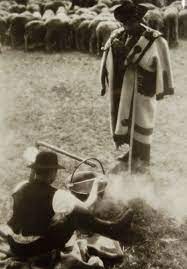
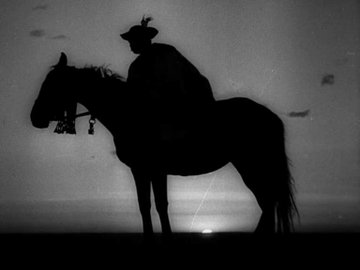
Höllering lovingly utilizes long takes to capture the daily lives of these sheepherders and horse breeders in the vast expanse of the puszta, but also the conflicts between the generations. Again, the scenes in the village and the market as peasants gather from the surrounding area have a documentary-like precision, contrasting with a fluid camera the movement of animals and their masters, as well as the myriad faces of country peasants. A particularly poignant moment involves an 80-year-old widow who travels to market to see – before she dies – the man she was not allowed to marry in her youth, the couple deciding to live out their final days together after they reunite at the festival. Jacques Lourcelles, the French film critic for Présence du cinema once wrote: “There is a cosmic dimension to Höllering’s characters, who have a forehead in the clouds and a soul among the stars.” And indeed, nature (and the weather) are constantly foregrounded, as in the violent storm that damages the oil well and kills Jansci’s horse.
Born in Vienna in 1897, George Hoellering started his film career as an exhibitor in Vienna in 1919, then moved to Berlin in the mid-1920s to produce and edit shorts. He was the production manager on Slatan Dudow’s left-wing Kuhle Wampe (1932) and on Heinz Paul’s right-wing, Tannenberg (1932), fleeing Germany shortly thereafter, because of his Jewish wife. They returned to Vienna but emigrated to London in 1937, where he managed the Academy Cinema in the West End. He also produced propaganda shorts for the British government during World War II and produced, directed, and co-wrote with T.S. Elliot, Murder in the Cathedral (1952), his last foray into film production.
He continued to manage the Academy Cinema until his death in 1980. Ironically my first knowledge of Hoellering came two years later when I found out that Helmar Lerski’s film, Avodah (1935), had been screened there in 1938 but was nowhere to be found. Miraculously, the 35mm nitrate print shown back in 1938 was found in a storeroom of the Academy, when the cinema was demolished in 1989 and is now preserved at the British Film Institute.
Lisa Gotto: Passing and Posing Between Black and White
Uploaded 26 November 2021
Symbol of the Unconquered (1920, Oscar Micheaux)
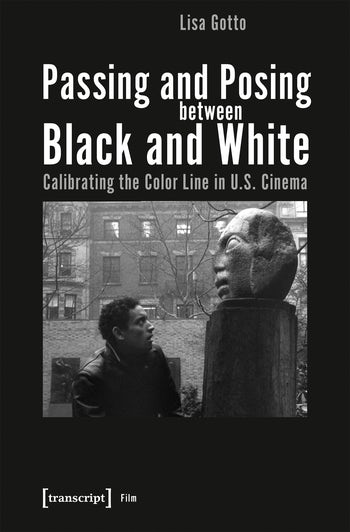
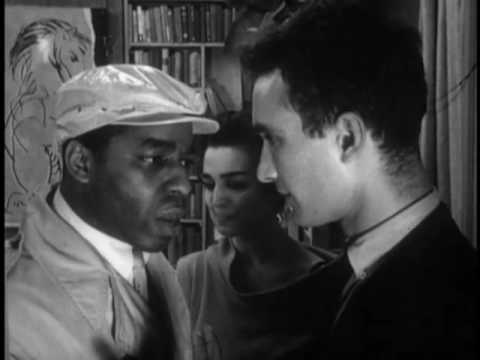
Lisa Gotto, a professor of film theory at the University of Vienna, originally published her book, Passing and Posing. Between Black and White. Calibrating the Color Line in U.S. Cinema (Bielefeld: transcript verlag, 2021) in German in 2006 as Traum und Trauma in Schwarz-Weiß. Ethnische Grenzgänge im amerikanischen Film, the German title playing on the German words for dream and trauma. The book was her Ph.D. dissertation in which she analyses the racial content of six films from three different periods in American film history, arguing that historically determined film aesthetics impact the formulation of racism/anti-racism in each film. Thus, while The Birth of a Nation (1915, D.W. Griffith) and Symbol of the Unconquered (1920, Oscar Micheaux) articulate polar opposing attitudes towards race, both narratives are structured according to the conventions of classical silent film. Imitation of Life (1959, Douglas Sirk) and Shadows (1959, John Cassavettes) acknowledge their own artifice, constructing narrative self-reflexivity. Finally, with Bamboozled (2000, Spike Lee) and The Human Stain (Robert Benton, 2003), both produced after the death of 35mm cinema and the proliferation of multiple media platforms, the epistemological, semantic, and technical presuppositions of these works are queried.
In D.W. Griffith’s ultra-racist narrative, Gotto defines white-nationalist ideological coordinates according to a strict color line between black and white, wherein the segregationist director’s venomous barbs are reserved for those persons who cross that line. The so-called mixed-race mulattoes defile the supposed purity of white blood and thereby muddle the film’s strict racial hierarchies, which simultaneously define stable class and economic relationships. Oscar Micheaux, on the other hand, constructs a racial binary between black and white from a distinctly opposite perspective, wherein the act of “passing” as an economic survival strategy in America’s viciously racist society is interpreted as a betrayal of Blackness, because passing’s temporal ambivalence is “constantly bound to the horror of concealing, denying, and white-washing.” (p. 56.)
Imitation of Life (1959, Douglas Sirk)
In the German émigré director Douglas Sirk’s Imitation of Life, whiteness is seen to be an ideological construct and a social formation, allowing the light-skinned daughter of a black maid to pass, but also consistently connecting Sara Jane’s whiteness to her African-American mother, thereby contextualizing her wish for social mobility as a denial of her family relations and rendering her emotionally torn; the inherent contradictions of the narrative thus constantly call attention to themselves, radical ambiguity becoming a stylistic device to avoid the hardest questions of race. Cassavettes’ independent, low-budget feature, Shadows, also fosters an extreme form of ambiguity that frustrates any unified legibility, its mixed-race characters confronting their racial identity only as a background theme when confronted with racist sentiments. Skin color vacillates with the light and camera exposure, but also defines racial identity, self, and the other, allowing actors to experiment with multiple identities.
Bamboozled (2000, Spike Lee)
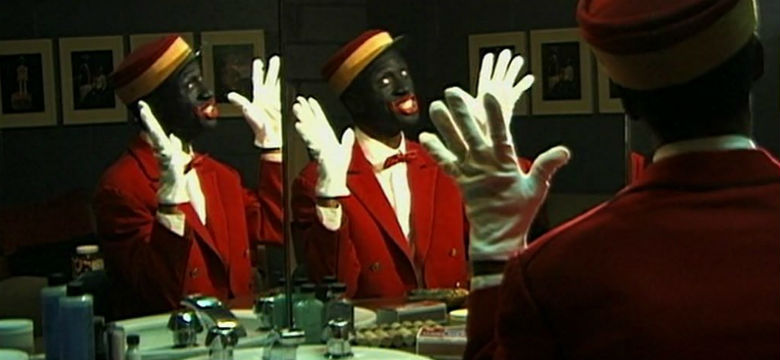
Spike Lee’s instrumentalization of black face in Bamboozled, in order to make manifest racist presuppositions of white America – even when confronted with a diversity and black and brown people – is primarily a critique of American cinema, but also of an audience that fails to see the bitterness behind the mask. Black face is connected to death and lynching, but also to the unreality of an entertainment reduced to smiling black mouths, eyes, and feet that eliminate any perception of humanness. In Benton’s The Human Stain, a “Jewish” (actually African-American) art history professor whose whiteness (and ability to pass) is reflected in the whiteness of the Greek statutes he studies, cannot escape his racial origins, “the ego remains constantly subjected to its racist definition.” (p. 218). Ironically, he is fired for making racist comments, but the ultimate and regrettably unmentioned irony of this film is that a white actor, Anthony Hopkins, plays an African-American passing as white, thereby metaphorically in black face.
Lisa Gotto
Lisa Gotto’s concluding remark for The Human Stain may hold true for all race relations in a society that has not freed itself of racism, even when obvious color lines have been legally eliminated and racially ambiguity is celebrated: “The ambition of self-discovery cannot be thought beyond racist regulation because within racist society the social being perpetually remains subject to a racial typecasting.” (p. 230). This is an important book and should be read, but I admit to feeling a certain discomfort in the fact only two of the six directors discussed here are African-American, possibly skewing the validity of any of its conclusions.
For the first time ever, I have given space in my blog for a guest author. On 4 November 2021, Martin Koerber, Curator at the Deutsche Kinemathek, Berlin, and also responsible for the film archive, gave the laudation speech in the Kino Arsenal when I received the Cinematheque Association‘s honorary prize. The original text was read in German.
Rainer Rother, J.-C. Horak, Kino Arsenal, 4 November 2021
Today, Prof. Jan-Christopher Horak receives the Honorary Prize of the Cinematheque Association for Service to Film Culture and Patrimony 2021. Since the 1970s, as anyone who has concerned themself with film archiving and film history knows, Chris Horak has been on the road as a film historical researcher, but also as an archive director, curator, and as the founder of diverse activities in our field. Only a few of his many accomplishments can be addressed in this short appreciation – a laudatio from the Latin- mentioning merely a few highlights, for example, the innumerable articles – according to Wikipedia over 300 – which Chris has published in the last forty-five years; these will hopefully be collected one of these days in an anthology or be available for reading on his blog, Archival Spaces. I want to warmly recommend, you subscribe to this blog, in which he speaks of his experiences, his contacts with other film preservationists and filmmakers, occasionally mentioning biographical details, which reveal much that is private, so the reader understands why certain topics interest him. Blogs are a publication modus to pursue so-called minor matters that unlock much more about the writer at times than serious missives and their accompanying footnotes. You will see, how useful it was for me that Chris is a blogger.
Acceptance Speech
The honorary prize which has been previously awarded only three times, applies not so much to a role or roles someone has filled than to the personality repeatedly displayed in the course of exercising one or more functions. Character manifests itself in an interest in professional activity, closely connected to a biography, and from this link emerges the passion and dedication necessary to perform the extraordinary. The film critic Andreas Kilb once described Chris Horak in Die Zeit (1999) as follows: „Chris Horak, the son of a Czech émigré and a German woman, raised in West Germany and the USA, is a hybrid of Germanic and American virtues: tall, energetic, affable, fastidious, a workaholic and a dreamer, he could easily be an ambassador for German film in Hollywood, a mediator between worlds.“
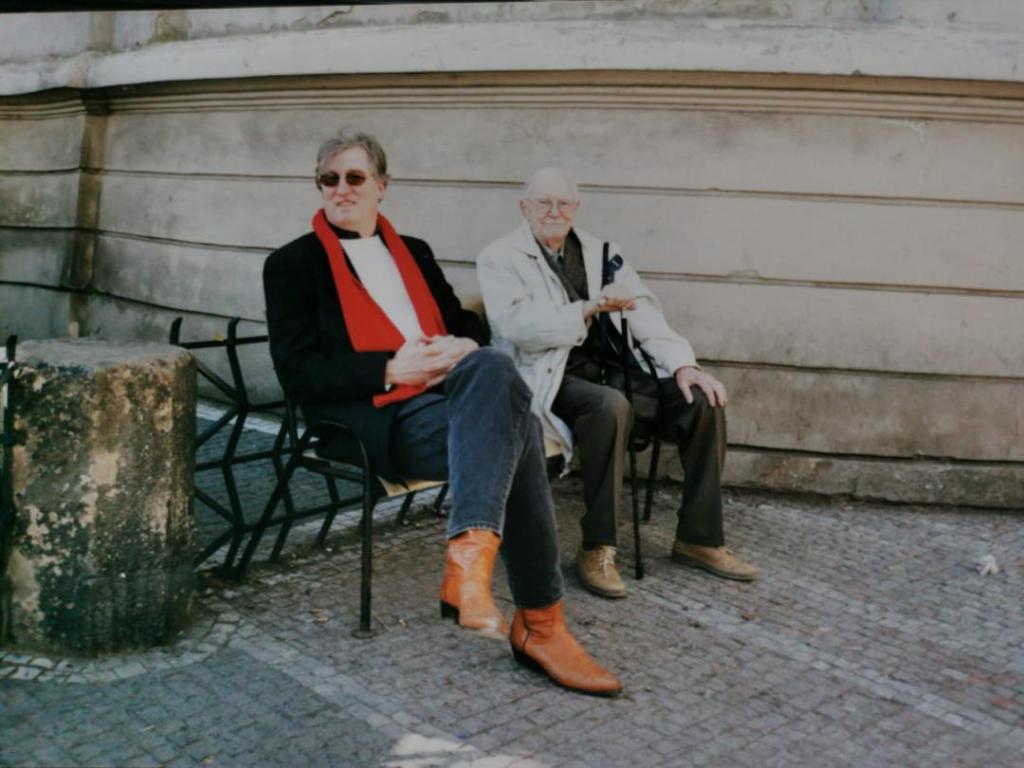
J.-C. Horak, Jerome V. Horak, Prague, 2002
The slogan for this year’s festival of the Cinematheque Association is “Cinematic Migrations” – a motto that could stand for the life and professional impact of Dr. Jan-Christopher Horak. Born in 1951 in Bad Münstereifel, and whoever doesn‘t associate evil with the naming of this quiet spa, knows nothing of the bitter ironies of the 20th century in Germany (Hitler’s Felsennest residence looked down on the medieval town). These accompany Chris’s life from the very beginning like a warning shadow, making him ever vigilant: His father illegally crossed the border from Prague into – of all places – Germany, where at the beginning of the 1940s Jaromír Horák had been incarcerated briefly in the Concentration Camp Sachsenhausen because he had been a university student when demonstrations against the Nazi German occupation had occurred. The grandfather was able to ransom his son’s release, but further political activity after 1945 finds him again on the „wrong side“ after the Communist Putsch in Czechoslovakia. In a strange reversal of fronts, Germany becomes a refuge for a man condemned in absentia to twenty years hard labor.
The family moved on to America, but returned in the mid-1960s to Germany, from where the father travelled repeatedly on business to the old CSSR. When the archives of the Czech Secret Police are opened after 1989, it becomes clear that they had considered finally arresting Jerome Horak numerous times on one of those trips, which elicited the following succinct comment from father to son: „Those were exciting times.“
Doctoral Candidate, Muenster
Chris Horak studies first in the USA and then in Germany, receiving his doctorate at the University of Münster with his dissertation, Anti-Nazi-Films of German-speaking Émigrés in Hollywood 1939-1945 (1984). The late/great film critic Karsten Witte emphatically recommended I read this work he undoubtedly saw in relation to his own studies of German cinema in the 1930s, which first appeared here and there and then collected in his seminal publication, Lachende Erben – Toller Tag, Film Comedy in the Third Reich (1995).
I should mention two publications from this period, written with Ute Eskildsen that indicate Horak‘s interest in international linkages in avant-garde film and photography: Film and Photo in the 1920s (1979)and Helmar Lerski, Lichtbildner und Fotograf (1982); again migration as a life-saving human right is a factor in the biographies of the artists discussed here and certainly also determined the creation of these studies. The 1980s find Chris Horak first as Associate Curator, later as the long-time Senior Curator in the film archive of the George Eastman Museum in Rochester. It was essential to move the film archive into professional channels, given that since its founding it had been operated as a personal collection, and establish first contacts to other film archives in the Fédération Internationale des Archiv du Film (FIAF). We, too, first met – I believe initially by mail – because the Kinemathek was a consistent client of Eastman House for its Berlinale film retrospectives, and was even able to „borrow“ their house pianist Phil Carli in the mid-1990s (under Chris‘ successor Paolo Cherchi Usai) for William Wyler’s silent films from Eastman.
Ron Magliozzi, Amy Heller, J.-C. Horak, Jacqueline Stewart at AMIA Pittsburgh, 2016
The mid-1970s sees the initial formation – with Chris Horak in attendance – of the forerunner of what will become the Association of Moving Image Archivists (aka AMIA), a global coalition of film archivists and those interested in film preservation, a fantastic network around the world which continues to coordinate the activities of our little industry. In contrast to FIAF, which unifies film archival institutions, AMIA engages individual members, whether they are at home in public film archives or in the collecting and preservation departments of the film industry, or work for equipment manufacturers and film post-production houses, or are students interested in entering the field. Chris Horak became the first vice president of the Association, its second official member. Later, he founded The Moving Image, AMIA’s journal concerned with film preservation issues, but whose professional importance expanded far beyond its membership. Chris edits the journal for its first six years, establishing it in the field as a serious publication with a considerably expanded thematic brief, in comparison to FIAF’s Journal of Film Preservation, reflecting topical debates in film studies and the archive world.
With Doris Dörrie, Munich, 1997
In 1994, Chris Horak is named Enno Patalas‘ successor as Director of the Munich Filmmuseum, and now becomes an active member of the German Cinematheque Association. Our contacts increase, especially in the preparation of the Berlinale retrospective for G.W. Pabst in 1997, for which our partners restore and make whole many of the director’s films. Under Chris‘ aegis, Pabsts’s seminal film, TheJoyless Street (1924) is restored, moving Enno Patalas‘ previous work far beyond what any of us could have hoped for. Wolfgang Jacobsen, René Perraudin, and I accompany their work with a camera for our film, Pabst Wieder Sehen, which is screened at the retrospective and on the Arte TV channel; I remember intense days of film shooting during which, on the one hand, we tried to capture work on the editing table, which collated shot by shot the severely mutilated and incomplete film, giving it a new lease on life by combing prints from numerous different countries. On the other hand, I remember the stunning richness of photographs and scripts from G.W. Pabst’s estate that had been deposited in Munich in the 1960s. For lack of other possibilities, we distributed this hardly manageable treasure on the floor of an empty room in the Filmmuseum and created – contrary to today’s stricter rules for the conservation of documents – a landscape over which our camera glided at the beginning of the film, in order to indicate all that had been lost and found during the search for Pabst’s oeuvre.
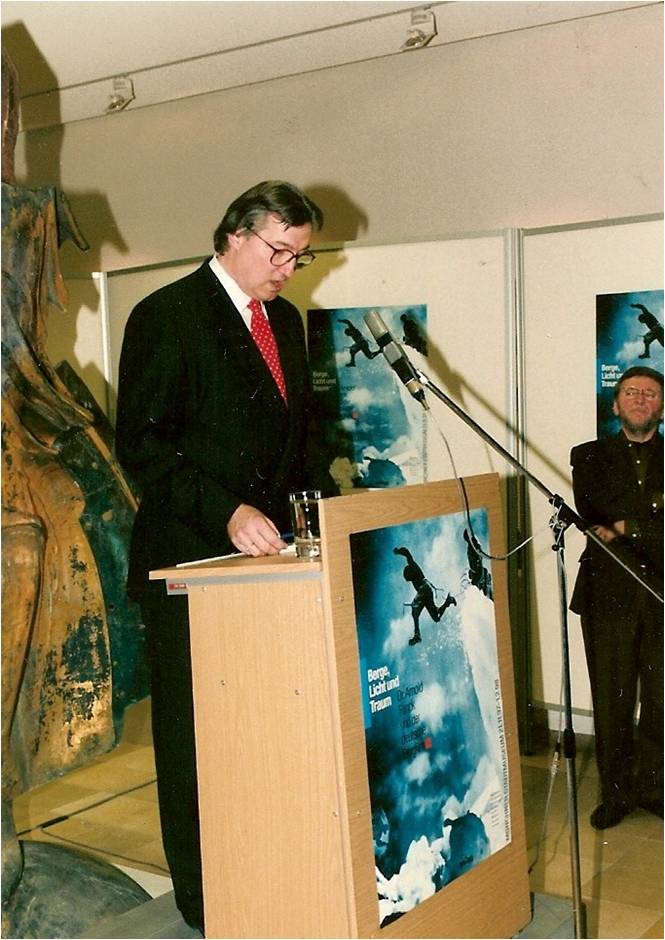
Opening Dr. Arnold Fanck Exhibition, 1997Exhibition catalog
Chris’ work in Munich is also characterized by the fact that he adds new accents beyond the Filmmuseum’s previous focus on the canonized German film classics. A lucky find in a Munich cellar reveals a whole bunch of previously thought „lost“ German film comedies from the early 1930s, which are then preserved, copied, and screened. Another outstanding project from this period is his exhibition on Dr. Arnold Fanck and the mountain film, including the publication, Berge, Licht und Traum. Dr. Arnold Fanck und der deutsche Bergfilm, which lifts this genre out of the trash or cozy corner (depending on the audience’s p.o.v.) of German film history, critically illuminating it.
The return to America occurs as early as 1998, this time to the heart of Hollywood: Chris Horak becomes the founding director of Archives & Collections at Universal Studios. Another transnational project: Universal was famously founded by the German Jew Carl Laemmle but had morphed into a multi-national, multimedia company, which like many others, functioned without a sense of its own history or a „narrative.“ That had to change. In an article, Chris Horak seems to me to be introducing his new job: In conjunction with Helmut Asper he publishes an essay in the journal Film History, „Three Smart Guys. How a few penniless German Émigrés saved Universal Studios.“ It concerns Joe Pasternak, Felix Joachimson aka Felix Jackson und Heinrich Kosterlitz aka Henry Koster who in Berlin und Budapest had successfully tested recipes for film comedies with Dolly Haas und Franziska Gaal, which they recycle with Deanna Durbin and Mickey Rooney after their emigration to Hollywood, earning millions from these films and thereby saving the nearly bankrupt Universal from ruin. Apart from the beautiful arabesque, Horak appends to one of his lifelong themes, namely film emigration from Nazi Germany, the article is interesting because it – in accordance with the „New film history“ – not only raises film aesthetic issues but also because it focuses on the film business, which makes artistic production even possible. What in fact drives film history forward? „It’s the business model – stupid!“
Unfortunately, the irreconcilability of serious academic research into film history and studio politics becomes apparent after a promising beginning, collecting, cataloging, and housing archival materials from Universal‘s various storage facilities. Chris‘ employment at Universal is cut short by the employer from one day to the next without warning, in the American way: „You’re fired!“ A serious blow for a film academic who in an interview in Die Zeit a short time before had declared that he was not planning on ever applying for another job, given his present life’s work, researching the studio’s history since 1912.
Filmmakers and presenters at the UCLA Film & Television Archive’s “L.A. Rebellion: Creating a New Black Cinema” symposium, on November 12, 2011 at the Archive’s Billy Wilder Theater in Westwood Village, CA. Back: Ben Caldwell, Morgan Woolsey, Daniel Widener, Jan-Christopher Horak, David James, Robert Wheaton, Michael T. Martin, Jamaa Fanaka, Larry Clark. Middle: Chuck Kleinhans, Cauleen Smith, Julie Dash, Samantha Sheppard, Alile Sharon Larkin, Zeinabu irene Davis, Monona Wali, Abdosh Abdulhafiz, Charles Burnett. Front: Ed Guerrero, Jacqueline Stewart, Clyde Taylor, Allyson Nadia Field, Gay Abel-Bey. PHOTO CREDIT: Todd Cheney, UCLA Photography.
But life continues: For a few years, Chris breathes new life into the privately-financed Hollywood Entertainment Museum on Hollywood Boulevard, organizes fifty exhibitions, and warms up for his next major assignment: From 2007 to his retirement in 2020 he is the director of UCLA Film & Television Archive, the second largest film archive in the USA. He brings about decisive improvements in the archive’s financial situation and champions the preservation of films by filmmakers of both genders with diverse ethnic backgrounds. He initiate projects, like LA Rebellion: Creating a New Black Cinema (2011), a retrospective of 58 African-American films, accompanied by a symposium, a book publication (2015), a DVD box-set, as well as an international tour of a traveling film program from 2012 to 2015. The program also occasioned the restoration of numerous films, which you can read about in Chris’s blog, as I never tire of pointing out.
With Luciano Castillo at LAX 2016
Another aspect of „Cinematic Migrations“ which long remained hidden was the Latin-American cinema in the USA, produced for Spanish-speaking inhabitants of this multi-ethnic country. Recuerdos de un cine en español: Classic Latin American Cinema in Los Angeles, 1930-1960 opened an extremely comprehensive UCLA Film and Television Archive retrospective. Chris even managed for this program to invite the director of the Cinemateca de Cuba to break the blockade and hand-carry original 35mm film cans of the previously suppressed pre-revolutionary period in Cuba, like Casta de Roble (1954), which was then restored. One result of the retrospective was the publication of Hollywood Goes Latin. Spanish-Language Filmmaking in Los Angeles (2019), edited by Chris Horak und María Elena de las Carreras. During his curatorial administration at UCLA, he also organized the retrospective Through Indian Eyes. Native American Cinema, illuminating another previously unknown or little-known chapter of American film history.
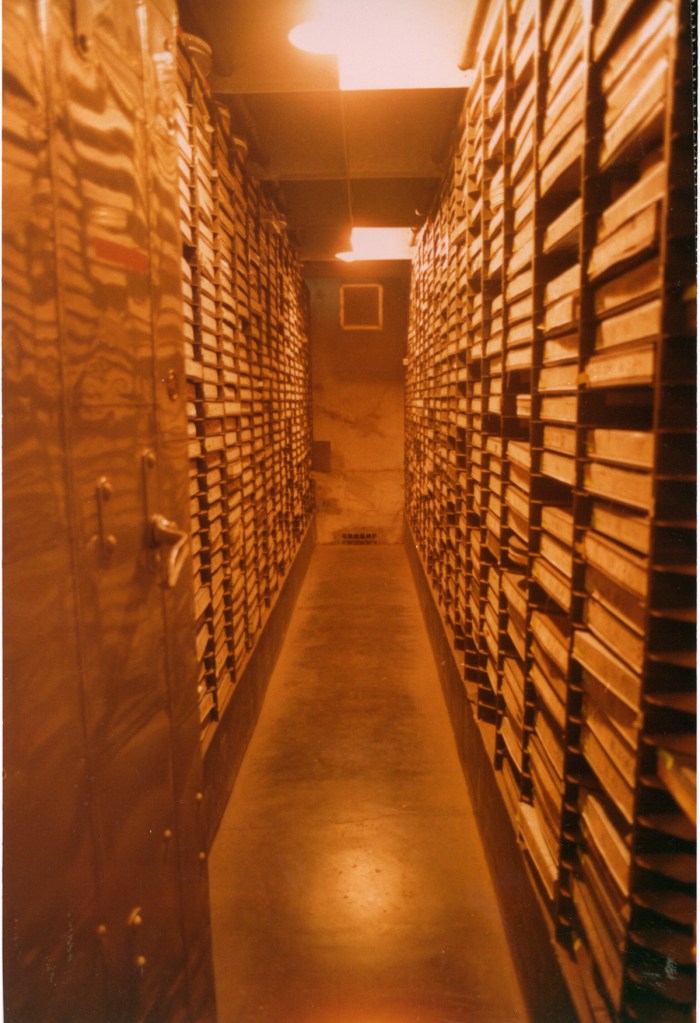
Archival Spaces signature image of old nitrate.
Next to these big achievements, other miniatures document Chris continuing preoccupation with cinematic migrations. Where do we find them? In his Archival Spaces blog, of course! A little study on the film director John H. Auer (from Budapest ) who directed Spanish-language films in America, or the mostly forgotten novelist, Ulrich Alexander Boschwitz, who escaped from the Nazis but then was interned as an enemy alien and deported to Australia. On the return to the U.K. his ship was torpedoed and he drowned; a memorial stone sits in front of his last residence before his emigration in Berlin Schmargendorf (Archival Spaces 272). Time and again, Chris delights the reader with little surprises, one would not have thought about, allowing us to partake in things that are on his mind or which he has noticed in his research. Sharing knowledge – how important that is! BTW that also manifests itself in the fact that Horak continues to teach after his retirement at UCLA, Chapman, and elsewhere.
The list is getting too long. I have to stop, otherwise, there won’t be time for The Killers. Dear Chris Horak, we are so happy that you have accepted the Prize and wish you our hearty congratulations.
Martin Koerber, Berlin, 4 November 2021.
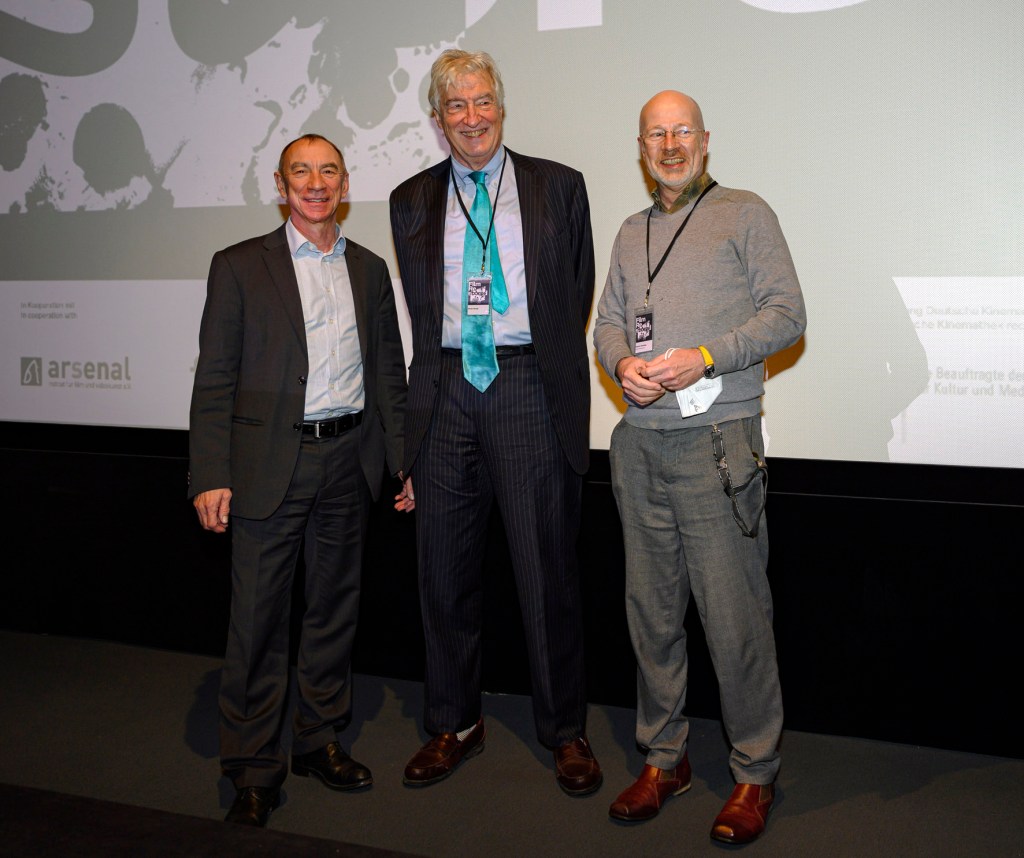
Rainer Rother, J.-C. Horak, Martin Koerber, Berlin, November 2021
In a few days I will leave be leaving for Berlin, where I will be giving a keynote at the German Kinemathek’s “Film Restored” film festival, which as the title says, highlights new film restorations, and also introduce a film with Tango star Carlos Gardel, El dia que me quieras (1935), which was first screened here in a new restoration from the Fundacion Cinemateca Argentina for the Pacific Standard Time film program in Autumn 2017. In preparation, I recently viewed on You-Tube another Gardel film, also directed by Austrian émigré John Reinhardt, and shot at Paramount’s Astoria Studios for Gardel’s own company, Exito Productions: Tango Bar (1935) is Gardel’s only film he never saw before his tragic plane crash and death on 24 June 1935 in Medellin, Colombia. Ironically, despite his incredible popularity in Europe and Latin America, Gardel remained even in his lifetime a virtual unknown in the United States.
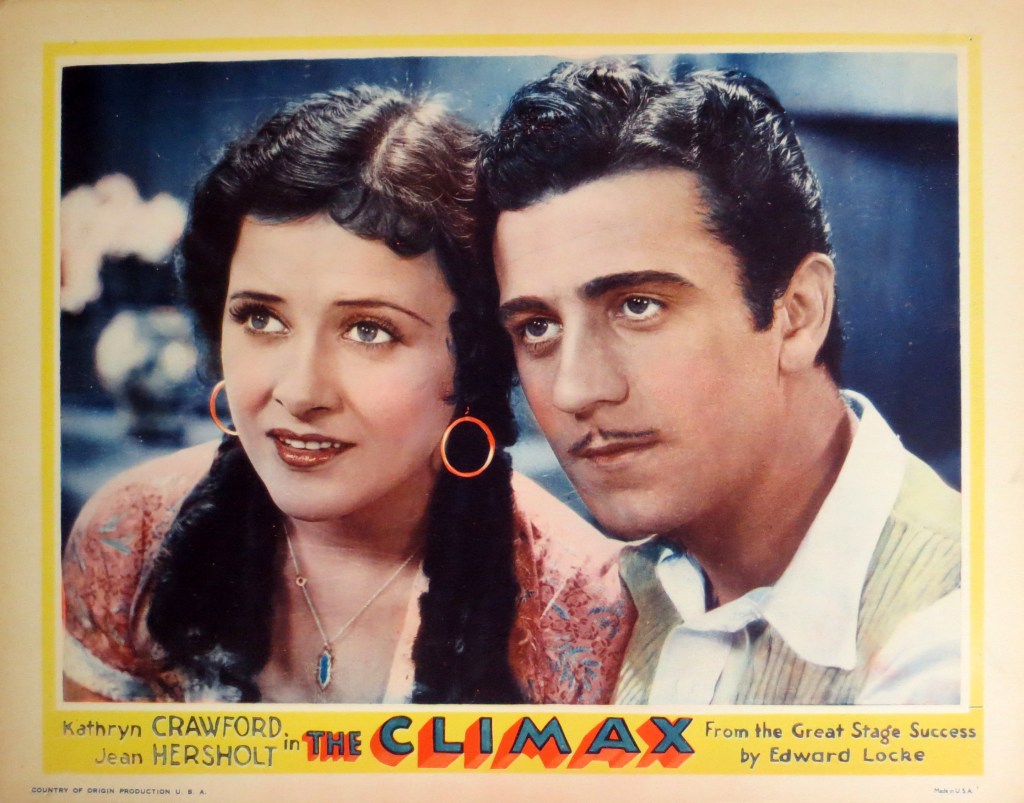
John Reinhardt, Kathryn Crawford in The Climax (1930, Renaud Hoffman)Lena Malena, John Reinhardt in Monsieur Le Fox (1931, WIllard Mack)
Born in Vienna in 1901, Harry John Reinhardt trained as a bank clerk but decided to reinvent himself, emigrating to Los Angeles in May 1922, after crossing the Atlantic on the Saxonia in November 1922. His first screen credit was as a scriptwriter on William K. Howard’s The River Pirate (1928), the same year he became an American citizen. There followed scripts for Prince of Hearts (1929), where he also acted, and Mamba (1930). His most important roles were as Jean Hersholt’s son in Universal’s The Climax (1930), in William Dieterle’s German-language version of Those Who Dance (1930) at Warner Brothers, Der Tanz geht weiter, and as Louis Le Boy in the German version of Men of the North (1930), Monsieur le Fox (1931). With only uncredited acting roles in the next two years, Reinhardt turned to directing, getting the nod from Fox’s Spanish language unit to direct Yo, tu y ella (1933), starring Mexican American star, Gilbert Roland, Mona Maris, and Rosita Moreno.
Carlos Gardel, Rosita Morena in El dia que me quieras (1935)
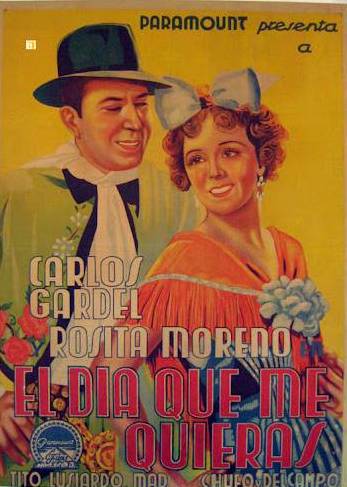
He followed up with three more Spanish language originals for Fox, starring Conchita Montenegro, José Mojica, and Rosita Moreno, respectively, before being hired by Paramount in January 1935 to direct Carlos Gardel’s seventh feature and the 3rd shot in New York’s Astoria Studios for Gardel’s Exito Productions: El dia que me quieras (1935). The film tells the story of a wealthy Buenos Aires businessman’s son, who flees his father’s house to become a tango singer. In the theatre, he meets a dancer (Rosita Moreno) and, despite his father’s opposition, elopes. He steals money from his father when she becomes ill, but she dies soon after, while he flees Argentina and rises to fame as a tango singer, even appearing in Hollywood films (autobiographical elements here). He then returns from exile to help his daughter (Moreno again). Gardel believed it his best film, maybe because he got along well with Reinhardt, unlike his previous experience with Louis Gasnier with whom he had made five films in New York and at Joinville outside Paris. Many critics consider Tango Bar even better, maybe because a decision was made to record Gardel singing live, rather than post-synchronizing the songs, giving them a liveliness not previously visible.
On the set of Tango Bar (1935), Reinhardt seated [center]
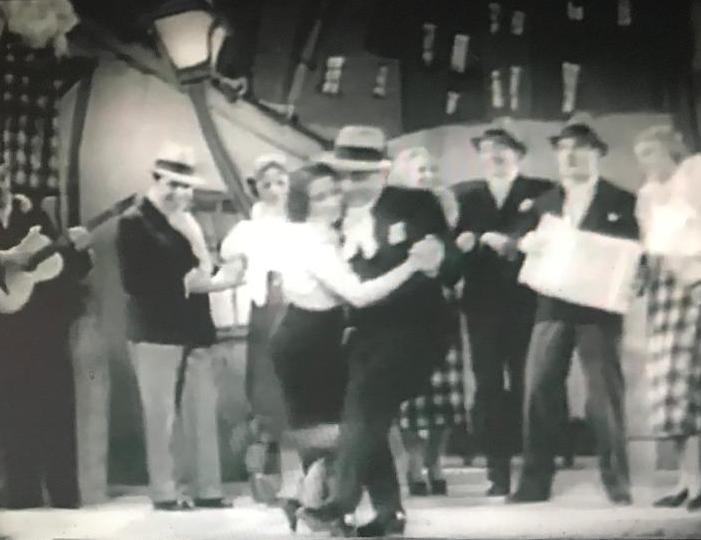
Shot in February 1935, Tango Bar starred Rosita Moreno, Enrique de Rosas, and Tito Lusiardo. The first half of the film takes place on a German ocean liner, where Ricardo meets Laura who is in league with a grifter and thief, the “Comandante.” They steal an expensive necklace from an American woman, and Gardel covers up the crime to protect her. Arriving in Barcelona, Ricardo opens a Tango Bar which features a reforming Laura, but he must purchase the necklace and return it to the American, in order to clear her name and rid himself of the Comandante. In an in-joke, a montage of Barcelona’s nightlife shows Gardel’s previous film, El tango en Broadway (1934) playing a local cinema palace. Interestingly, given Gardel’s origins as a French émigré to Argentina and Reinhardt’s bio, the ship becomes a transnational space, a space of exile as the scenes in steerage make clear, where Ricardo parties with a group of Spaniards returning to their homeland; together they remember their Spanish ancestors and sing “Lejana tierra mía” (My Distant Homeland), a tango written by Gardel and Alfredo de Pera, which has enjoyed countless re-recordings. An ocean liner also appears prominently in the final section of El dia que me quieras and becomes a method of conflating geographic and social mobility, as Rielle Navitski argues (Cinema Journal, 51/1/2011). Another famous tango by the pair, “Por una cabeza” (By a Head), referring to a horse race and Ricardo’s lack of luck at the track, his debts being the initial reason for him to leave Argentina, is sung twice; Gardel’s recording was later heard in Martin Brest’s Scent of a Woman (1992), in Steven Spielberg’s Schindler’s List (`1993), and in James Cameron’s True Lies (1994).
Carlos Garde singing in steerage in Tango Bar
The film premiered in New York City on 5 July 1935, in Mexico City on 18 July, in Buenos Aires at the “Cine-Teatro Suipacha” on 22 August, in Montevideo on 5 September at the “Cine Arie” and “Rex Theater, and in Lima, Peru on 29 October. Possibly because Tango Bar eschewed American stereotypes and was crafted with Latin-American audiences in mind, it became a worldwide hit.
After Gardel’s death, Reinhardt directed three more Spanish-language features for George Hirlman’s independent Metropolitan Studios: De la sartén al fuego (1935) with Moreno and Juan Toreno, El capitán tormenta/Captain Calamity (1936), shot simultaneously in English and Spanish, starring Fortunio Bonanova and Lupita Rovar, and Tengo fe en tí (1940), starring again Rosita Moreno and Frank Puglia. Before America’s entry into the war, Reinhardt directed two films in Argentina, returning to the USA a week after Pearl Harbor, then enlisting in the U.S. Navy in July 1942. Returning to Hollywood after his demobilization in July 1945, Reinhardt was hired by various poverty row studios, directing among others, Open Secret (1948), about anti-Semitism in America, and Sofia (1948), an anti-Communist spy melodrama. His American career concluded with his late masterpiece, Chicago Calling (1951), a film noir starring Dan Duryea as a poor man desperately searching for funds, as his daughter lies in hospital after a car accident. The script for that film was written by German émigré Peter Berneis with whom Reinhardt traveled to Germany to direct two films, the second being Briefträger Müller (1953) with Germany’s favorite comedian, Heinz Rühmann.
Tragically, John Reinhardt died in Berlin at 52 of a heart attack during the production, forcing Rühmann to finish the film. His wife, scriptwriter Elizabeth (Betty) Reinhardt née Neely, who he had met in 1933, while both worked at Fox’s Spanish language unit, died at 44 seven months later.
Tito Lusiardo and uncredited woman in Tango Bar (1935, John Reinhardt)



















 Archival Spaces