Archival Spaces 394
Curating a 1960s Avant-Garde Program
Uploaded 6 March 2026
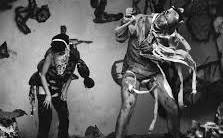
For me, film archival work has always included curatorship through programming, making historical and therefore archival objects visible and accessible. While curator of the film department in what is now called the George Eastman Museum, I introduced this program at a “1960s photography” symposium in Rochester. “Avant-garde film in the 1960s” had its own blind spots. The argument for the program that the available evidence suggested these privileged white males constituted the canon was short-sighted. Today, I know I could have found avant-garde works, produced by people of color, by women, by LGBTQ people, in amateur film collections, in historical societies, archives not yet visible. To my own defense, I did program a Chicago Newsreel, which probably included persons of color among the makers. Below is my introduction, slightly edited, to the film program, the 1990s looking at the 1960s, now read from the 2020s:
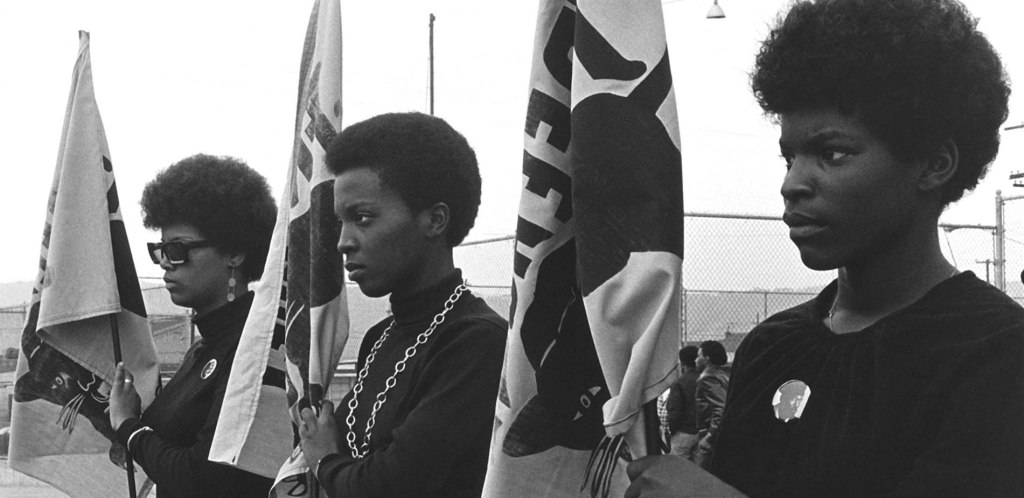
No single film program can do justice to the 1960s, as they played themselves out in the basement haunts of the East Village, in Canyon cinema’s backyards in Berkeley, in the streets of Chicago, in the communes of California, but also in the manifestoes of the New American Cinema, the debates of the Free Speech movement, the reviews of Jonas Mekas in Film Culture, the demonstrations of the Peace movement, the Black Panther Party’s cry for revolution, the drug culture’s psychedelic illusions, the hard-driving rhythms of Rock & Roll and Soul. A myriad of contradictions – social, political, aesthetic, economic – mark the decade: a time of intense changes and strong continuities. So, how does one choose a program that encapsulates the 1960s? The present program privileges those films that seemed to be milestones but were actually enshrined in the official canon written by males, and thereby present merely a facet of the decade. And even in this selection, numerous canonized films are missing: Ron Rice’s homoerotic narratives, the dream films of Stan Brakhage, the semiotic films of Hollis Frampton, the kitsch-fantasies of the Kuchar Brothers, Ken Jacobs’ structuralist work, the films of the Black Panthers, Jonas Mekas’ personal diary films, Paul Sharits’ cinematic poems.
From the vantage point of a post-structuralist, post-modernist, feminist, and progressive consciousness, 1960s avant-garde and independent cinema appeared to be dominated by a few young white guys, middle-class, well-educated, socially aware, but with a lot to learn. With that in mind, I would like to start at the beginning of the decade with Bruce Conner’s Cosmic Ray.
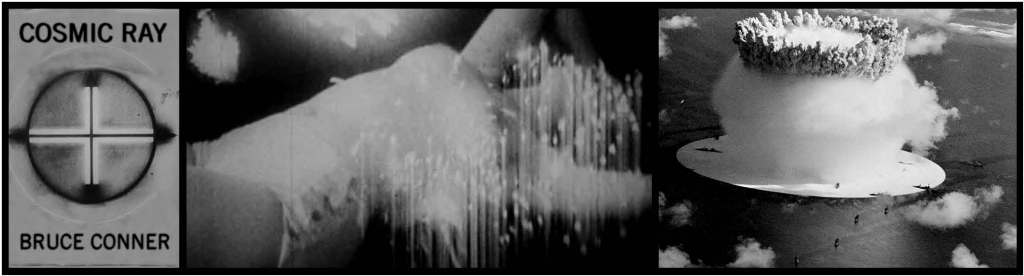
Cosmic Ray (1962) Where would MTV be today without Conner’s experimental, rapid-fire montage, rhythmically edited to the beat of a music track? Like one of those crazy Coke commercials, which features an image every 1/4 second, four images a second, 120 images in a thirty-second spot, Conner’s film causes information overload. Back in 1960, it was something new. Today’s kids are bored if the cutting is any slower. Conner’s film also makes exclusive use of found rather than original footage, decontextualizing the images, creating new meanings through their juxtaposition. In terms of its images, Cosmic Ray features an almost complete catalogue of 1960s iconography: Black music, comics, Native Americans, sex, War, military parades. In its use of the flicker effect and an endless repetition of academy leader, sound bleeps, and other technologically-based film images, Conner’s work is also self-reflexive, a metafilm, articulating a discourse on the possibilities of cinema.
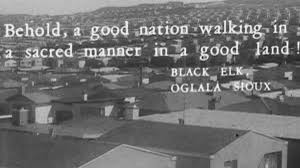
Mass for the Dakota Sioux (1964) by Bruce Baille uses multiple exposures to create a complex, many-layered point of view in the same way that Conner uses montage. Structured as a Catholic mass, complete with Gregorian chants, Baille’s film, indeed all of Baille’s work, is a eulogy for man’s ruptured relationship to nature. The Native Americans of the film’s title never in fact make an appearance in the film, but are present as a structuring absence, as a metaphor for man’s former integration with and place in a natural environment. Baille quotes Black Elk: “Behold a good nation walking in a sacred manner in a good land,” before cutting to endless housing tracks.
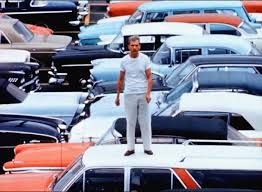
Relativity (1966) Ed Emschwiller once said that he would love to be a camera. Indeed for him the camera is an extension of his body, swooping, swaying, constantly moving, discovering, probing, thrusting, even violating spaces. Made over a three-year period, Relativity takes a cosmic view and a microcosmic view of the universe: from the golf ball to the galaxy in two shots. Given the extreme physicality of Emshwiller’s moving camera, it is not surprising that he seems most interested in experiencing the textures of life, caressing a field of flowers, a pig’s innards, and miles of computer wires with the same fascination. More than other directors, Emshwiller gives his voyeuristic drive completely free rein, unabashedly scopophilic, implicating the viewer in his extreme subjectivity. True to many 1960s filmmakers, though, the medium is the message, the image is the idea.
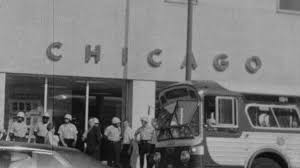
Chicago Convention Challenge (1968) The Newsreel was founded in December 1967 in New York by a group of filmmakers, organizing a collective to record contemporary events in opposition to the ideological thrust of the American mass media. The Newsreel films look like battle footage, extremely grainy, without synchronous sound, almost consciously unprofessional, all overlaid with a first-person narration in manifest opposition to the disingenuous objectivity of the evening news. Chicago Convention Challenge, Newsreel # 17, was in many ways a diary film from the point of view of the grunt in the street, rather than from the podiums of power, covering the “Days of Rage” in those August nights of the 1968 Democratic National Convention. True to leftist politics, the film also contains its own critiques, uncertainties, and mistakes, thereby creating a sense of immediacy, of the process of history unfolding. The whole world was watching.
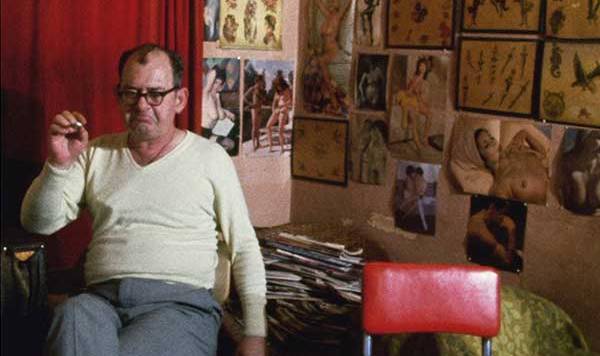
Soc. Sciences 127 (1969) Danny Lyon’s first film begins and ends with its hero, the tattooist/photographer Bill Sanders, lecturing on tattooing in what appears to be a college classroom. This is, in fact, only a ruse, since Lyon subsequently makes clear that Sanders’ knowledge is hardly taught in an institution of higher learning. The latter exists ostensibly to produce knowledge in a “production-profit” system. Sanders, on the other hand, turns his knowledge against the institutional conception of education when he quizzes a female client on the Latin root of “fellatio,” while ornamenting her naked breasts. For Danny Lyon, Sanders is a scientist, a philosopher, a documentarian. His polaroids mimic the scientific method of inquiry, of taxonomy, of classification. Like his near namesake, August Sander, Bill Sanders uses photographic media to capture human bodies. Each image is framed similarly. They are hung with thumb-tacks, side-by-side, row-by-row, for comparison and classification. While the institutions of learning utilize classification as an instrument for social control, Sanders’ photographs are not rarified: They are throw-away objects, as ephemeral as the serendipity at their root. They are indices of a freedom beyond institutional control.
 Archival Spaces