Archival Spaces 388:
Riefenstahl (2024) – The Movie
Uploaded 12 December 2025
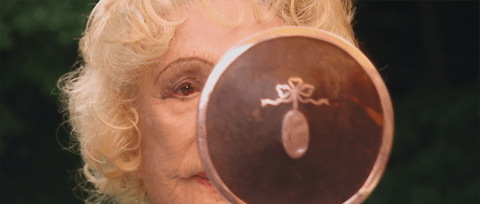
The penultimate scene in Andres Veiel’s new documentary, Riefenstahl (2024), which opened recently in Los Angeles, shows footage that producer Sandra Maischberger possibly shot in ca. 2002, when Leni Riefenstahl was over 100 years old. In close-up, the Nazi diva frets fussily in front of a mirror, complains to the cameraman about the lighting, wearing enough make-up to look like a way-over-the-hill Kurfurstendam whore. The scene is a metaphor for Riefenstahl’s whole life, a life spent polishing her image, brow-beating journalists into submission, denying she was only an artist, not a propagandist, and certainly not complicit in the Holocaust, despite substantial evidence to the contrary. I wrote about my own encounters with la Riefenstahl in Archival Spaces 352 (https://archivalspaces.com/2024/07/26/352-riefenstahl/), so I was anxious to see the new film, as well as meet the filmmakers Andres Veiel and Sandra Maischberger, who answered questions at the Thomas Mann House in Malibu on 12 September, and again after a screening the same evening at the Laemmle Royale.
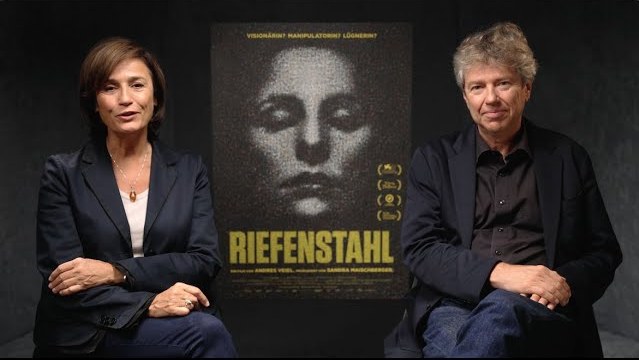
As the pair explained, there have been several documentaries about Riefenstahl, most famously Ray Müller’s The Wonderful, Horrible Life of Leni Riefenstahl (1993), but after the death of Horst Kettner in 2016, the secretary-husband of Leni, the estate papers promised to reveal new information. In fact, there are some surprising new details, although, as both admit, Leni worked very hard “to curate” the papers and surviving film footage, and apparently also spent weeks in late Spring 1945 burning evidence of her Nazi past. From the drafts of her highly sanitized memoirs, we learn that she had been abused by her authoritarian father, who threw her into a lake to let her sink or swim, and was sexually and violently abused by her relatively short-lived husband, Peter Jacob (1944-46). Riefenstahl also claimed that Joseph Goebbels and a 1930s German tennis star attempted to rape her. Unmentioned, but repeatedly stated in her memoirs, is the allegation that Henry Sokal, her Jewish producer, tried for years to get into her pants; passages that reek of anti-Semitism.
That experience of sexual violence in her childhood and adulthood may be the key to her fascination with Hitler, since, like most Nazis, she firmly believed that what doesn’t kill you makes you stronger; she apparently also had an abhorrence of any physical or mental weakness. When her Olympia cameraman, Willy Zielke, had a nervous breakdown in 1937, Riefenstahl supposedly had him committed to a psychiatric clinic where he was forcibly sterilised, in keeping with Nazi euthanasia and sterilisation policies for “all unworthy life.”

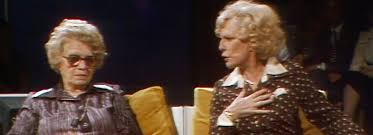
One of the most important aspects of Riefenstahl is that it makes clear that the actor-director never really relinquished her Nazi ideology. Like tens of thousands of ordinary Germans who participated willingly in the Third Reich and its policies of genocide, she just screamed her innocence over and over after the war to anyone who would listen. After one controversial TV appearance in November 1976, which included a woman who had resisted the Nazis, she received hundreds of phone calls and letters from ordinary Germans expressing their support for her, many revealing their own overt racism by attacking the “Jewish” press of Springer et al. She remained friends with Albert Speer and other Nazis to the end. Horst Kettner, who filmed Leni obsessively until literally the moment of her death, shot footage of Riefenstahl “directing “ Nuba children in the 1960s by beating them with sticks, always the Aryan superwoman, the white colonialist, despite her expressed love for black bodies. In that sense, she was a prototypical fascist, not unlike many Germans (and Americans) who today support anti-immigrant ideologies and yearn for dictatorship. Despite her protests to the contrary, she was always close to Hitler and never gave up that love, even after she should have known better. Maischberger theorises that the reason Jody Foster’s Riefenstahl film never came to fruition was that there was no “third act.” Riefenstahl remained the same after 1945, no repentance, no acknowledgement of guilt, no cathartic realisation of her flaws.
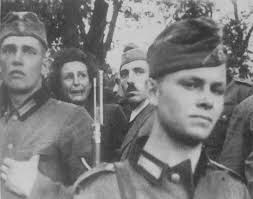
Apart from the hundreds of photographic portraits of Leni, documenting he overt narcissism, and the many interviews where she is constantly denying EVERYTHING, the filmmakers subtly contradict her with images: In one interview, she states that there is absolutely no anti-Semitism expressed in Triumph of the Will, followed by a clip from the film of Julius Streicher claiming the Jewish race must perish. Leni claims she never abused any Jews or Roma/Sinti, then we see photos of her in Konskie, Poland, looking in horror as Jews are gunned down before her eyes, possibly at her unwitting instigation, according to a Wehrmacht officer. She also claimed she met her Roma and Sinti extras from Tiefland after the war, when in fact almost all died in Auschwitz. This is a hard film to watch, but also a necessary film, given the fact that so many Americans are falling prey to anti-democratic sentiments.
 Archival Spaces
Hi Chris,
thanks for this, and pointing out the right thing about this production. Nothing new in it, for those who can see and read, though. I saw the Maischberger Arte program celebrating Leni’s 100th birthday back in the day, and was appalled how uncritical it was. Just a friendly chat with Granny Leni on her sunny terrace. The good news is that Sandra Maischberger somehow redeemed herself by producing this film, and in the preparations for it this also meant give the Kinemathek funding to process and assess the (unfortunately also cleaned-up) film elements, including her home movies.
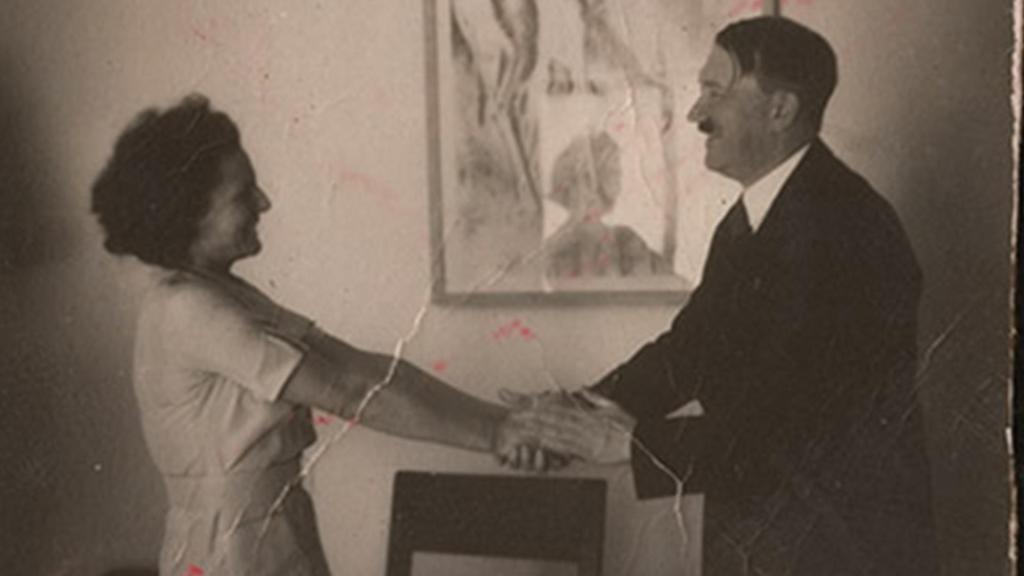
The photo with AH is obviously from the inauguration of her newly built villa https://de.wikipedia.org/wiki/Villa_Riefenstahl in Dahlem. This house has also an „arianization“ background, as you will read in Wikipedia. Ugh.
The villa was bought by the owners of the somewhat famed art(y) magazine 032c https://taz.de/032c-das-angeblich-beste-Magazin-der-Welt/!5181106/. Ugh again. More in the NY TImes Style magazine…. and so the story goes on and on…
Andreas Veil wird mit V geschrieben.
Herzliche Grüße aus Warschau! Die Polen sind jetzt sauer, dass sie zur “Koalition der Willigen“ nicht eingeladen sind, obwohl sie die stärkste Armee in Polen haben. Leider stimmt es aber auch, dass sie beinahe alle Waffen schon der Ukraine abgegeben haben und nun nicht mehr so viel übrig ist, wie „willig“ auch immer sie sein mögen. Die Umfragen hier zeigen, dass der Willen stark nachgelassen hat, selbst hier, wo der Russenhass zur DNA gehört.
Wo sind wir nur hingekommen, das alles in den wenigen Wochen seit Pordenone…
Herzliche Grüße
Martin Koerber Hauptstr. 4K 10317 Berlin
Ul. Dmochowskiego 4/12 00-427 Warszawa
Mobil: +49 179 – 764 63 81 Email: makoerber@web.de
>
LikeLike
Vielen Dank fuer die Korrektur. Du bist wirklich ein treuer Leser.
LikeLike
Such a fascinating film, Chris. I saw it a few months ago when in played in the theaters (for a couple of hours). I think this one did a better job of depicting her odiousness than previous films like “Wonderful, Horrible Life” despite the latter covering more material of her life. Thanks so for your always compelling commentary. – Scott Weiss
LikeLike
Thanks, Scott. All the best.
cHRIS
LikeLike