Archival Spaces 365:
Nicholas Baer: Historical Turns: Weimar Cinema and the Crisis of Historicism (2024)
Uploaded 24 January 2025
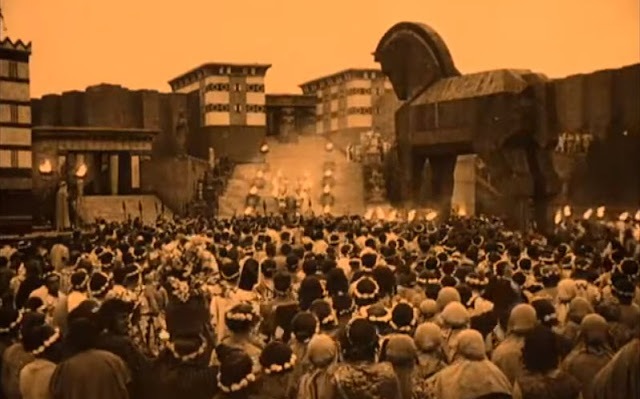
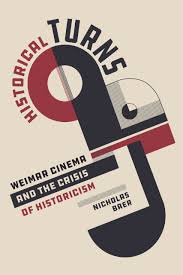
Nicholas Baer’s now-published dissertation, Historical Turns: Weimar Cinema and the Crisis of Historicism (Oakland, CA: University of California Press, 2024), attempts to read five canonical German films from the Weimar Republic in the light of the early 20th-century crisis in historicism, to demonstrate that these films not only reflected that crisis but through formal experimentation embodied it. The guiding light here is Siegfried Kracauer who had since the 1920s contributed to the historicism debate by pointing out the parallelism between the writing of history and photographic media, e.g. in his 1927 essay about photography and in his posthumously published History: The Last Things before the Last (1969). Walter Benjamin also published two essays in exile, which critiqued German historian Leopold von Ranke’s conception of historicism because it created a homogeneous and therefore false image of the past.
Employing hermeneutics, historians had since the middle of the 19th century demanded a new kind of “objective” history, which gathered facts in the context of a precisely defined period and ordered them in a logical and chronological narrative; conclusions were only valid for the defined era. according to Baer, Kracauer and other contemporary philosophers questioned this methodology because they understood that historians could neither free themselves from their own subjectivity nor from influences of the time in which they lived. In the following chapter Baer describes Kracauer’s intellectual and methodological engagement with the cinema, beginning with his early film reviews in the 1920s for the Frankfurter Zeitung, in which he initially praised historical costume pictures, like Danton (1921, Dmitri Buchowetzki), but then found fault with subsequent films, like Peter the Great (1922, Dmitri Buchowetzki), due to their seemingly coherent portrayal of historical events. Baer then traces Kracauer’s development in his Marxist and social-psychologically influenced books from the late Weimar Republic to his exile, From Caligari to Hitler (1947)and Theory of Film (1960). In the last-named work historical costume films are decried as a betrayal of the cinema’s inherent realism.
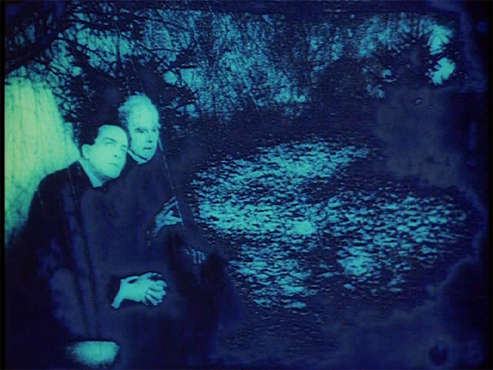

Dedicated to The Cabinet of Dr. Caligari (1920, Robert Wiene), Chapter 3 illustrates the way different figures in the film – the somnambulist Cesare, Dr. Caligari, Francis, Alan – embody completely contradictory narratives of events, i.e. the film rejects realism in favor of a subjective, expressionistically formed relativism. Baer hypothesizes, then, that Caligari inserts itself directly into the debate on historicism: “Wiene’s film perpetually reveals epistemic insufficiency of external signs, featuring figures who deceive sensory perception, assume alternate names or identities, are driven by obsessive ideas, or are even unaware of their own actions.” (p. 81)

Der müde Tod/Destiny (Fritz Lang, 1921) is all about the inevitability of death, however, (hi)story is no longer tied to a specific spatial or historical moment, but evolves in a circular fashion through numerous countries and epochs, thus denying coherence or meaning to history itself, thereby again contradicting the tenants of historicism. About Hans Richter’s abstract animated film, Rhythmus 21 (1925), Baer notes that it is a radical, avant-garde repudiation of the cinema’s narrative function, and therefore of historicism, placing the viewer in the position of the “nonsimultaneousness of simultaneity/Ungleichzeitigkeit des Gleichzeitigen” (p. 107), whereby the present is seen from the perspective of the future.


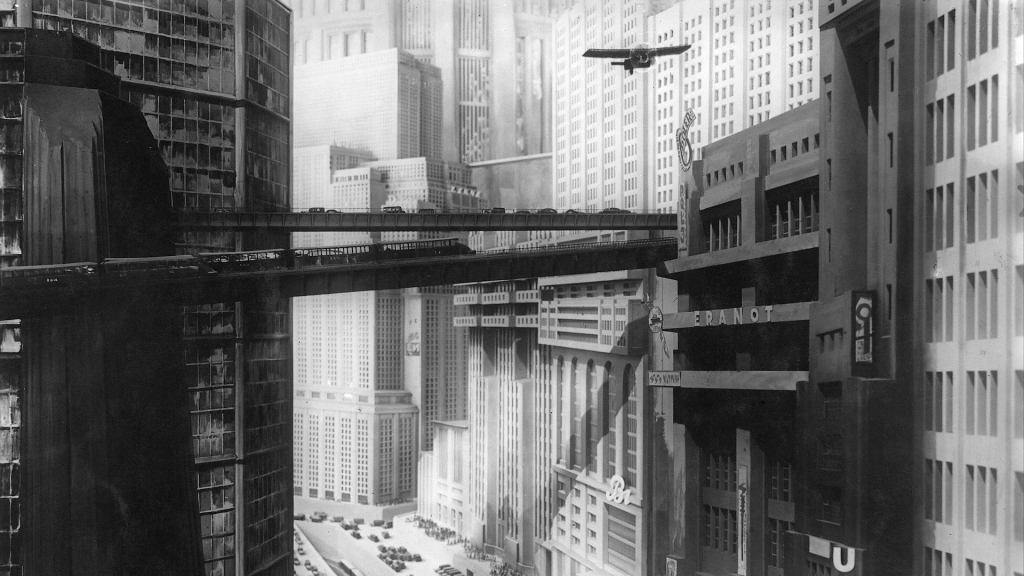
The mountain film, The Holy Mountain (1925, Dr. Arnold Fanck), draws its ambivalent position to historicism dialectically by deriving its concrete and seemingly authentic visualization of nature from an ahistorical myth of the eternally male and female: Paradoxically, “… the film suggests a disharmony with human consciousness and nature, with catastrophe and ruinous fragmentation in the place of classical balance and universal totality.” (S. 141) Baer reads Fritz Lang’s Metropolis (1927) in a final chapter designated as Epilogue as a critique of capitalism, viewing the crisis in historicism in the context of the “disunified incoherence of Weimar culture” (p. 149), but also as a trope for a vertical class structure, which reappears in such modern films as Bong Joon-ho’s Parasite (2019). However, this attempt at topicality seems forced, lacking details to be convincing.

Nicholas Baer’s Historical Turns thus significantly enlarges our understanding of Weimar art cinema through its contextualization of the crisis of historicism, framing the former as a modernist art that privileges fragmentation over unity, disjuncture over narrative coherence. Based on the book’s title, though, one may ask the question, can the discussed art films function pars pro toto as “Weimar Cinema” as a whole, or as German film studies have established over the past twenty years, art cinema is only one of a multitude of genres defining Weimar German cinema in the 1920s.

 Archival Spaces