Archival Spaces 363
Mitchell and Kenyon Discovery in Dispute
Uploaded 27 December 2024

I can’t quite remember when I first saw the Mitchell and Kenyon films but Andrea Leigh tells me it was at the AMIA Conference in 2001 when the British Film Institute first began circulating 35mm prints of their restorations. I was truly astounded by the clarity and detail of these non-fiction actualités, so unlike most of the washed-out and grey Edison and Lumiere films I had seen from the turn of the last century. It was as if you were actually looking through a window onto the world of 1900, the clothing and the faces looking back at you felt tactile, immediate, real. Sagar Mitchell and James Kenyon had operated a local film production company between 1897 and 1913 in Blackburn, England but had previously warranted only a footnote in British film history, the glory going to Brighton filmmakers, like G.A. Smith and James Williamson. Their films of workers leaving factories, local processions, and parades, shot in the small towns of the industrial North of England and Ireland were often produced on spec for fairground operators so that local audiences could see themselves in the movies. As founding editor of The Moving Image, I published a piece in Fall 2003, co-authored by Vanessa Toulmin, which argued that the discovery of the M&K films in June 1994 forever changed our sense of British cinema history.


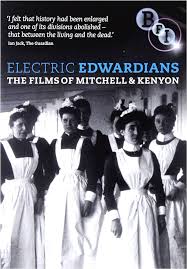
According to Toulmin, workmen demolishing Mercers Toy Shop in Blackburn, an establishment previously owned by Mitchell until 1960, had found three metal drums filled with 826 short camera negatives. Toulmin, now a professor at Sheffield University, and founder of the National Fairgrounds and Circus Archive, as well as the academic most responsible for disseminating the collection in the modern era, goes on to quote Peter Worden, after whom the M&K Collection at the BFI is now named: “All were crammed solid with film, and if I didn’t ‘rate’ them, they were going into the skip.” I contacted the foreman of the work gang and, curbing my excitement, arranged for them to be delivered to me.” (p. 5) In July 2000, the collection was turned over to the BFI for restoration, resulting in a host of book publications and DVDs, including Electric Edwardians. The Films of Mitchell and Kenyon (2005), available in America through Milestone.

So much for the official story. But why had it taken six years before restoration began? Toulmin noted in an email to me (12-16-24) that Worden had spent £ 20,000 trying to restore the films himself, before turning them over to the BFI and that Anne Fleming at BFI and Janet McBain at North West Film Archive had negotiated with Worden for much of that period. But Nigel Garth Gregory, owner of Gregory Audiovisual in Blackburn, tells a different story in an undated blog (maybe 2005) on his website (https://gregoryav.co.uk/the-mitchell-and-kenyon-film-collection/). According to Gregory, the Irish workman who found the churns, first brought them to his video store to see if they were valuable. Not being a film historian, but a video techie, Gregory called Peter Worden, his optometrist who he knew to collect old films. When he heard where the films had been found, he almost immediately identified them as Mitchell and Kenyon films and asked Gregory to negotiate a price of £50 for their purchase. Worden placed the films in a freezer, then registered himself as a finder with his solicitor – a property that is not claimed after six years becomes the legal asset of the finder. Gregory never heard from Worden again and when the films began circulating, it was under the guise of the Peter Worden Collection.
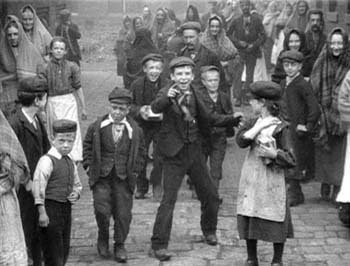
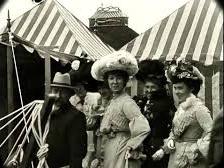
How true is this story? I have no idea. Worden has disputed Gregory’s claim. But the timeline does give one pause, and it’s interesting to note that Worden is no longer identified as the discoverer, e.g. in the Giornate del Cinema Muto program in 2003 when an 80-minute program of Mitchell and Kenyon films screened, the wording is as follows: “They were not rediscovered until the 1990s when Blackburn businessman and local historian Peter Worden retrieved them”
To be clear, Worden never tried to financially profit from the collection, but in my long experience as a film archivist, film collectors are a jealous lot, and many have rightly or wrongly claimed to have discovered lost films or owned the best surviving material. Sometimes did, sometimes they didn’t. Every film collector dreams of finding Lon Chaney’s London After Midnight (1927).

What seems more important is that the impact of that discovery has changed our notion not only of early British film production but also of early film exhibition. Before this discovery, film historians of early cinema tended to follow the American line that vaudeville and music halls were the primary sites of exhibition, followed by Nickelodeons. With the work of Vanessa Toulmin in Britain and Claude Bertemes and Martin Loiperdinger in Germany, we now know that ambulatory tent cinemas at fairgrounds and carnivals were much more important in Europe in disseminating this new medium of the 20th century. It was no accident that so many of the M&K films were produced for fairground operators.

 Archival Spaces