Archival Spaces 358
Robert Rosen (1940-2024)
Uploaded 18 October 2024

Robert Rosen, the former Dean of UCLA’s School of Theatre Film and Television(TFT), and Director of UCLA Film & Television Archive (FTVA), passed away on 2 October in Los Angeles. I owed a huge debt of gratitude to Bob, who hired me as Director of the Archive, against intense resistance from the archive’s staff and the Archive’s major funder, David W. Packard. I first met Rosen at the Brighton FIAF Conference in June 1978, when he was still a newbie to the International Federation of Film Archives and I had started a PhD. in Germany. After I moved to George Eastman Museum in 1984, our paths crossed continually, at FIAF, at the Film Archives Advisory Committee, and at other film archive events. At the 1987 FIAF Congress in Berlin, I strongly supported UCLA’s application for full membership and Rosen’s candidacy for the Executive Committee, which had met with resistance from the Eastern European Archives who supported a candidate from the Soviet block. It was still the Cold War. Bob never forgot that help and remained a loyal colleague. When I was out of a job in 2006, he named me administrator of the fledging Moving Image Archives (MIAS) program at TFT, while I in turn invited him after he had retired to attend the FIAF Beijing Congress in 2012, where he was able to renew contacts with old Chinese friends he had made in the early 1980s.

Rosen’s early life is shrouded a bit in mystery. He was born near Piscataway, N.J. on 29 December 1940 to Nathan and Fay Rosen, a carpenter and housewife. The second of three sons, Bob’s family had moved from New York to what he liked to tell people was the anarchist colony of Francisco Ferrer, where he spent twelve formative years; he often addressed me as Compañero. He received his B.A. in political science from Rutgers University and an M.A. from Stanford University in history. In 1969 he entered the PhD. Program in history at Columbia University, where he also started teaching, then transferred a year later to the University of Pennsylvania, where a colleague eventually asked him to teach a film course. The course drew 500 students, and Bob had found his calling, according to Mary Daily, a journalist at UCLA.


In the Fall quarter of 1974, Rosen moved to UCLA for a one-year appointment at the Department of Film and Television in the School of Fine Arts. Almost a year later in June 1975, Rosen unified the Television Archive, which had been founded in 1965 by the Academy of Television Arts and Sciences, and the Film Department’s nitrate film collections under Howard Suber to become the first director of UCLA Film & Television Archive. Under Bob’s leadership, the Archive soon became the second largest moving image archive in the United States, its phenomenal growth accelerated by its close proximity to Hollywood and an enthusiastic staff of initially amateur preservationists.

Becoming a champion for film preservation, Rosen took a leave of absence in 1985 to become the founding director of the National Center for Film and Video Preservation at the American Film Institute, a short-lived organization that faltered due to funding issues and political resistance from the other major American film archives. Undeterred, Rosen next teamed up with Martin Scorsese in 1990 to found the Film Foundation, chairing its Archivist’s Advisory Council, which has had a lasting effect to this day on film preservation. He also became UCLA’s delegate for the National Film Preservation Board, after Congress appropriated funds for the National Film Registry in 1988. In 2008, Rosen received The Film Foundation’s John Huston Award for his significant contributions and commitment to film preservation and restoration. He was also a mover and shaker in the development of Outfest and the Outfest Collection at UCLA.
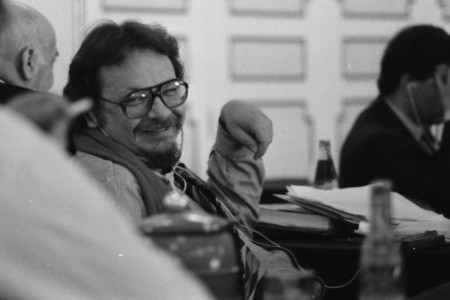
Two characteristics stand out in my mind about Bob. First, he was a tireless advocate for his many students and protégés. Among his flock, Geoffrey Gilmore moved from programmer at UCLA to head Sundance in the 1990s, Greg Lukow became head of the National Film Preservation Center, then to MPBRS at the Library of Congress, Michael Friend also worked at the NFPC, then moved to Sony, Steve Ricci became the first director of the Moving Image Archives Studies program. And it was Bob’s concern for training the next generation of film archivists that led him to support the establishment of MIAS, the first program of its kind, which was so successful that it had a 90% placement rate. Unfortunately, Rosen’s successor as Dean at TFT eliminated the program as part of her effort to erase all traces of Bob’s legacy; one can also argue that her lack of support for Bob’s FTVA eventually led to its restructuring as a mere department within UCLA Library.
Finally, Bob was an excellent negotiator, mediator, and compromiser. It was thanks to Bob that David Packard became a major funder of the Archive, first purchasing the Hearst Metrotone Newsfilm Collection, then eventually funding a film preservation lab. When I took over FTVA, a staff member poisoned the well with Packard, even though we had had a good relationship when I was at Eastman. Six months after starting, Bob traveled with me up to Silicon Valley to visit with David and calm the waters; we returned to L.A. with a major funding grant to cover the significant deficit the Archive had incurred before my arrival. Bob just knew how to get along with anyone, even an eccentric. R.I.P. Bob Rosen.
 Archival Spaces
A lovely tribute, Chris.
Marty Cooper
LikeLike
Chris, thank you for your loyal and truthful tribute to Bob, one of the most exceptional, influential and totally committed moving image archivists of our generation, and mentor to a whole cabal of talented conservationists of your generation. I was privileged to be considered for the role of head of the UCLA FTVA, and fully understood and respected Bob’s reasons for not giving me the job. We remained distant colleagues for more than fifty years, and I shall miss his intelligence, humour and dedication to the important work that we do.
Clyde Jeavons
Thank you for your kind words. I had no idea you had been a candidate and am now doubly honored to have gotten the job. Be well.
LikeLike
Another Bob Rosen achievement- when he served on the Librarian of Congress’s National Preservation Board, helping to choose the 25 film nominated into each year’s National Registry, he was instrumental with Mary Lea Bandy (MOMA) and me, in getting the 8mm documentary of the Japanese American imprisonment by President Franklin Roosevelt admitted as the second home movie into the Registry- (the Zapruder film of JFK’s assassination was the first,.)
Bob was also a major advocate for retaining original nitrate film, even after safety film copies were made.
While his many achievements will live on, as a special person, he will be sorely missed.
Milt Shefter
LikeLike