Archival Spaces 358
Babylon Berlin, Season 4 (2024)
Uploaded 4 October 2024

After Netflix canceled the excellent German TV series Babylon Berlin, at the end of Season 3, I purchased a DVD of Season 4. In the meantime, it has actually become available on MHz Choice, but dubbed into English (as are the previous 3 seasons),
so I’m happy I can watch the DVD because I love hearing the Berlin dialect although Inspector Gereon Rath’s Cologne accent is barely audible, except for a few soft Gs. The series is very loosely based on three best-selling Gereon Rath detective novels by Volker Kutscher, but while the novels are relatively realistic crime dramas, the TV series sensationalizes the novels into an expansive phantasmagoria of Weimer Republic tropes about popular culture and politics.

For example, the central character of Charlotte Ritter, Rath’s love interest, is in the novels first a secretary with the police, then returns to college to study law, while helping Gereon solve cases; in the TV series “Lotte” starts out as a part-time prostitute and It girl, who joins the police force as an assistant, gets kicked off for helping her juvenile delinquent sister to escape custody but is finally asked to return (Ep. 12, S. 4) after almost single-handedly rounding up a criminal conspiracy of vigilantes. Gereon, on the other hand, has in the novels a brother in America and suffers under the shadow of his father who is a police commissioner in Cologne, and his accidental killing of a suspect, but he is neither haunted by his World War I experience and his supposedly dead brother in the trenches who morphs into Dr. Schmidt (or does he?), nor is he a cocaine addict, as in the tv-series. Finally, as a pastiche of popular culture and historical politics, Babylon Berlin freely mixes genres: political thrillers, detective/gangster films, sci-fi, medical films, musicals, and even avant-garde cinema.


Referencing 1920s avant-garde film techniques, the title sequence is itself a post-modern montage of German Expressionism, kaleidoscope images, and flashing views from history, seemingly culled from newsreels, but actually recreating the feel of the late Weimar Republic through digital technology. Each episode begins with an iris, a silent film anachronism that calls attention to its own artifice. With the story of Toni Ritter, Lotte’s sister, the film takes us into the slums of Berlin, recalling late Weimar proletarian films, like Mother Krausens Trip to Heaven (1929). Episode 11 includes a flashback that employs Lotte Reininger’s cut paper silhouette animation in The Adventures of Prince Achmed (1926), a signature film of the Weimar film avant-garde, to reveal the origin of the “Blue Rothschild” diamond. All episodes end with the credits scrolling over a clever computer-generated recreation of Walter Ruttmann’s Opus 1 (1921), the director’s first abstract animation.
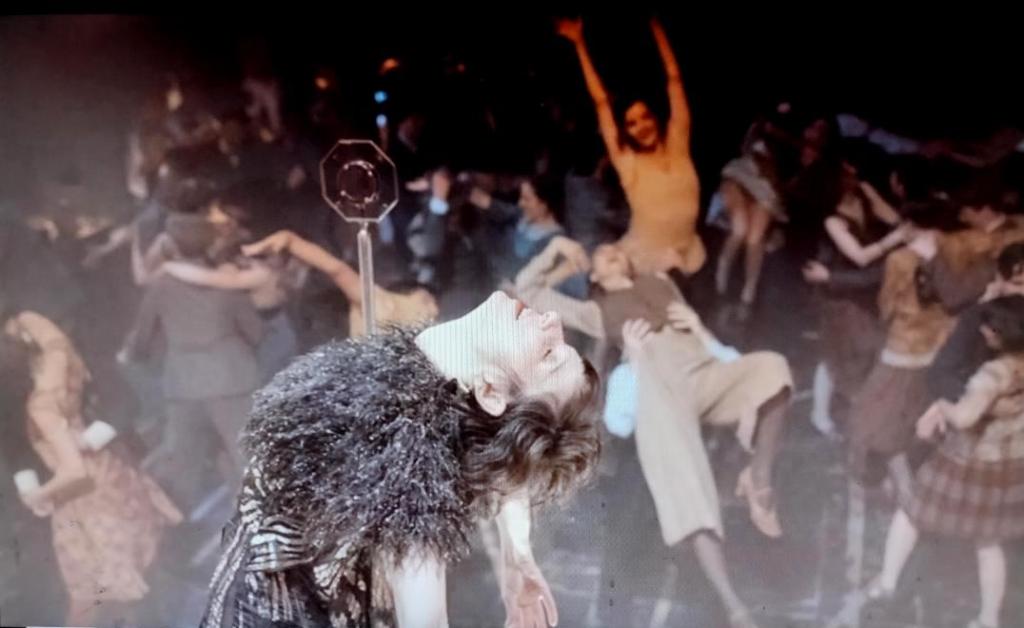
Throughout the series, choreographed musical numbers are interpolated for both spectacle and entertainment; Season 4 begins with a New Year’s Eve Party given by the psychopathic industrialist Nyssen, a reference to steel magnet Fritz Thyssen who was incarcerated in an insane asylum by the Nazis, but was not insane. Two episodes show Charlotte participating in a dance marathon, a phenomenon which was hugely popular in America in the 1930s, but unknown in Weimar; numerous other musical numbers also take place at the “Moka Efti” nightclub, shot in the former Delphi Cinema in Berlin. Later, Esther Korda, a gangster’s wife, auditions at a smaller club, after the Moka Efti is closed, where she served as star attraction and proprietress.


Dr. Schmidt’s numerous experiments, executed on Rath and others, reference Dr. Mabuse and the UFA’s first medical films, as well as Fritz Lang’s sci-fi epics, like Metropolis. In Episode 1, Schmidt immerses Rath in clear fluids, hooking him up to electrodes, like some Dr. Frankenstein monster; later Schmidt has a small weasel attack a wolf four times its size and kills it after it has been shot full of amphetamines. He next tries the same “speed” experiment on the diminutive Rath, who proceeds to beat a much larger man to a pulp, both sequences referencing Mungo, der Schlanentöter/Killing the Killer (1927), in which a mongoose kills a deadly cobra. One of the last images of the Season is of a courtyard full of war veterans who have been transformed into an army of grey-clad automatons, ready to conquer the world, another Metropolis reference.


While Kutscher’s third novel, Goldstein, has a Jewish-American gangster possibly inciting a gang war in Berlin though actually only trying to help his terminally ill uncle, Season 4’s Goldstein is trying to recover the blue diamond stolen from his orthodox grandfather by the Nyssen family. Like classic American gangster films, the series features a St. Valentine’s Day-like massacre with Tommy guns, incited by the rivalry between two gangster bosses who also happen to be amorous rivals for the affection of Esther Korda. Rath is partially responsible for the massacre because he had attempted to negotiate a peace treaty between rival gangs at police headquarters. While crooked cops, standard in any American gangster film, also make an appearance here, they are part of a vigilante conspiracy, while lining their own pockets. Finally, these German crime families, as well as Alfred Nyssen dress like American gangsters. Boxing, a popular sport in Weimar, like indoor bicycle races, is also controlled by gangsters.


While previous seasons had exposed a Reichswehr conspiracy to undermine the Republic through secret rearmament, Weimar is threatened here by a secret vigilante organization, “the White Hand,” made up of reactionary judges, prosecutors, and police. The White Hand is pure fiction in this political thriller but the judiciary in Germany indeed contributed mightily to the end of the Republic by consistently coddling right-wing assassins, including Hitler, while mercilessly hounding perceived leftists. Shockingly, we see Gereon Rath in a Nazi S.A. uniform – the German police was riddled with Nazis, despite legal prohibitions – but learn he is working undercover to ignite a gang war between the rival Stennes and Hellldorf S.A. factions of the Nazi Party. Indeed, a revolt of the Berlin S.A. against Hitler by Walter Stennes had in fact occurred in August 1930 and again in March 1931. Nyssen who supports the Nazis, as did Thyssen, Krupp, and many other German industrialists, is developing an offensive missile as a weapon of mass destruction, something that would not actually occur until the 1940s with the V-2 rockets, although Werner von Braun’s experiments had begun in 1930 when he was a doctoral student.


German producer/director Tom Tykwer has announced a final and fifth season of Babylon Berlin, which should please fans of this engaging potpourri of Weimar history and cinema.

 Archival Spaces